
Every mapped journal needed multiple official sources
No journal in the sample could be resolved from a single official page.
Reproducible findings · version 1.8
Across this purposive sample of 30 journals, every submission job required more than one official source. 27 journals required three distinct surfaces to settle fit, package, review, policy, or editorial decisions.
Headline findings
These are exact descriptions of the maintained corpus. They are not population estimates for all journals.
No journal in the sample could be resolved from a single official page.
The third source often supplied policy, review-model, or editorial context missing from the journal overview.
Some official URLs limit automated access. That is an evidence constraint, not proof that a rule changed or disappeared.
Editorial context can sharpen a decision without being misrepresented as a required submission rule.
Cross-journal analysis
The corpus spans 26 official domains. More pages alone would not solve the author’s problem. A useful map has to say which page controls which decision, and where a second page adds context without becoming a rule.
Each cell records a decision that appears in a maintained journal path. Blank cells remain blank instead of being turned into inferred requirements.
These are the clearest collision points. Two official pages can contribute to the same decision, so role and provenance matter.
Springer Nature is the largest group in the sample. No single publisher system controls the result.
Decision coverage
A blank decision in the dataset means it was outside that journal's mapped path, not that no rule exists.
| Decision area | Journals mapped | Resolving sources |
|---|---|---|
| Package requirements | 29 | 29 |
| Scope & fit | 29 | 29 |
| Disclosure & data | 25 | 25 |
| Article type & genre | 22 | 22 |
| Review model & anonymity | 22 | 23 |
| Contribution framing | 17 | 17 |
Portable benchmarks
These measures describe the maintained sample exactly. Publisher rows retain their sample size, so a one-journal group cannot masquerade as a general publisher result.
average required official surfaces per mapped journal
share of mapped journals requiring three controlling surfaces
separately named publisher or society systems in the sample
Source roles
30 were required for the core submission job. 10 limited automated retrieval during the review.
30 were required for the core submission job. 8 limited automated retrieval during the review.
27 were required for the core submission job. 5 limited automated retrieval during the review.
Open chart reuse
Each SVG is stable for version 1.8, readable without JavaScript, and licensed under CC BY 4.0. The embed code includes the attribution. No tracking pixel and no required followed link.
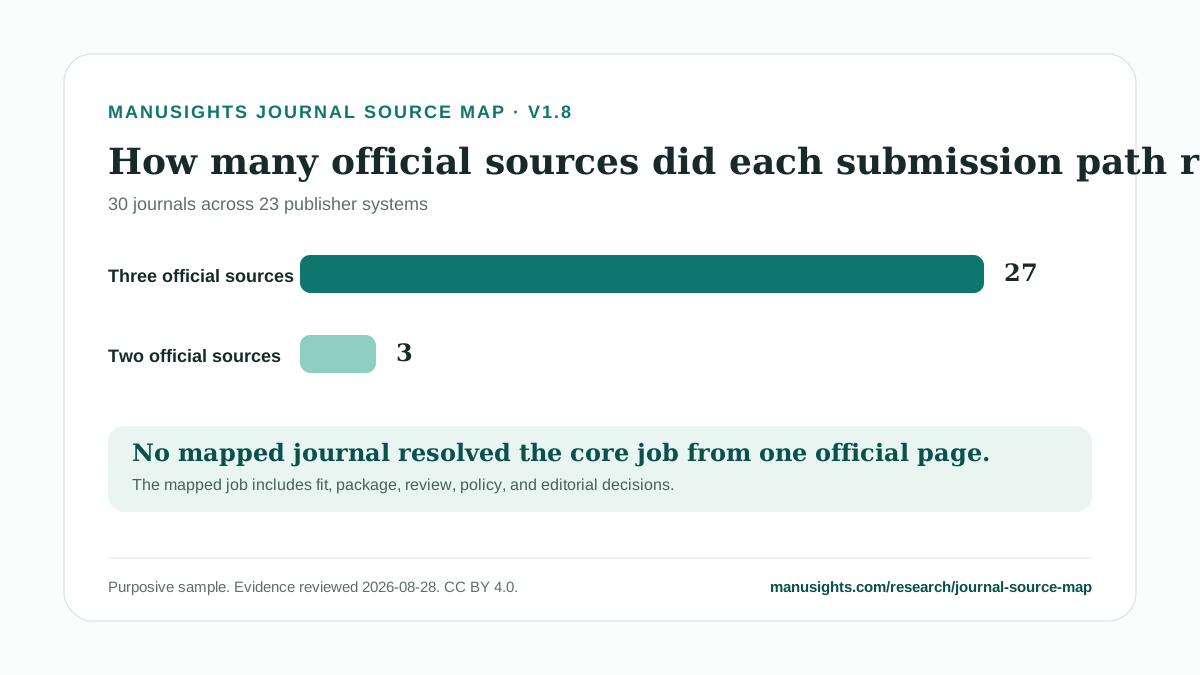
The SVG is fixed to version 1.8. Copy the HTML to reuse it with visible attribution, or download the image directly.
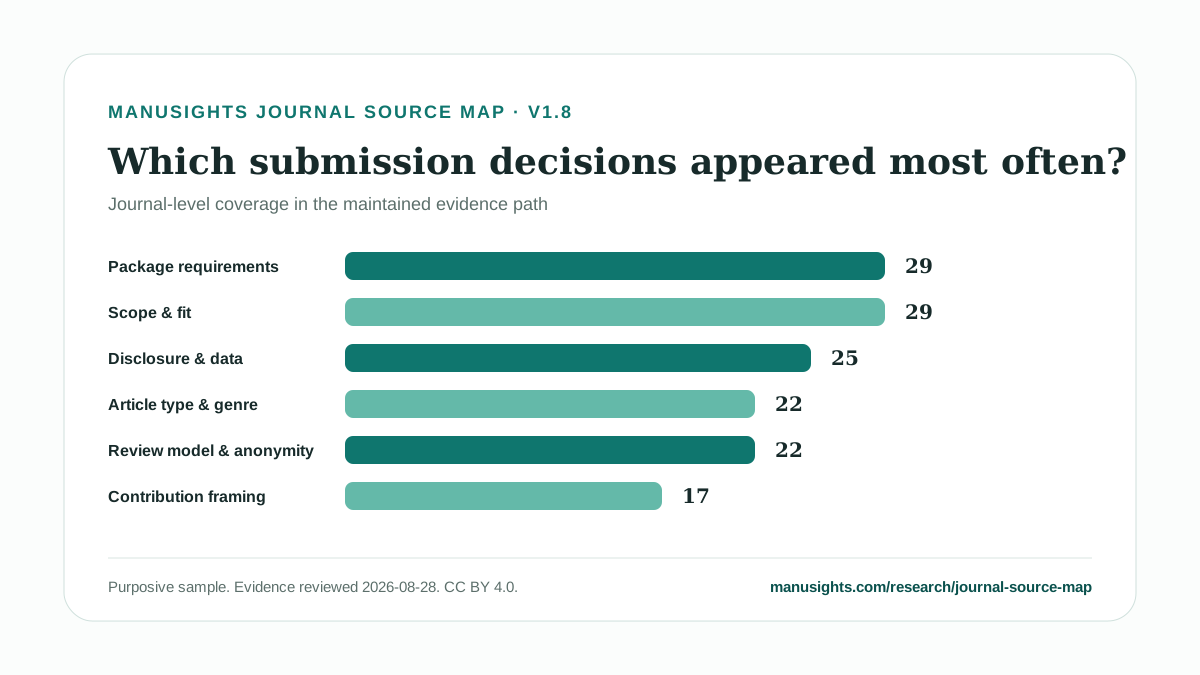
The SVG is fixed to version 1.8. Copy the HTML to reuse it with visible attribution, or download the image directly.
Reproducibility bundle
The codebook names the unit of observation, missing-value rule, and counting formulas. SHA-256 digests cover the complete release payload. This makes an accidental file change visible before anyone reruns the analysis.
Interpretation boundary
Keep going
Find another practical resource or follow a guided publishing path when you want deeper support across the process.