
Journal submission specifications
Check the article type before counting words. Compare publisher rules without turning recommendations or missing information into hard limits.
32 observations · 8 journals · Publisher sources checked 2026-09-11 · Selected reference set
Find the rule for your article
Each row is one observation. Expand its evidence for the source section, counting exclusions and submission stage.
| Journal | Article type | Requirement | Rule strength | Publisher evidence |
|---|---|---|---|---|
| Nature | Article | Main text: About 2,500 words for 6 pages or 4,300 for 8 pages | layout guidance | Nature formatting guide · checked 2026-09-11Definition and limitsArticles; Text. Summary paragraph plus body; final print length is editorially determined. Stage: Publication formatting; initial submission is a separate step. Effective date not established by this observation. |
| Nature | Article | Abstract: Ideally at most 200 words; referenced summary paragraph | recommendation | Nature formatting guide · checked 2026-09-11Definition and limitsArticles. Not a conventional unreferenced abstract. Stage: Publication formatting; initial submission is a separate step. Effective date not established by this observation. |
| Nature | Article | Figures and tables: 4 modest items with 6 pages; 5 or 6 with 8 pages | layout guidance | Nature formatting guide · checked 2026-09-11Definition and limitsArticles; Text. Figure size competes with text space. These are examples, not a universal cap. Stage: Publication formatting; initial submission is a separate step. Effective date not established by this observation. |
| Nature | Article | References: Typically up to 50 main-text references | recommendation | Nature formatting guide · checked 2026-09-11Definition and limitsReferences. Additional Methods and Supplementary Information references excluded. Stage: Publication formatting; initial submission is a separate step. Effective date not established by this observation. |
| Nature Communications | Article | Main text: Ideally at most 5,000 words | recommendation | Nature Communications: Article · checked 2026-09-11Definition and limitsArticle. Excludes abstract, Methods, references and figure legends. Stage: General formatting guidance; flexible initial submission. Effective date not established by this observation. |
| Nature Communications | Article | Abstract: At most 200 words; no references | limit | Nature Communications: Article · checked 2026-09-11Definition and limitsArticle. Applies to Article abstract. Stage: General formatting guidance; flexible initial submission. Effective date not established by this observation. |
| Nature Communications | Article | Figures and tables: Up to 10 figures and tables combined | conditional limit | Nature Communications: Article · checked 2026-09-11Definition and limitsArticle. For text under 2,000 words: no more than 4. Match display count to length. Stage: General formatting guidance; flexible initial submission. Effective date not established by this observation. |
| Nature Communications | Article | References: No more than 70 as a guide | recommendation | Nature Communications: Article · checked 2026-09-11Definition and limitsArticle. Not labeled an absolute limit. Stage: General formatting guidance; flexible initial submission. Effective date not established by this observation. |
| Scientific Reports | Article | Main text: 4,500 words recommended | recommendation | Scientific Reports submission guidelines · checked 2026-09-11Definition and limitsFormat of articles. Excludes abstract, Methods, references and legends; guide says most word/page limits are not strict. Stage: Article preparation; checklist distinguishes mandatory limits. Effective date not established by this observation. |
| Scientific Reports | Article | Abstract: At most 200 words; unstructured | limit | Scientific Reports submission guidelines · checked 2026-09-11Definition and limitsFormat of articles; Abstract. No references or figures. Stage: Article preparation; checklist distinguishes mandatory limits. Effective date not established by this observation. |
| Scientific Reports | Article | Figures and tables: At most 8 figures and tables combined | limit | Scientific Reports submission guidelines · checked 2026-09-11Definition and limitsManuscript. For text of 2,000 words or less, 4 or fewer is suggested. Stage: Article preparation; checklist distinguishes mandatory limits. Effective date not established by this observation. |
| Scientific Reports | Article | References: 60 references; not strictly enforced | recommendation | Scientific Reports submission guidelines · checked 2026-09-11Definition and limitsManuscript. Do not recast as an absolute cap. Stage: Article preparation; checklist distinguishes mandatory limits. Effective date not established by this observation. |
| Scientific Reports | Article | Supporting material: Submit alongside manuscript; separate files | procedure | Scientific Reports submission guidelines · checked 2026-09-11Definition and limitsSupplementary Information. Reviewed with the paper; not edited, typeset or proofed by the journal. Stage: Article preparation; checklist distinguishes mandatory limits. Effective date not established by this observation. |
| PLOS ONE | Research Article | Main text: No word-count restriction | explicitly unrestricted | PLOS ONE submission guidelines · checked 2026-09-11Definition and limitsStyle and Format: Length. Concise presentation is encouraged; abstract has a separate limit. Stage: Manuscript submission. Effective date not established by this observation. |
| PLOS ONE | Research Article | Abstract: At most 300 words | limit | PLOS ONE submission guidelines · checked 2026-09-11Definition and limitsAbstract. No citations; follow any study-specific requirements. Stage: Manuscript submission. Effective date not established by this observation. |
| PLOS ONE | Research Article | Figures and tables: No restriction on number of figures | explicitly unrestricted | PLOS ONE submission guidelines · checked 2026-09-11Definition and limitsStyle and Format: Length. The cited statement names figures, not an independent table allowance. Stage: Manuscript submission. Effective date not established by this observation. |
| PLOS ONE | Research Article | Supporting material: No restriction on amount of supporting information | explicitly unrestricted | PLOS ONE submission guidelines · checked 2026-09-11Definition and limitsStyle and Format: Length. File preparation instructions still apply. Stage: Manuscript submission. Effective date not established by this observation. |
| PLOS Medicine | Research Article | Main text: No word-count restriction | explicitly unrestricted | PLOS Medicine submission guidelines · checked 2026-09-11Definition and limitsStyle and Format: Length. The journal encourages concise reporting. Stage: Manuscript preparation; format-free initial submission available. Effective date not established by this observation. |
| PLOS Medicine | Research Article | Abstract: 300 words preferred; maximum 500 | conditional limit | PLOS Medicine submission guidelines · checked 2026-09-11Definition and limitsAbstract. Structured: Background; Methods and Findings; Conclusions. Stage: Manuscript preparation; format-free initial submission available. Effective date not established by this observation. |
| PLOS Medicine | Research Article | Figures and tables: No restriction on number of figures | explicitly unrestricted | PLOS Medicine submission guidelines · checked 2026-09-11Definition and limitsStyle and Format: Length. The source does not separately state a table cap here. Stage: Manuscript preparation; format-free initial submission available. Effective date not established by this observation. |
| PLOS Medicine | Research Article | Supporting material: No restriction on amount of supporting information | explicitly unrestricted | PLOS Medicine submission guidelines · checked 2026-09-11Definition and limitsStyle and Format: Length. Other submission and file requirements still apply. Stage: Manuscript preparation; format-free initial submission available. Effective date not established by this observation. |
| The BMJ | Research | Main text: No fixed word-count limit | explicitly unrestricted | The BMJ: Article types and preparation · checked 2026-09-11Definition and limitsResearch: Word count and style. Reported main-text count excludes abstract, references, tables, boxes and figures. Methods are not excluded by this definition. Stage: Research article preparation. Effective date not established by this observation. |
| The BMJ | Research | Abstract: 250 to 300 words; up to 400 for CONSORT or PRISMA abstracts | conditional guidance | The BMJ: Article types and preparation · checked 2026-09-11Definition and limitsResearch: Structured abstract. Structured; use the study-appropriate headings. Stage: Research article preparation. Effective date not established by this observation. |
| JAMA | Original Investigation: cohort study | Main text: At most 3,000 words | limit | JAMA Instructions for Authors · checked 2026-09-11Definition and limitsOriginal Investigation; Cohort Study. Excludes abstract, tables, figures, acknowledgments, references and online-only material, not Methods. Stage: Manuscript preparation. Effective date not established by this observation. |
| JAMA | Original Investigation: cohort study | Abstract: At most 350 words; structured | limit | JAMA Instructions for Authors · checked 2026-09-11Definition and limitsAbstracts for Reports of Original Data. Use headings for reports of original data. Stage: Manuscript preparation. Effective date not established by this observation. |
| JAMA | Original Investigation: cohort study | Figures and tables: At most 5 tables and figures combined | limit | JAMA Instructions for Authors · checked 2026-09-11Definition and limitsCohort Study. Article-type requirement. Stage: Manuscript preparation. Effective date not established by this observation. |
| JAMA | Original Investigation: cohort study | References: 50 to 75 references | published range | JAMA Instructions for Authors · checked 2026-09-11Definition and limitsCohort Study. Preserve the publisher's range; do not invent a 35-reference cap. Stage: Manuscript preparation. Effective date not established by this observation. |
| Nature Genetics | Article | Main text: At most 4,000 words | limit | Nature Genetics Content Types · checked 2026-09-11Definition and limitsArticle: Format. Excludes abstract, Methods, references and figure legends. Stage: Article preparation. Effective date not established by this observation. |
| Nature Genetics | Article | Abstract: At most 150 words; unreferenced | limit | Nature Genetics Content Types · checked 2026-09-11Definition and limitsArticle: Format. For Article, not Letter or Brief Communication. Stage: Article preparation. Effective date not established by this observation. |
| Nature Genetics | Article | Figures and tables: At most 8 figures and tables combined | limit | Nature Genetics Content Types · checked 2026-09-11Definition and limitsArticle: Format. Article-specific allowance. Stage: Article preparation. Effective date not established by this observation. |
| Nature Genetics | Article | References: Typically up to 50 | recommendation | Nature Genetics Content Types · checked 2026-09-11Definition and limitsArticle: Format. Publisher describes this as a guideline. Stage: Article preparation. Effective date not established by this observation. |
| Nature Genetics | Article | Supporting material: May accompany the article | procedure | Nature Genetics Content Types · checked 2026-09-11Definition and limitsArticle: Format. Check separate preparation instructions. Stage: Article preparation. Effective date not established by this observation. |
The same manuscript needs different counts
Fictional case: a paper has 3,900 words including 800 words of Methods, plus an abstract, references and six main display items. This is a counting exercise, not a judgment of journal fit.
JAMA: cohort study
The 3,000-word allowance does not exclude Methods. The counted text is 3,900, not 3,100. Six displays also exceed the five-item allowance. Revise the package or clarify an exception before treating these checks as resolved.
JAMA article-type instructionsNature Communications: Article
Its recommended main-text count excludes Methods, leaving 3,100 words. Six displays are within the stated allowance at that length. That does not establish scope fit, evidence quality or submission readiness.
Nature Communications Article guidanceCarry a decision record into submission
- Name the journal, article type, and initial or revised submission stage.
- Record what counts toward each limit, then calculate the matching manuscript count.
- Separate required changes, recommendations and unresolved questions. A missing cap is not unlimited.
- Check the complete instructions for reporting checklists, declarations, data and files. Save the source and check date with your submission checklist.
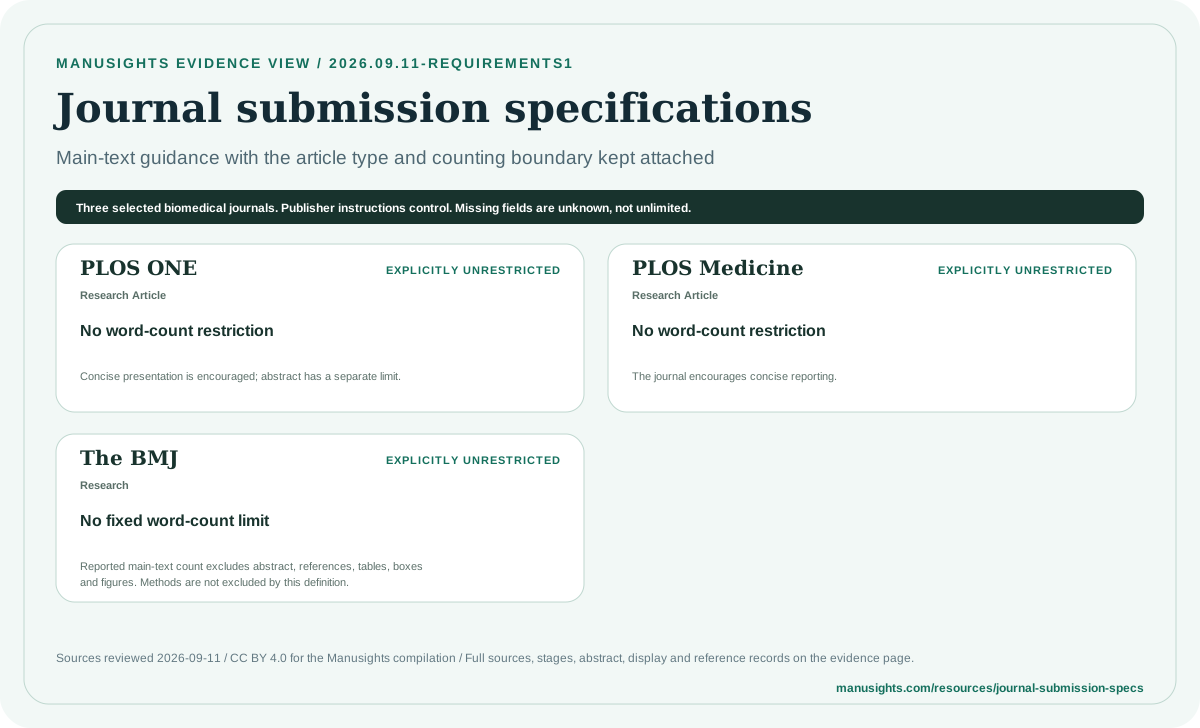
Portable evidence view
Reuse the visual with its source boundary
This portable view keeps the journal, exact article type, rule strength and counting boundary attached to every main-text value. Reuse it in a guide, course or author-support page without flattening recommendations into limits.
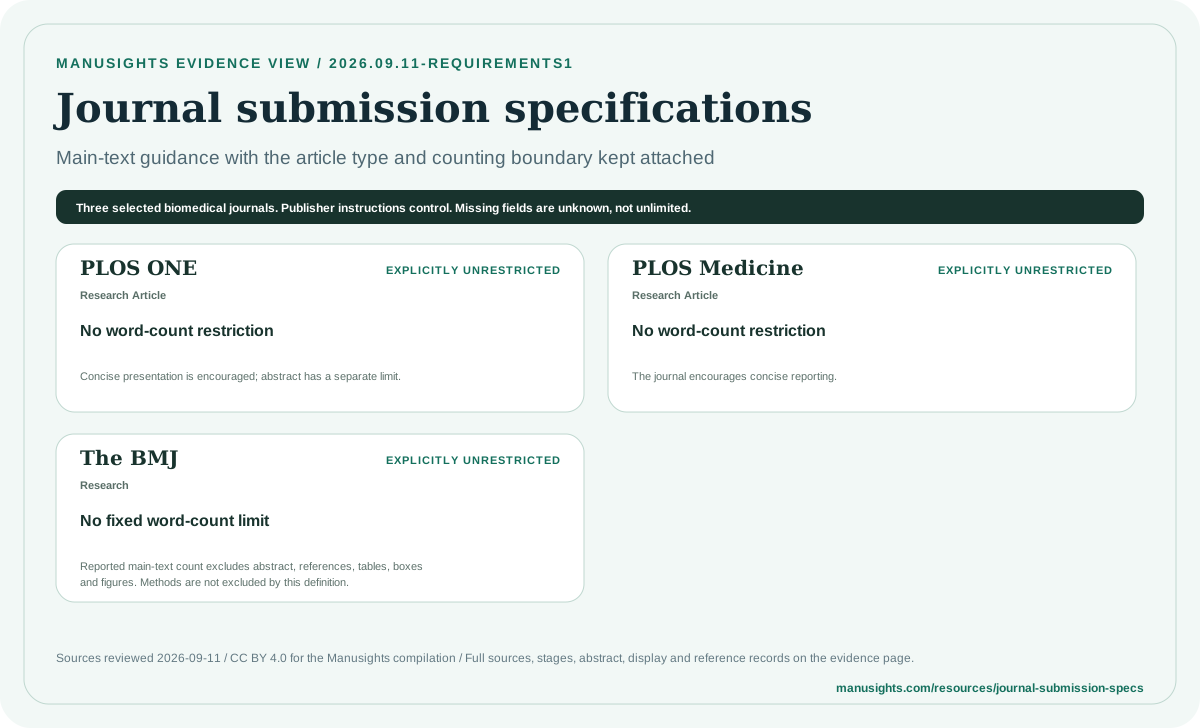
View the HTML embed code
<figure><a href="https://manusights.com/resources/journal-submission-specs"><img src="https://manusights.com/resources/journal-submission-specs/view.svg" alt="Three selected journal submission specifications with article type, rule strength and counting boundary"></a><figcaption>Source: <a href="https://manusights.com/resources/journal-submission-specs">Journal submission specifications, Manusights version 2026.09.11-requirements1. Sources reviewed 2026-09-11. CC BY 4.0.</a></figcaption></figure>Tracking-free SVG. The copied caption includes the edition, review date, license and canonical evidence page. Publisher source material retains its own rights.
Take the evidence into your workflow
Use the designed PDF for teaching or source review, CSV for analysis, and JSON for structured reuse. Table exports contain your filtered subset. Every format keeps the edition and evidence boundary visible; unknown effective dates stay unknown.
For a printable source-tracing exercise, use the Source Map teaching kit and its PDF worksheet.
Methodology, sources and coverage
A purposive reference set of eight journals, not a representative sample or a complete submission checklist. Each observation is paraphrased from the named official source section for one article type. Limits, recommendations, layout examples and explicit absence of a restriction remain distinct. Missing fields mean not verified in this edition, not unlimited. Observation dates do not establish when a policy took effect.
Publisher instructions control. Recheck the exact article type, submission stage and any editor-specific instructions before submitting. Historical March 2026 unsourced cells are withheld from current tables and exports; they are not retroactively verified.
This edition has passed Manusights internal publication review only; it has not been independently or peer reviewed.
- Nature formatting guide
Article. Checked 2026-09-11. Row details identify the source section.
- Nature Communications: Article
Article. Checked 2026-09-11. Row details identify the source section.
- Scientific Reports submission guidelines
Article. Checked 2026-09-11. Row details identify the source section.
- PLOS ONE submission guidelines
Research Article. Checked 2026-09-11. Row details identify the source section.
- PLOS Medicine submission guidelines
Research Article. Checked 2026-09-11. Row details identify the source section.
- The BMJ: Article types and preparation
Research. Checked 2026-09-11. Row details identify the source section.
- JAMA Instructions for Authors
Original Investigation: cohort study. Checked 2026-09-11. Row details identify the source section.
- Nature Genetics Content Types
Article. Checked 2026-09-11. Row details identify the source section.
49 directory journals without a verified requirements record
Science; Cell; New England Journal of Medicine; The Lancet; Nature Medicine; Cancer Cell; Journal of Clinical Oncology; Circulation; European Heart Journal; JACC; Blood; Journal of Clinical Investigation; JAMA Oncology; The Lancet Oncology; Nature Biotechnology; Nature Methods; Nature Immunology; Cell Metabolism; Cell Reports; Molecular Cell; Neuron; Nucleic Acids Research; BMJ Open; BMC Medicine; Gastroenterology; GUT; Hepatology; Immunity; Genome Biology; PNAS; Science Advances; Brain; Cell Host & Microbe; Cell Stem Cell; Circulation Research; Current Biology; Developmental Cell; eLife; The EMBO Journal; JAMA Cardiology; Journal of Neuroscience; Lancet Infectious Diseases; Lancet Neurology; Molecular Psychiatry; Nature Chemical Biology; Nature Neuroscience; Nature Structural & Molecular Biology; Science Translational Medicine; Frontiers in Immunology.
Absence here is a coverage gap, not evidence of absent requirements. Included journals also have unverified fields and unlisted article types.
Correction history
September 11, 2026: replaced 33 historical specification rows that lacked cell-level sources. Removed contradictory FAQ values and unsupported generalizations. Current exports use a new observation schema. Earlier downloads are not current. The original snapshot remains in repository history.
September 25, 2026: requirements sourced from Nature Portfolio and JAMA Network pages (22 observations) stay in the table above as linked citations but are no longer in the CSV, JSON, table exports, evidence brief or embeddable view, because those sites' terms restrict compiling their content into a database or could not be read.
Original Manusights text and compilation: CC BY 4.0. Publisher material retains its own rights. Report a correction. No publisher endorsement is implied.
Cite this resource
Citation formats
Free to use and cite, with attribution. See the reuse policy for what you may republish.
- APA
- Manusights. (2026). Journal submission specifications (Version 2026.09.11-requirements1; observed 2026-09-11). https://manusights.com/resources/journal-submission-specs
- MLA
- Manusights. "Journal Submission Specifications." Research Library, version 2026.09.11-requirements1, 11 Sept. 2026, https://manusights.com/resources/journal-submission-specs.
- Vancouver
- Manusights. Journal submission specifications [Internet]. Version 2026.09.11-requirements1. 2026 Sep 11. Available from: https://manusights.com/resources/journal-submission-specs