OpenAI posted 722 maths papers. Three lasted a day.
Get Manusights Weekly free, every Monday

OpenAI posted 722 AI-written maths preprints in one go and withdrew three of them within a day. Also this week: nearly 100 retractions over phrases like "savvy lattices", and a journal that keeps correcting published papers because the ethics statement was missing.
 | Erik Founder, Manusights |
Forward this to the colleague who keeps saying a model could write their next paper. Send it to a colleague
Whenever it is useful: if you have a draft going, run it through the free check and see what an editor would screen for. If you are earlier than that, the Academy works the same method on whatever you have so far.
OpenAI posted 722 maths preprints at once. Three were withdrawn within a day.
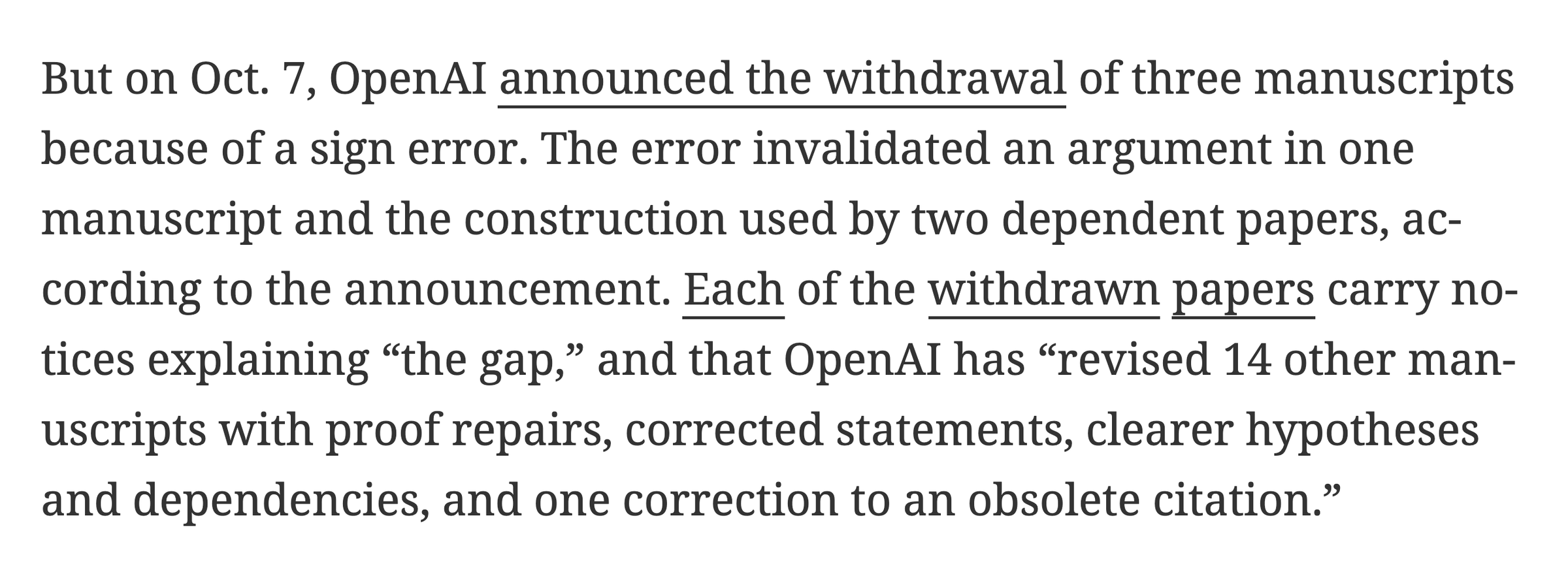
On October 6, OpenAI published 722 preprints in a GitHub repository, on purported progress by an internal AI model in solving 372 maths problems. Nature describes the preprints as entirely generated by artificial intelligence.
Less than 24 hours later, it withdrew three of them because of a sign error. An OpenAI spokesperson told Retraction Watch that the company found the errors during an audit, and that roughly 50% of the results were released unconfirmed. The spokesperson said the company's collaborators at the Advisory Group on Mathematics and Artificial Intelligence recommended releasing the results without waiting for "full formalization".
What mathematicians said:
- Ursula Martin, of the University of Oxford, says in Nature that the release is "tossing the community a messy first draft and expecting us to clean it up for them".
- Michael Harris, a number theorist at Columbia University, says in Nature that he will not be reading the papers.
- Levent Alpöge, a mathematician at rival company Anthropic, wrote on X: "It's obviously the most significant moment in mathematical history".
- Andrew Sutherland, of the Massachusetts Institute of Technology, told Retraction Watch he thinks the withdrawals and corrections will be viewed positively, "but it will take a lot more than that to earn back the trust they have lost".
My read: the argument about who should check these papers will run for months. The part you can use today is how the error spread. It invalidated an argument in one manuscript and a construction that two dependent papers used, so one mistake cost all of them.
One question: would you referee a paper written entirely by a model? Reply yes or no. I will share the results next week.
Do this today: If a model drafted any step of your argument, check that step by hand before you build the next section on it. If two of your papers share a derivation, an error in it is an error in both.
Reference: Retraction Watch, 8 Oct 2026
Coverage: Nature, 7 Oct 2026
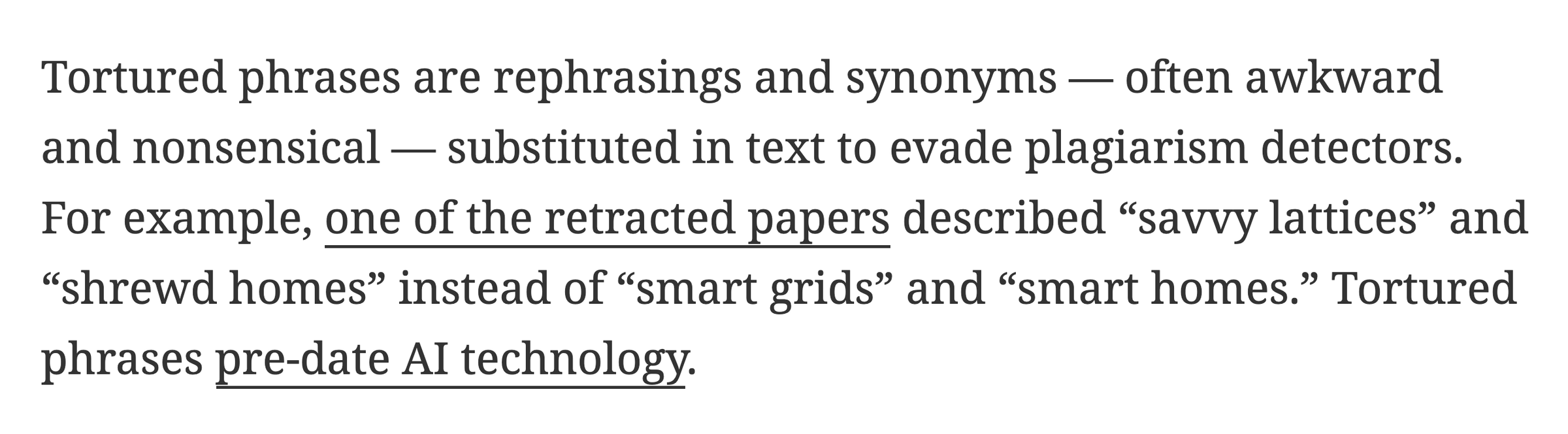
🌀 IOP Publishing retracted nearly 100 conference papers over "tortured phrases". IOP Publishing has retracted nearly 100 papers from three of its conference proceedings. The notices, dated August 27, say the articles contain nonsensical phrases to the extent that they make very little sense. A 2021 paper on detecting brain tumours used "cerebral torment" in place of headache.
Why it matters: The publisher's investigation followed flags from the Problematic Paper Screener, a tool that looks for these phrases. One of its creators says IOP Publishing has now retracted upward of 1,000 papers for them.
What I would do: Read your draft aloud once before you submit. An odd synonym is easy to hear, and easier to fix now than after a screener finds it.
Reference: Retraction Watch, 9 Oct 2026
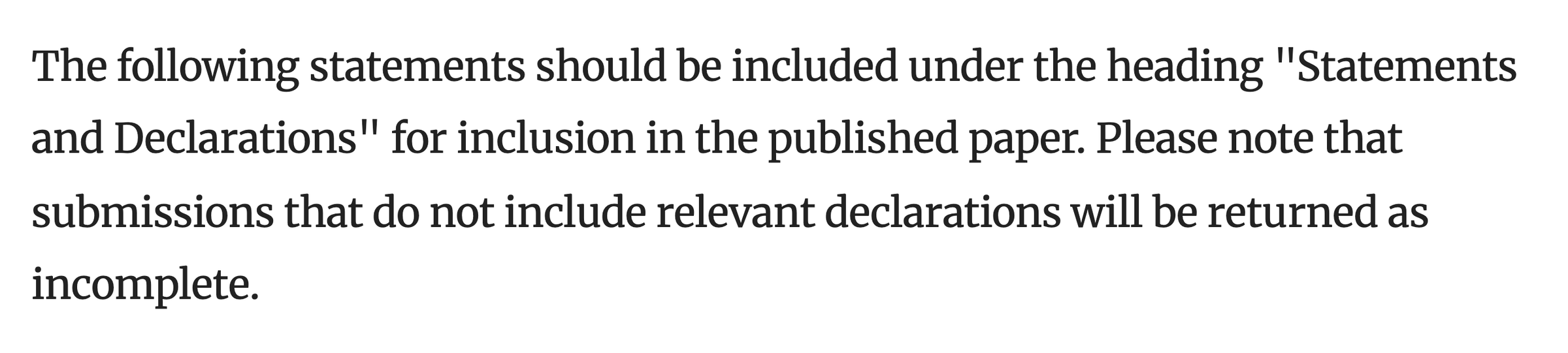
🦌 A wildlife journal keeps correcting papers for missing ethics statements. The European Journal of Wildlife Research has run at least four corrections since 2022 that fix nothing in the science. Each one adds an ethics statement the paper should have carried. The latest, on September 8, says that a camera-trap study of mammals in Mexico did not require approval from an animal ethics committee. An anonymous PubPeer commenter has pointed to more papers, including a 2021 one with a survey of nearly 1,500 people whose ethics approval section says "Not applicable".
Why it matters: The journal's current instructions for authors are pictured above. A vice president at its publisher, Springer Nature, cautioned against drawing conclusions about the journal's processes from a small number of unrelated cases.
What I would do: Before you submit, check that your paper says which committee approved the study, or that no approval was needed and why. Our free Submission Declaration Builder drafts that statement, along with the data, funding, interests and consent statements, in your browser.
Reference: Retraction Watch, 7 Oct 2026 · European Journal of Wildlife Research, submission guidelines
Which story was most useful to you this week? Tap one to vote.
🏢 Taylor & Francis may be leaving its owner. Informa announced plans last week to separate its academic business and focus on its business-to-business operations. If you publish in a Taylor & Francis journal, this is one to watch. Journalology
⌛ NIH takes comments on its peer review score proposal until Tuesday, October 13. If you have a view on which numbers belong on your summary statement, send it today. NIH
🎲 Which researcher type are you? Our short test asks how you write, submit and handle reviewers. You get your type, your blind spot, and the reviewer comment you are most likely to see. Take the test
Corrections: None this week. Spot an error? Reply and we will run the correction right here, loudly.
That's the week. Forward this to a labmate deciding where to submit, and if it reached you secondhand, subscribe in one tap.
How was today's issue? Great · Fine · Meh
| Erik Founder, Manusights |
Forward to a friend
Get this every Monday
What changed in publishing, what it means for your submission, and one thing to try. Free.