A million-dollar maths problem, and a fight over credit

Last week OpenAI said one of its models had solved a million-dollar maths problem, and the argument has been over credit, including whether a mathematician's use of OpenAI's own coding tool could have played a part. Plus, Springer Nature's updated AI policies, OSF stops taking new projects in nine weeks, and someone counted 3,200 Beatles references in paper titles.
 | Erik Founder, Manusights |
Know one person who puts unpublished work into AI tools? Forward this to them. It takes ten seconds, and today's try-this-week takes five minutes.
📨 Newly released records show the US Justice Department wrote to at least 11 journals in 2025, including Science, Nature Medicine and Pediatrics, saying publications like theirs were "conceding that they are partisans in various scientific debates". Each letter posed questions about the journal's editorial practices, and the one to JAMA said its questions covered all of JAMA's journals. In the replies released, Family Medicine and American Family Physician directed any further requests to their lawyers (AIP's report names Science as one of the two, but Science's reply in the records does not mention lawyers). AIP FYI · The letters
💸 Wiley's research publishing revenue rose 12% at constant currency in the quarter to 31 July. Gold open access, AI licensing and $13 million from Emerald, which it acquired, drove the rise; AI licensing in its separate Research Solutions business brought in $4 million, down from $16 million a year earlier. Research Information
⚖️ The US Justice Department urged the judge in the New York Times copyright case against OpenAI to find that training AI on copyrighted work is fair use. Its brief argues that requiring licences would give the largest tech companies an oligopoly on AI training; a Times spokesman said the government was siding with "trillion-dollar A.I. companies". Publishing Perspectives
🩺 A boycott of the American Diabetes Association now includes halting the review of new articles submitted to its journal Diabetes Care. It follows the removal of five members from the ADA's June meeting after they handed out an editorial from that journal. An ADA committee initially found they were removed for conduct that disrupted the event and broke the attendee code of conduct, and not because of what the editorial said, a finding the boycotters reject; on 6 September the ADA said further findings may clarify or correct that account. If you are under review there, ask the journal for a timeline. Fierce Biotech · STAT · ADA
OpenAI says it solved a Millennium problem. The fight is over credit.
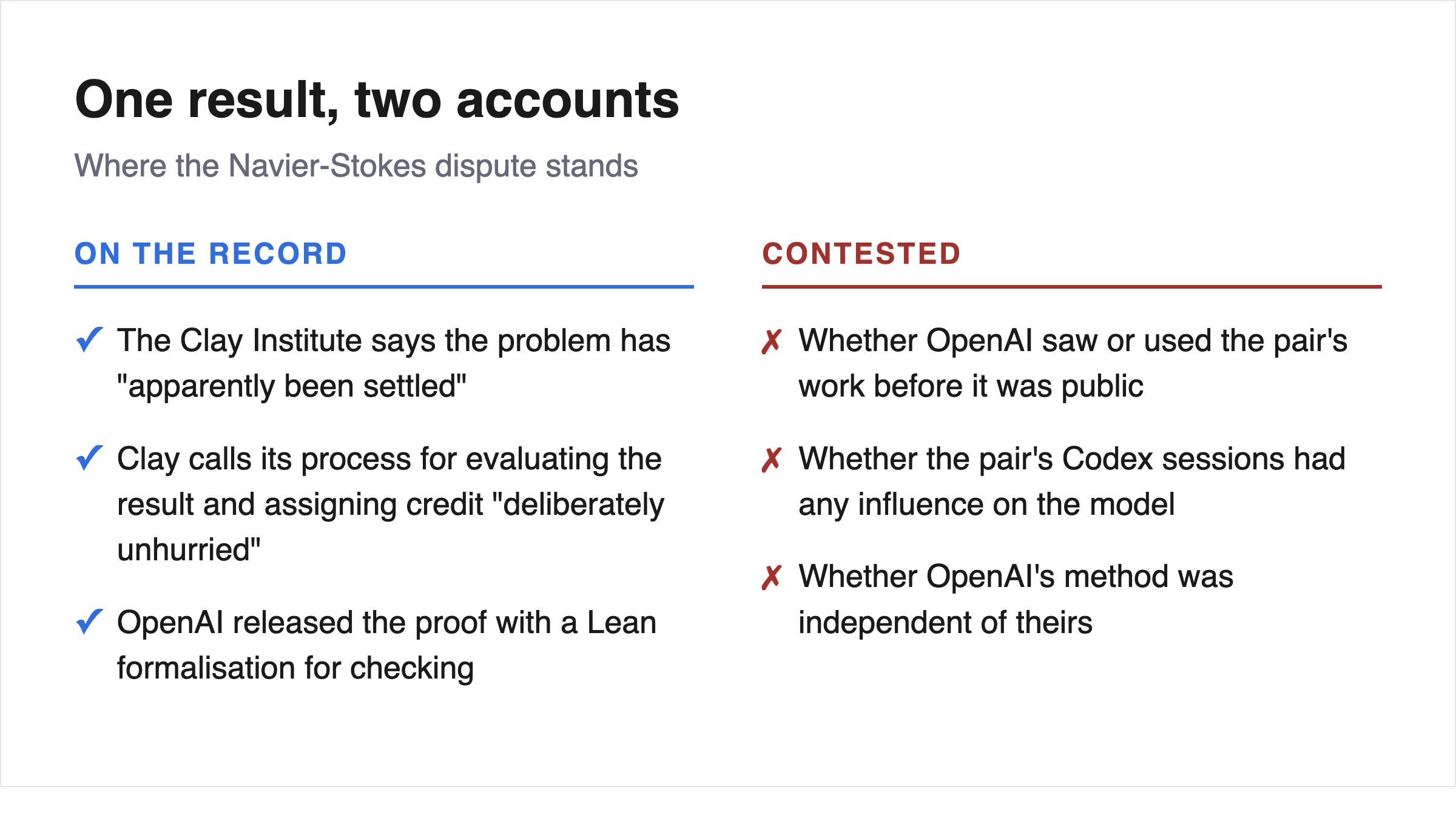
OpenAI says an internal model produced a proof that the Navier-Stokes equations, which describe how fluids move, can break down in finite time when a smooth force is applied to the fluid. It is one of the seven Millennium Prize Problems, each carrying a $1 million prize, though OpenAI says it does not intend to claim it. By the company's own account, it turned a new internal model on all the open Millennium problems after hearing rumours on 1 September that two had been resolved, and the group of agents that produced this proof numbered on the order of 10,000.
Why it matters: Tristan Buckmaster of NYU and Levent Alpöge, who works at Anthropic, had already made public a proof of a forced version of the closely related Euler problem, from what Buckmaster calls a purely personal collaboration. OpenAI recognises their priority on that result and says the proofs differ significantly, though Scientific American reports that its Navier-Stokes solution followed a similar method to the pair's. The dispute is over what came before. Buckmaster says OpenAI's first prompt was sent after information about their work had reached it, and that the smooth-force route it took "is not the direction one arrives at in a few days by giving a model the problem statement"; OpenAI says it did not see any of their work until they released it. He also asked whether OpenAI's model had been trained on, or had access to, their sessions in Codex, where they had put all their drafts for the project, and OpenAI's answer has changed over the week. On 8 September it said that, while unlikely, it could not rule out that de-identified data from the pair's use of its products had helped improve its models. The next evening it told the New York Times it could "say categorically" that his Codex prompts over the last two months could not have influenced the system, and it later said that "no user inputs past July 3rd" could have. Both later statements are limited to recent inputs; the pair had used Codex for the whole project.
No public evidence shows their data played any part. Buckmaster's statement says he does not know whether it was used, though after OpenAI's announcement he asked on Mastodon whether it was ethical "to use customer's data to try to scoop their customer". The question could be asked at all because what people type into AI tools can be used for training, and that part applies to you: on a personal ChatGPT plan, your Codex tasks can be used to train OpenAI's models unless you switch that off, and switching it off covers only new tasks.
Reference: OpenAI write-up, 8 Sep 2026, updated 10 Sep 2026 · Clay Mathematics Institute statement, 11 Sep 2026 · OpenAI Help Center, Data Controls FAQ
Coverage: Tristan Buckmaster's statement, 7 Sep 2026 · Tristan Buckmaster on Mastodon, 8 Sep 2026 · OpenAI write-up as first published, 8 Sep 2026, archived · Scientific American, 8 Sep 2026 · The New York Times, 10 Sep 2026 · Wikipedia, timeline of OpenAI's statements · OpenAI, 7 min read
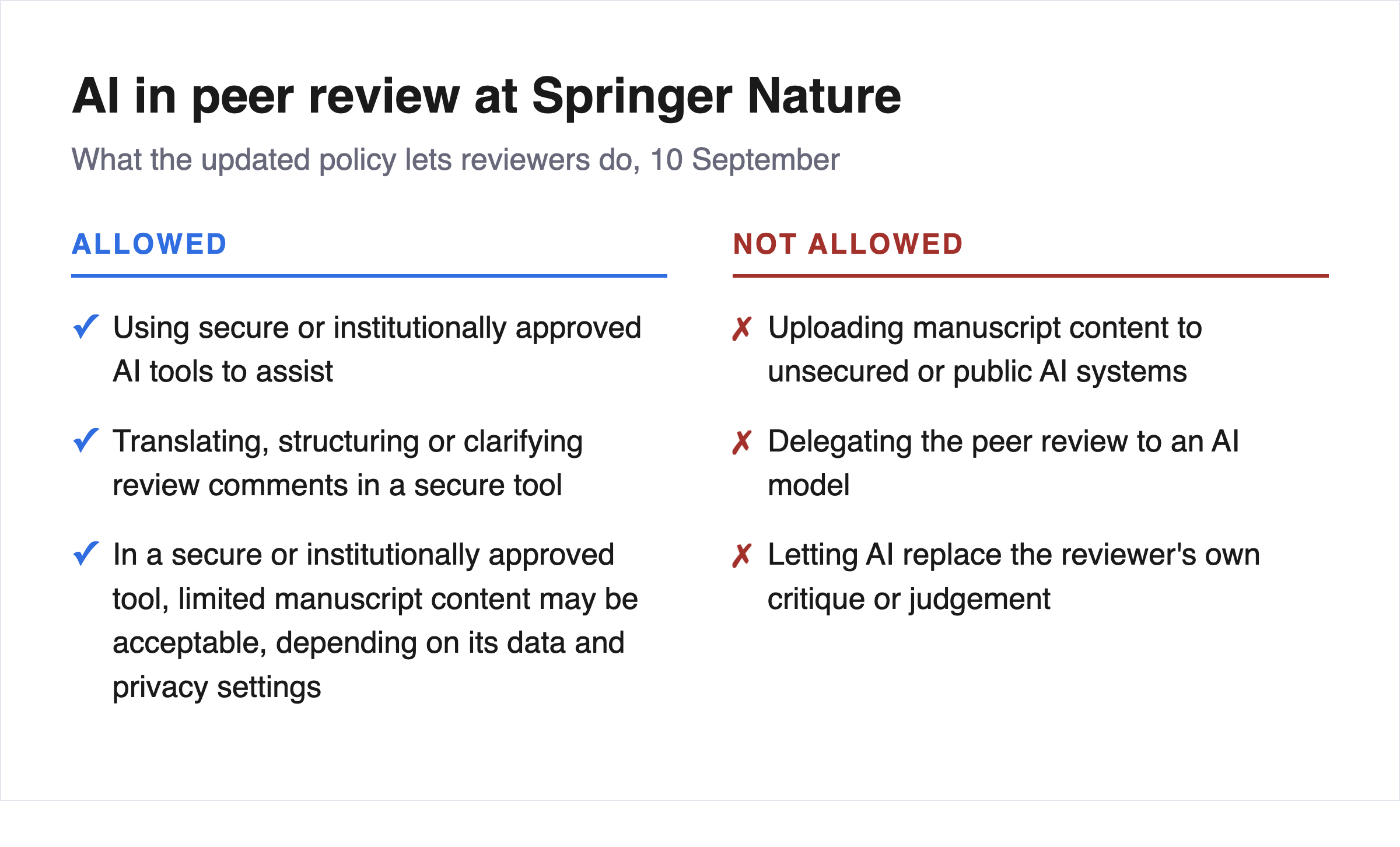
🔐 Springer Nature now weighs AI use by its risk, not by whether you used it. Springer Nature has updated its AI policies for authors, reviewers and editors. Rather than asking whether AI was used, the new framework asks about the impact of that use, the risk it adds and whether a human stayed in charge, and it still requires AI use to be declared.
Why it matters: The guidance names a trap that has nothing to do with chatbots. Some enterprise and institutional versions of AI detectors can keep and train on what is uploaded to them, which Springer Nature says makes them inappropriate for unpublished manuscripts, because using one would breach confidentiality. That is the same question as this week's lead, asked from the reviewer's chair. Check the checker.
What I would do: Before you review for a Springer Nature journal, check the data and training terms of any AI tool you plan to use, including your institution's detector, keep manuscript text, figures and identifiable details out of public or unsecured tools, and describe any AI use in your report. If you are an author, declare any AI use in your manuscript.
Reference: Springer Nature press release, 10 Sep 2026 · Springer Nature AI guidance for researchers, editors and reviewers
Coverage: Springer Nature policy, using AI in peer review · 2026-09-10
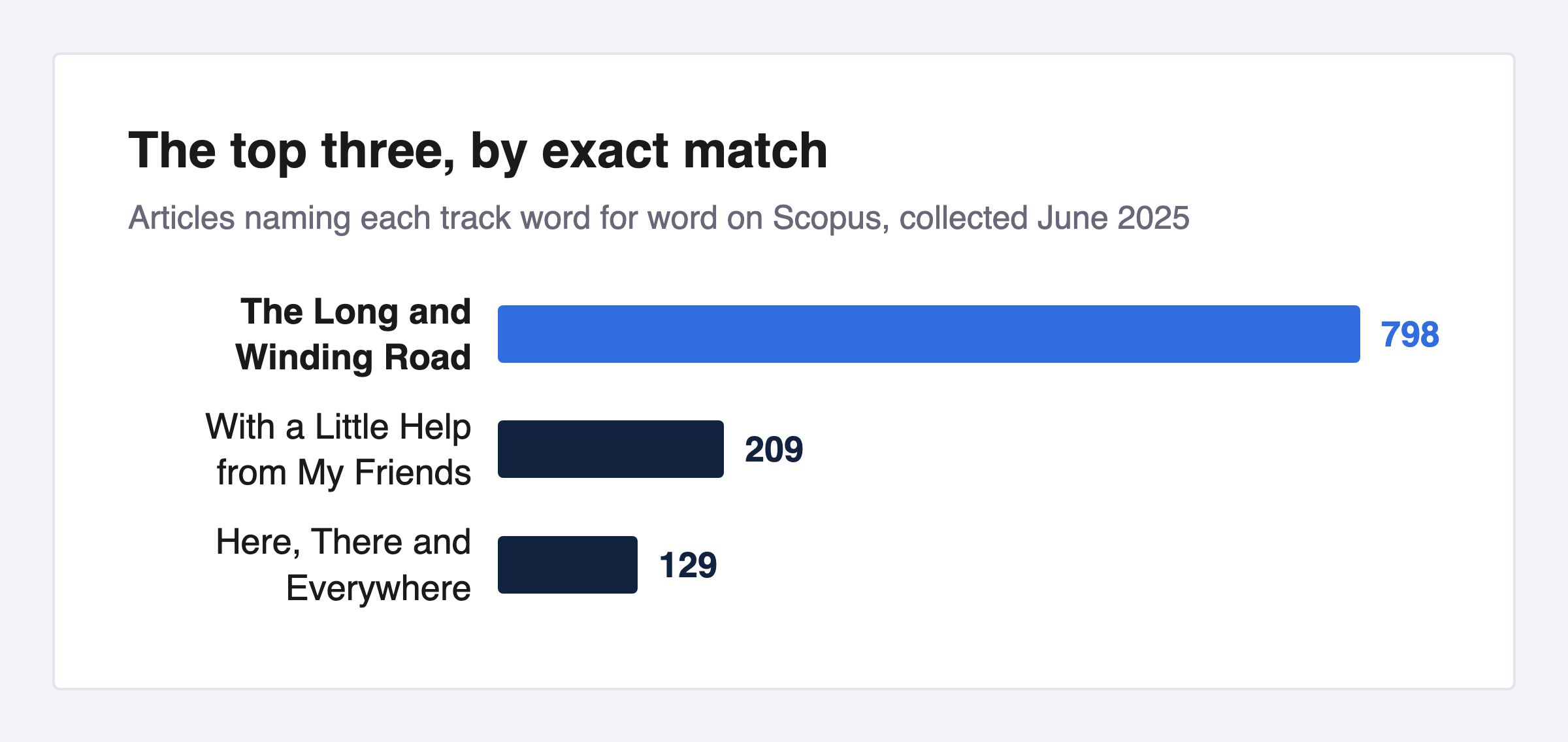
🎸 3,200 Beatles references in paper titles. A team from Delft University of Technology and Radboud University searched Scopus article titles, used a language model and hand checks to catch the puns, and found 2,237 titles that quote a Beatles song title or lyric outright and another 963 that pun on one. The ten most-quoted songs turn up in 1,584 titles. The equivalent top tens for Michael Jackson and Elvis Presley manage 65 and 196.
Why it matters: Among titles quoting the ten most-used songs, medicine and the social sciences lead, but the tail runs through computer science, economics and environmental science. The most famous example is a pun: "Attention Is All You Need", the 2017 paper behind today's large language models, which plays on the lyric "love is all you need". The authors count 89,737 Scopus citations for it, nearly three times the total for the 2,048 papers that quote a song title exactly, and they think most of the 305 "is all you need" titles counted as puns are riffing on that paper rather than on the song.
What the study cannot tell you is whether a memorable title helps. The authors say their citation figures do not show that a Beatles reference causes more citations. Counting is not testing. Science points to other work: a 2023 analysis of ecology and evolution papers by Stephen Heard and colleagues found that papers with funnier titles were cited less overall, apparently because authors gave them to papers they thought less important, but once that was accounted for, funnier titles had higher citation rates.
What I would do: Say your title out loud. If nobody could repeat it back, try a version a colleague could say from memory. The authors' own advice is that a cultural reference can make a paper more memorable if it fits the content and costs nothing in clarity or searchability. Check your target journal first, because some do not allow humorous titles.
Reference: Budel, Kooij and Tjepkema, PLOS One, 9 Sep 2026 · Heard, Cull and White, FACETS, 2023
Coverage: Science, 9 Sep 2026 · Phys.org, PLOS press release, 9 Sep 2026 · 2026-09-09
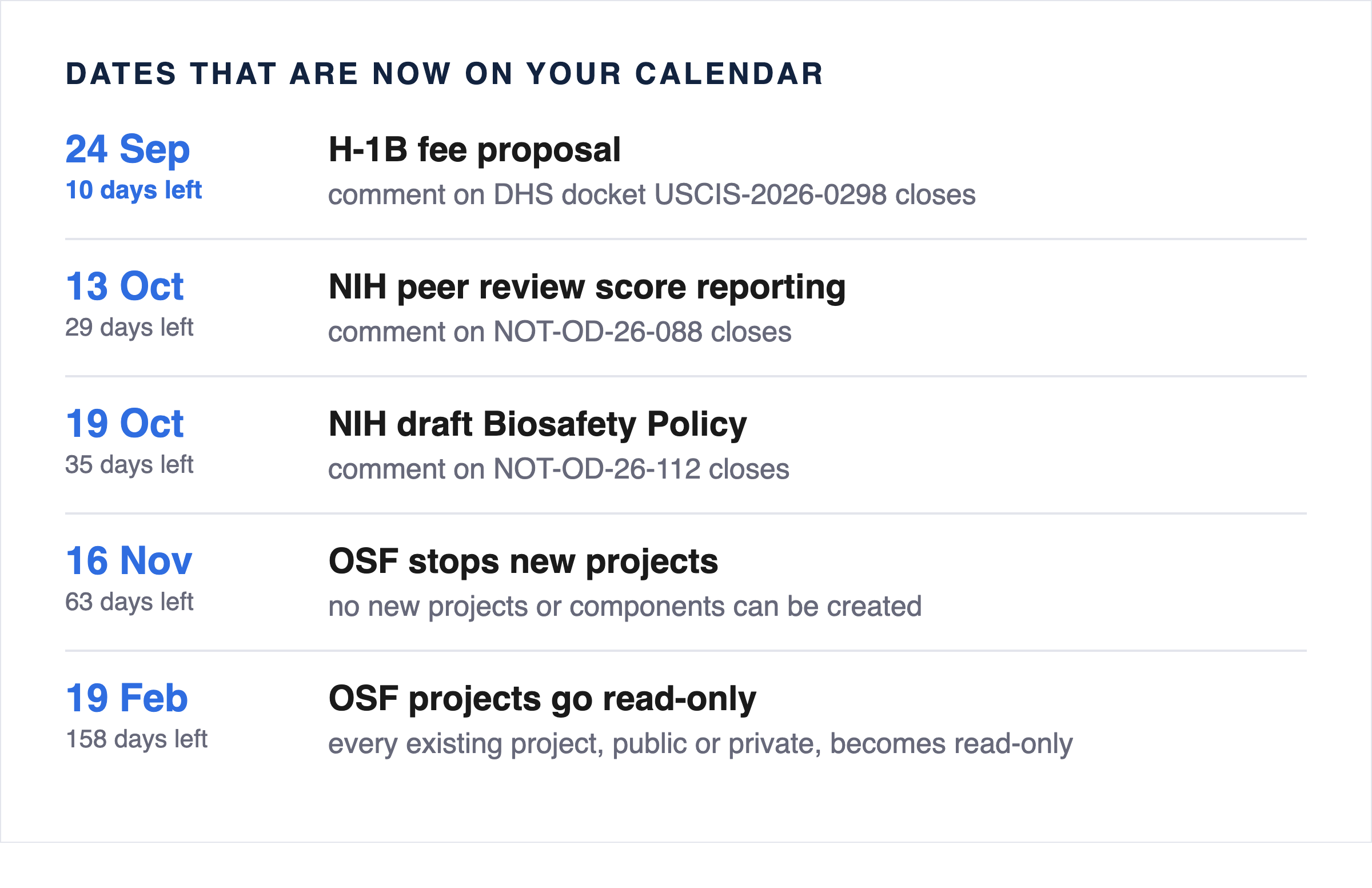
Five dates, three of them comment windows. The last two are OSF's, announced by the Center for Open Science in August, and for finished public work they change less than they sound. Until the February cutoff you can still add files to what you already have there, registrations and preprints carry on (though after the cutoff a registration can no longer be started from a project), and public work stays online with its links and DOIs.
If a paper you have submitted points to OSF material you will still need to change after the February cutoff, the Center suggests checking your institution's repository or one for your discipline first, then a generalist one such as Zenodo, and asking OSF to redirect the old link. View-only links to private material keep working after the February cutoff, but the Center expects to remove private projects in future and aims to give at least 12 months' notice. Finished public work and preregistrations can stay where they are.
Open every AI tool you have used on unpublished work this year and find its training setting. On a personal ChatGPT plan it is Settings, then Data Controls, then "Improve the model for everyone", and it covers your Codex tasks too. Then open Codex's own settings, because it has a separate setting for training on full environments that the ChatGPT one does not change. Do the same search in the privacy settings of anything else you use. Checking does not mean anything has gone wrong for you. Turning these settings off closes that door for new conversations and tasks from then on. The same care applies to us. We use models from Anthropic and OpenAI, both named in this week's lead; Manusights does not train AI models on your manuscript, and both providers' API terms say they do not train on it by default. Source files are scheduled for deletion seven days after the review settles.
a year for the next several years is what the Center for Open Science says it would need to raise to keep OSF running at its current scope. "In the present funding environment, we cannot expect that level of annual support," it says. That is the price COS puts on the OSF you know, and why its project workspace is closing to new projects.
Sources: Center for Open Science
Corrections: Last week's issue went out missing three paragraphs, cut by a formatting bug we have since fixed, including the caveat that none of the figures on editors prove anyone did anything wrong. Three links were also wrong; the right ones are doi 10.1007/s10551-026-06441-2 for the FT50 audit by Mindel and Ciriello, published 27 August, arXiv 2605.20668 for the Kim et al. comparison of AI and human reviews, and COPE's guidance at publicationethics.org/guidance/cope-position/editors-submitting-articles-their-own-journal.
That's the week. Forward this to a labmate deciding where to submit, and if it reached you secondhand, subscribe in one tap.
Whenever it is useful: if you have a draft going, run it through the free check and see what an editor would screen for. If you are earlier than that, the Academy works the same method on whatever you have so far.
What should be in next week's issue? Reply to this email with the thing you wish someone would explain, or the deadline you nearly missed. I read every one, and the ones I can source go in with a note that you asked.
How was today's issue? Great · Fine · Meh
| Erik Founder, Manusights |
Forward to a friend
Get this every Monday
What changed in publishing, what it means for your submission, and one thing to try. Free.
Subscribe