A top fellowship hit 800 applications in 21 hours
Get Manusights Weekly free, every Monday

Good morning. A prestigious fellowship closed 21 hours after it opened, and if you were locked out, one rule in the small print helps you. Then how junior researchers are getting onto Nature's reviewer lists, and what to do when AI makes the review you get back much longer.
One question for you: what is the one thing about your current paper you most want a straight answer on? Reply with it. I will pick one and answer it here next Monday, without your name.
 | Erik Founder, Manusights |
Sending a paper soon? Run the free check on your draft before you submit. It reads the paper the way a reviewer would and flags what they are likely to question, in about 2 to 3 minutes.
A top fellowship hit 800 applications in 21 hours, then shut
For: Postdocs and experienced researchers planning a stay in Germany
The Humboldt Research Fellowship, which pays researchers from abroad to work in Germany, opened its November call on a Sunday. It hit its new cap of 800 applications within 21 hours and closed, Nature reported.
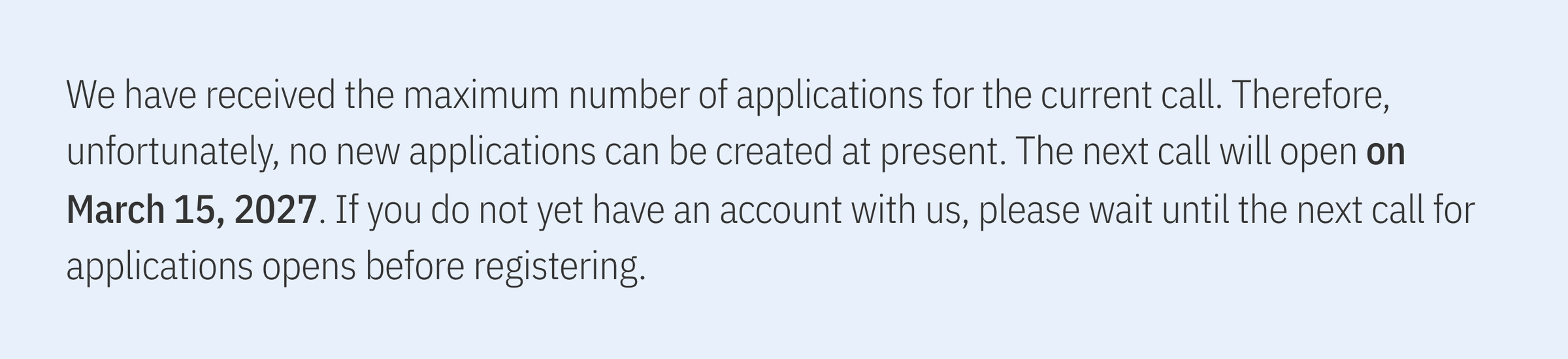
Nature reported that one astrophysicist had spent three and a half months on his application and stayed up through the night finishing it. He sent it to his host in Germany for a last check, went hiking, and came back to find the call closed.
The foundation told Nature it had not expected the cap to be reached within 24 hours, and apologised. It said applications have risen as more researchers use AI to prepare them faster. It does not ban generative AI in applications, and applicants do not have to declare using it.
How the rules work now. There are three calls a year, and each closes once it reaches the cap, currently 800 applications. The foundation expects to approve 20 to 25% of the applications it receives.
My read: a fellowship that sells out like concert tickets rewards whoever is ready the hour it opens, not only whoever wrote the best proposal.
Do this today: If you were locked out mid-application, your draft is saved. Submit it no more than 14 days after the next call opens and it counts as received on the day the portal closed. That date is the one used for the career-stage limits, so you cannot age out while you wait. Planning to apply in March? Have your proposal, host and referees lined up before the call opens.
Sources: Nature, 20 Nov 2026 · Alexander von Humboldt Foundation, Humboldt Research Fellowship · 2 min
Forward this to a postdoc who is eyeing a stay in Germany. Send it to a colleague
Junior researchers now make up 17% of Nature's reviewers
For: PhD students and postdocs who want reviewing experience
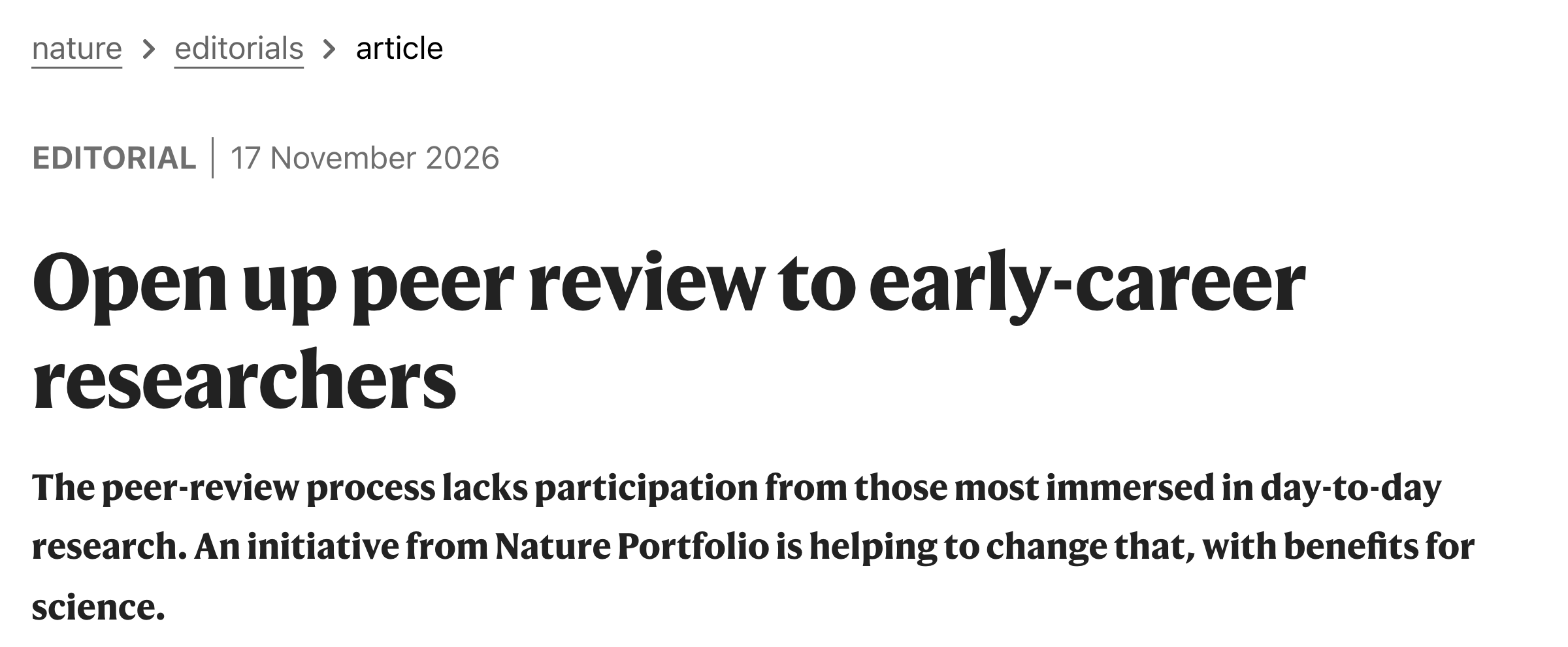
A Nature editorial reported the first large analysis of its journals' co-review programme, in which an established reviewer brings a PhD student or postdoc into a review. Junior researchers accounted for 17% of reviewers at Nature and 11% at Nature Communications. In a survey of about 2,500 established researchers who had taken part, 88% said they are more likely to agree to a review if they can co-review with a junior researcher.
Why it matters: Reviewing someone else's paper is like reading the examiner's marking notes before your own exam. The editorial also says that in some cases junior researchers do the work and their senior colleagues take the credit.
What I would do: Ask your supervisor to bring you in, by name, on their next Nature Portfolio review; co-reviewers are later offered reviews of their own. EMBO Press also runs a programme, launched in 2024, that invites researchers with at least two years of postdoc experience to review on their own.
Sources: Nature editorial, 17 Nov 2026
AI makes reviewer criticism cheap. Which points must you answer?
For: Anyone answering reviewers
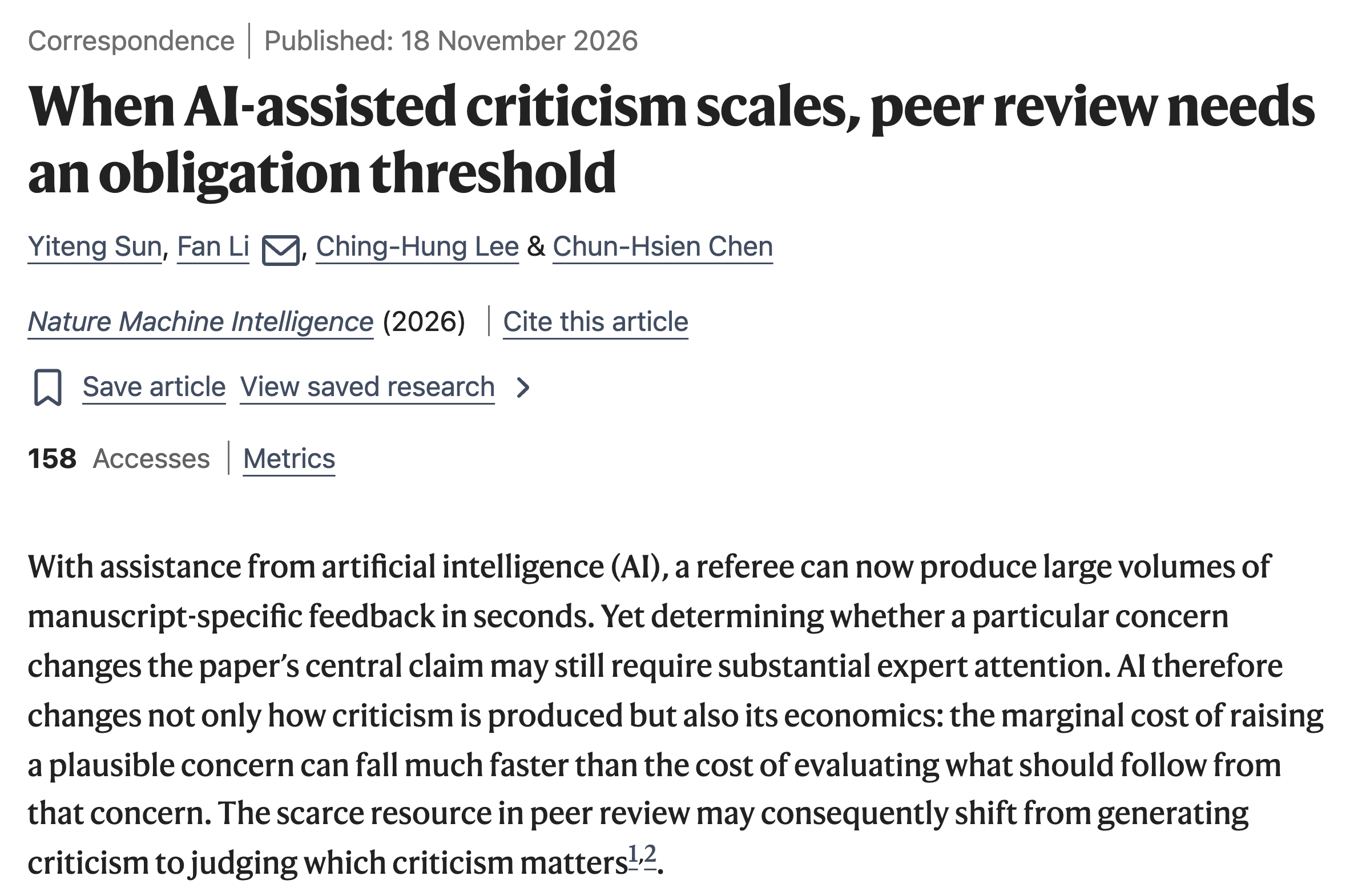
A letter in Nature Machine Intelligence argues that with AI, the cost of raising a plausible concern can fall much faster than the cost of judging whether it changes a paper's central claim, which may still need substantial expert attention. Since authors are usually expected to address every concern or explain why not, the letter's writers argue that peer review now needs "an obligation threshold".
Why it matters: A plausible point now costs a reviewer seconds to raise; answering it can still cost you a week. Last week's preprint found AI models flagging problems even in trial reports that had no planted errors.
What I would do: When a long review lands, sort it first. Mark the points that would change your main conclusion if the reviewer were right, and answer those in full, with new analysis where needed. Answer every other point too, briefly, and where you disagree, say why in one sentence.
Reference: Sun et al., Nature Machine Intelligence, 18 Nov 2026
🇺🇸 NIH K applicants · NIH extended its parent K award announcements, including the K01, K08, K23 and K99/R00, to 13 November 2027. The extension adds new-application due dates of 12 June 2027 and 12 October 2027. NIH notice
⚖️ University of California researchers · The US Supreme Court declined to review the UC grants case on 16 November. That leaves in place the lower-court orders that made the administration return hundreds of cancelled research grants to UC academics. CalMatters
🧩 Last week's challenge · The planted error was C: the trial left out everyone who stopped using their inhaler. All three of you who answered found it. CONSORT 2025 warns that, without appropriate methods, excluding participants "may compromise the randomisation and lead to biased estimates of treatment effects". CONSORT 2025 guidance
Which one was most useful to you today? Tap it, then press send.
15 March 2027: the next Humboldt Research Fellowship call opens, and closes again once it hits its cap. Have your application ready that day.
Where to act: Humboldt Research Fellowship (15 Mar)
Corrections: None this week. Spot an error? Reply and we will run the correction right here, loudly.
That's the week. Forward this to a labmate who is applying for fellowships, and if it reached you secondhand, subscribe here.
| Erik Founder, Manusights |
You're getting this because you subscribed at manusights.com or uploaded a manuscript for review.
Forward to a friend
Get this every Monday
What changed in publishing, what it means for your submission, and one thing to try. Free.