arXiv now caps you at two papers a month
Get Manusights Weekly free, every Monday

Since Thursday, arXiv has limited every submitter to two submissions a calendar month, and a rejected paper still uses one. So this week's lead is a to-do list: what to sort out now so the cap never meets your conference deadline. Plus, a reviewer finds two published papers that claim to use open brain-imaging data and probably did not, and a heart-implant paper turns out to cite the registration number of a different trial.
 | Erik Founder, Manusights |
Forward this to whoever in your group clicks submit on arXiv. The limit counts against them, not against the co-authors. Send it to a colleague
Whenever it is useful: if you have a draft going, run it through the free check and see what an editor would screen for. If you are earlier than that, the Academy works the same method on whatever you have so far.
💰 arXiv has $17.2 million to become independent. Simons Foundation International, XTX Markets and the Siegel Family Endowment committed it over three to five years. Some of it is for the technical platform, including managing AI-generated content. arXiv
💶 Firms are advertising paid freelance peer-review jobs. A preprint identified some 1,000 online adverts. If one recruits you, ask which journal the manuscript is for: the study gives no conclusive evidence about which journals use them. Of five reviewers interviewed, most reported being paid €30–40 per review, often with two to three days to deliver. Nature
🏛️ NIH's more than 700 websites are becoming one. A new NIH site is due on Monday, organised around eight hubs, one of them for grants. "Trying to find something on the old website required the skills of an Egyptologist," Kathleen Hall Jamieson of the University of Pennsylvania told STAT. Existing sites stay up for now and will be retired on a rolling basis, so re-save your grants bookmarks when they start redirecting. STAT
arXiv has capped you at two submissions a month. Here is how to plan around it.

Since October 1, everyone who posts on arXiv has a monthly limit, in every category. arXiv calls it a stopgap while it works out what the best practice should be for authors who use more and more advanced AI tools.
Why now. arXiv received 40,363 submissions in September, a record, up from 20,569 in September 2024 and 9,869 in September 2016. That one month also generated almost 9,000 support tickets. Its moderators, who are volunteers, are seeing more thin papers of narrow scope and more "salami" papers, where a single work is broken up and submitted as a set of smaller ones. arXiv also reports a marked increase in dense, AI-written papers.
Most of us will never post three papers in a month. But the months when you might are the ones that matter: a conference deadline, a thesis coming out as chapters, a lab clearing a backlog before a grant report. So here is what I would do this week.
1. Decide who submits. The limit applies only to the submitter. A paper you submit with several co-authors counts towards your rate. It does not count towards theirs. If one person in your group posts everything, that person now has two slots a month for the whole group. Spread the submitting across the authors, and agree on it before the month you need it.
2. Put your deadlines on a calendar and count back. arXiv offers no exemption for a backlog or a conference. It asks authors in that position to plan their submissions carefully. The count runs by the calendar month, so write down which two papers go in October, which two in November, and which one has to wait.
3. Treat a rejection as a spent slot. The limit counts submissions, not announced papers. If you submit two papers in a month, accepted or rejected, you wait until the next month. So check the category and arXiv's submission guidelines before you submit, and get a hard read of the draft first.
4. Keep an eye on your three active submissions. Papers still on hold from last month do not count against this month's two. They do count towards your three active submissions. A paper stuck on hold can block a new one.
5. If you spot a mistake before the paper is announced, delete it. A submission deleted before it is announced does not count towards either limit, whatever the reason. After it is announced, arXiv's instruction for a corrected article is to replace the original, never to make a new submission. arXiv's post does not say whether a replacement uses one of your two slots.
6. Combine the thin ones. Moderators are seeing more salami papers, and each piece now costs you a slot as well. If two of your planned papers share a dataset and a method, ask whether they are one paper.
My read: arXiv says it will monitor the effect of the policy and modify it as needed, so the numbers may move. I would still plan as if they stay, because the planning costs you a few minutes and missing a conference deadline costs you a year. This is arXiv's rule only. I have not seen bioRxiv or medRxiv announce one, but arXiv says repositories across the board are seeing the same rise, so I would not bet against it.
Has the cap already caught a paper of yours? Reply and tell me what happened. I will run the best workaround here next week, without your name.
Why it matters: Open your calendar, find the next month in which your group planned to post more than two papers, and decide today who submits which. The person in your lab who posts everyone's preprints has two slots a month now.
Reference: arXiv, 1 Oct 2026 (6 min read) · arXiv, submission guidelines
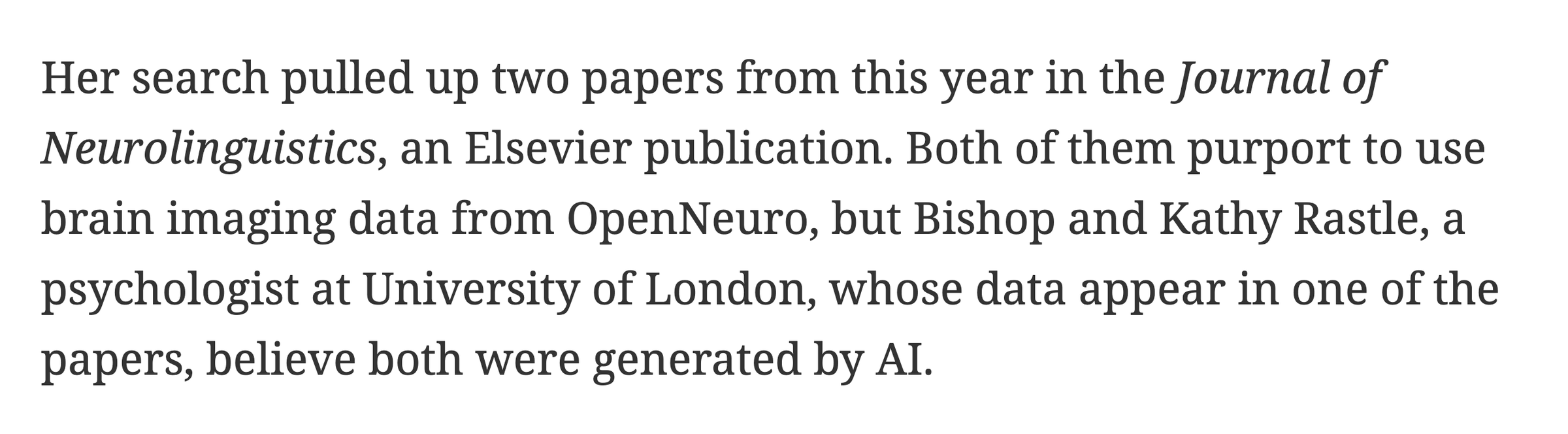
🧠 A reviewer found published papers that claim to use open data and probably did not. In August, Dorothy Bishop, an emeritus professor at the University of Oxford, was asked to review a manuscript built on fMRI scans she had posted on the public repository OpenNeuro. Its description of the dataset did not match what her team had done, and the paper was eventually rejected. Searching the authors' names, she found two papers from this year in the Journal of Neurolinguistics that purport to use OpenNeuro data. She and Kathy Rastle, whose data appear in one of them, believe both were generated by AI. Elsevier says it is investigating.
Why it matters: One of the papers thanked Rastle and her colleagues for sharing their data, and reported reading comprehension scores that the dataset does not contain. If you share data openly, your name can turn up in the acknowledgements of a paper you have never seen, and nobody will tell you.
What I would do: Search Google Scholar this week for your dataset's name and its accession number. For any paper that claims to use it, check the number of participants and the variables against what you posted. Those were the mismatches here.
Reference: Retraction Watch, 1 Oct 2026
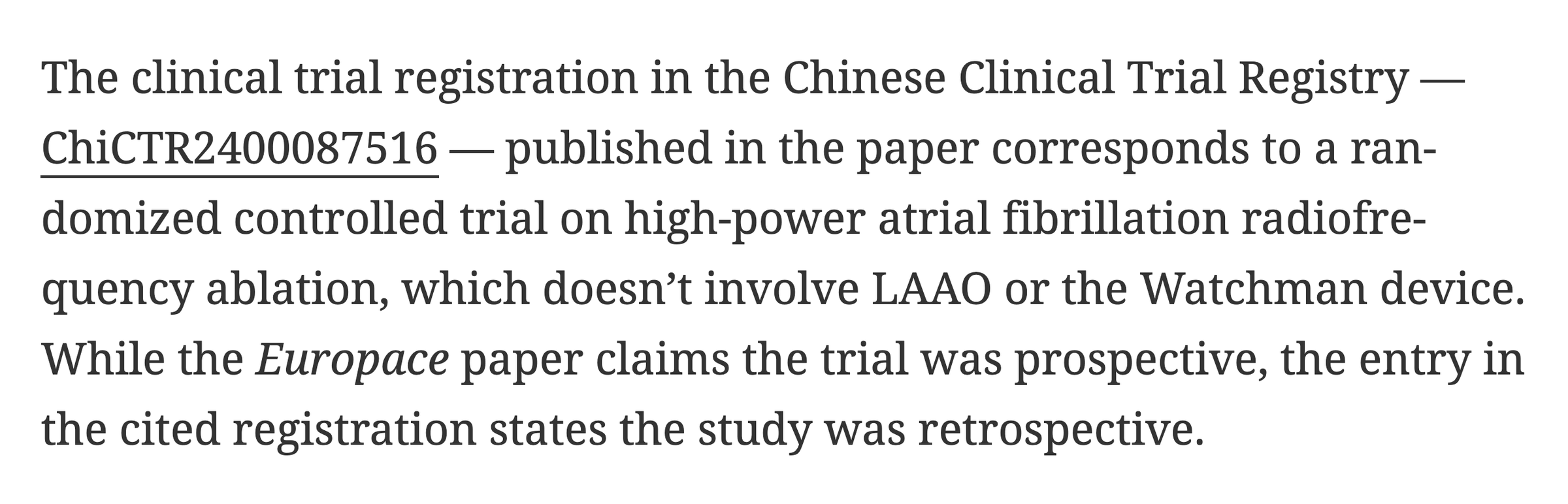
🫀 A heart-implant paper cited the registration number of a different trial. A paper published in EP Europace in May described a prospective study of a heart implant in 400 people. The registration number it lists belongs to a randomized study of a different procedure, as the excerpt above shows. A separate entry in the same registry seems to describe the methods the paper reports. The journal's publisher is investigating.
Why it matters: Nobody rereads a registration number after the first draft, and it is one of the few things in a paper that a stranger can check in a minute.
What I would do: Before you submit, paste your registration number into the registry and read the entry against your methods section: the design, the intervention, and whether it says prospective or retrospective.
Reference: Retraction Watch, 30 Sep 2026
Which story was most useful to you this week? Tap one to vote.
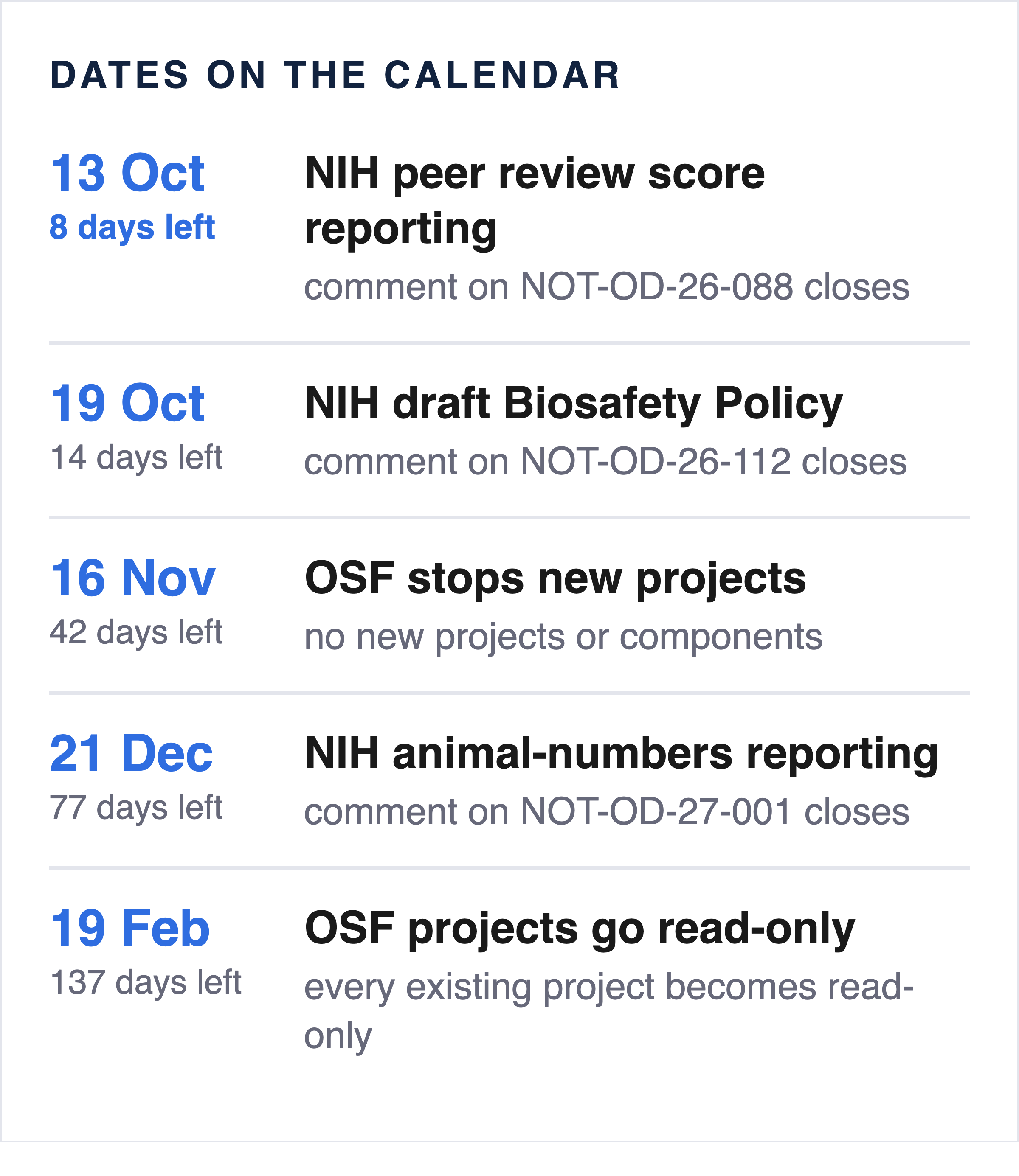
The first date on the card is next week. NIH is proposing to change what it reports from review scores, and if you have a view on which numbers you should see on your summary statement, this is the week to send it.
No dates were added this week. If you have OSF projects you still need to edit, move that work before the last date on the card, because after it every OSF project is read-only. Registrations and preprints are not affected.
With two slots a month, a paper split in three costs you more than a month of slots. Paste the abstracts or outlines of the next few papers you plan to post into a chatbot and ask the question a moderator would. You do not have to take its advice, but it is better to hear it from a chatbot than from a rejection that used a slot.
of 460 academics surveyed by The Chronicle of Higher Education said they had never used generative AI when preparing writing for publication. A quarter called doing so "completely unacceptable". Among the 75% who showed some openness, 41% said it was acceptable in publications read primarily by academics, such as journal articles and monographs. Academics do not agree with each other on this, and your reviewers are academics, so write your AI disclosure in the exact form the journal's policy asks for.
Corrections: None this week. Spot an error? Reply and we will run the correction right here, loudly.
That's the week. Forward this to a labmate deciding where to submit, and if it reached you secondhand, subscribe in one tap.
What do you want more of? Reply to this email and tell me. I read every reply.
New on YouTube: How to Submit a Paper to a Journal, Step by Step, a 10-minute watch.
How was today's issue? Great · Fine · Meh
| Erik Founder, Manusights |
Forward to a friend
Get this every Monday
What changed in publishing, what it means for your submission, and one thing to try. Free.