bioRxiv and medRxiv may decline preprints with many fabricated references
Get Manusights Weekly free, every Monday

Last week I asked whether anyone had ever offered you authorship on a paper you did not work on. Three of you answered, and all three said no. This week: bioRxiv and medRxiv may decline preprints with many fabricated references. The fix takes minutes: open each DOI at doi.org before you post. Plus a Wednesday cutoff for some Wellcome applicants.
One question before you read on: what is your field? Cell and molecular biology · Neuroscience · Cancer and immunology · Clinical medicine or public health · Something else. A tap opens an email with your answer in it; just press send. Next week I will share what you said and mark which fields each item is for.
 | Erik Founder, Manusights |
Posting a preprint or submitting soon? Run your draft through the free check and see the top concerns an editor might flag.
bioRxiv and medRxiv may decline preprints with many fabricated references. Four steps for your next preprint.
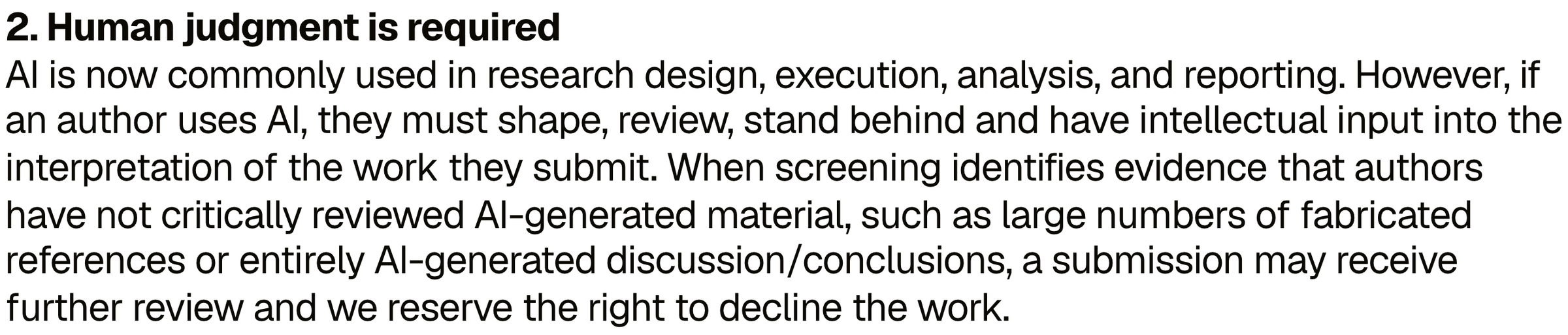
On October 20, openRxiv, which runs bioRxiv and medRxiv, set out how it handles AI. Using AI is not the problem: "Our goal is not to penalize AI use." What it will act on is evidence that authors did not check what AI produced, and it names two examples: large numbers of fabricated references, and a discussion or conclusions written entirely by AI. A preprint that shows either may get further review, and openRxiv reserves the right to decline it. Separately, it says it may rate-limit authors in some instances.
Every author must also be a verifiable person, affiliated with an organisation openRxiv can contact if misconduct is alleged. Its staff, not the screening tools, make the final decision, and authors can appeal.
My read: of the two problems openRxiv names, fabricated references are the one you can rule out yourself before you post. An AI-drafted reference list can look perfect and still point to papers that do not exist.
1. Check that every reference exists. Open each DOI at doi.org, or search the title in PubMed. A reference you cannot find anywhere is the one to check by hand. The box below does the lookups for a whole list at once.
2. Reread the discussion and conclusions as your own. openRxiv says an author who uses AI must "shape, review, stand behind" the interpretation of the work. If an AI drafted these sections, rewrite them and check each claim against your results.
3. List every author with a real affiliation. Each one has to be a person openRxiv can verify, at an organisation it can contact.
4. If a preprint is declined by mistake, appeal. openRxiv says it will keep reevaluating its screening tools so that work is not wrongly flagged.
Do this today: Pick your next preprint or submission, check its reference list, and fix anything that does not resolve.
Reference: openRxiv, How we're approaching AI at bioRxiv and medRxiv, 20 Oct 2026 · 2 min
Forward this to anyone in your lab who posts preprints. Checking a reference list takes a few minutes. Send it to a colleague
Manusights now works inside ChatGPT and Claude. Paste your reference list, ask it to check the list with Manusights, and each reference comes back marked as found, retracted or not found, with where it looked. Not found means check that one by hand; it does not prove the paper is fake.
We tried it on a real paper, a retracted one and one we made up. The real one, a 2016 mBio paper on image duplication, came back as found, with no notices on record. The 1998 Lancet paper by Wakefield and colleagues came back as retracted, with the 2010 retraction notice. The made-up one came back as not found: Crossref and the DOI registry had no record of its DOI, and a title search found no match.
In Claude, reference checks work without a Manusights account: set it up in Claude. In ChatGPT, you connect a Manusights account first: set it up in ChatGPT.
Sources: Manusights in Claude · Manusights in ChatGPT
💷 Wellcome applicants · From Thursday, Wellcome Early-Career Awards will only accept lead applicants based in the UK or in low- and middle-income countries in Africa, South Asia and South-East Asia. Applications submitted on or before 28 October are assessed under the current rules, and the scheme has no other deadline, so if your organisation is in the Republic of Ireland, or in a low- or middle-income country outside Africa, South Asia and South-East Asia, submit by Wednesday to be assessed under the current rules. Wellcome
🗂️ Anyone reusing NIH-funded data · Asked an NIH-funded lab for its data and been refused? NIH says to tell it. It wants to hear when a researcher is not sharing data as its 2023 Data Management and Sharing Policy requires, and it suggests going to your own Office of Sponsored Programs first. NIH
🔎 PLOS and MDPI authors · A tool called EditorCheck found more than 8,000 PLOS papers and around 2,500 MDPI papers whose handling editor had coauthored with an author within the publisher's limit. The limit is five years at PLOS and three at MDPI. If your handling editor has written a paper with you in that window, say so and ask for another editor. Retraction Watch · The paper
Which one was most useful to you today? Tap it, then press send.
Corrections: None this week. Last week's promise is kept: the answers to the authorship question are at the top. Spot an error? Reply and we will run the correction right here, loudly.
That's the week. Forward this to a labmate who posts preprints, and if it reached you secondhand, subscribe here.
| Erik Founder, Manusights |
You're getting this because you subscribed at manusights.com or uploaded a manuscript for review.
Forward to a friend
Get this every Monday
What changed in publishing, what it means for your submission, and one thing to try. Free.