Can you spot the planted error?
Get Manusights Weekly free, every Monday

Good morning. A challenge first this week: one sentence in the short trial report below hides a major error. Find it and tap your answer, and next Monday I will share the answer and how many of you got it right. Then what happened when AI models and human reviewers hunted for errors like it, and California's billions for immunology.
 | Erik Founder, Manusights |
Sending a paper soon? Run the free check on your draft before you submit. It reads the paper the way a reviewer would and flags what they are likely to question, in about 2 to 3 minutes.
Can you spot the planted error?
For: Anyone who writes, reviews or reads clinical research
A new preprint hid major methodological errors in clinical trial reports and compared who found them. Before the results, try it yourself. I wrote the short trial report below for this challenge; the trial is made up. One sentence hides a major error. Which one?
- A. We randomised adults with moderate asthma to a new inhaler or an identical-looking dummy inhaler, on top of their usual treatment, using a computer-generated list that clinic staff could not see.
- B. Our main outcome, registered before the first patient enrolled, was the number of severe asthma attacks in the year after randomisation.
- C. Patients who stopped using their assigned inhaler were left out of the analysis, so the results reflect the people who actually took the treatment.
- D. Patients on the new inhaler had fewer severe attacks, a statistically significant difference, and we call for a larger trial to confirm the effect before it changes practice.
Tap your answer: A · B · C · D. Tap one, then press send. Next Monday: the answer, why it matters, and how many of you found it.
What the study found. Researchers took three trial reports with major errors planted in them, the same reports untrained human reviewers had checked in an earlier study, and gave them to 15 AI models with the same reviewer guidance. The models found between 53% and 96% of the planted major errors. The human reviewers had found 27% on average. They then planted errors in 58 trials published in 2026, to cut the chance that a model had seen them in training. The best model tested on all 58 found 94% of the major errors.
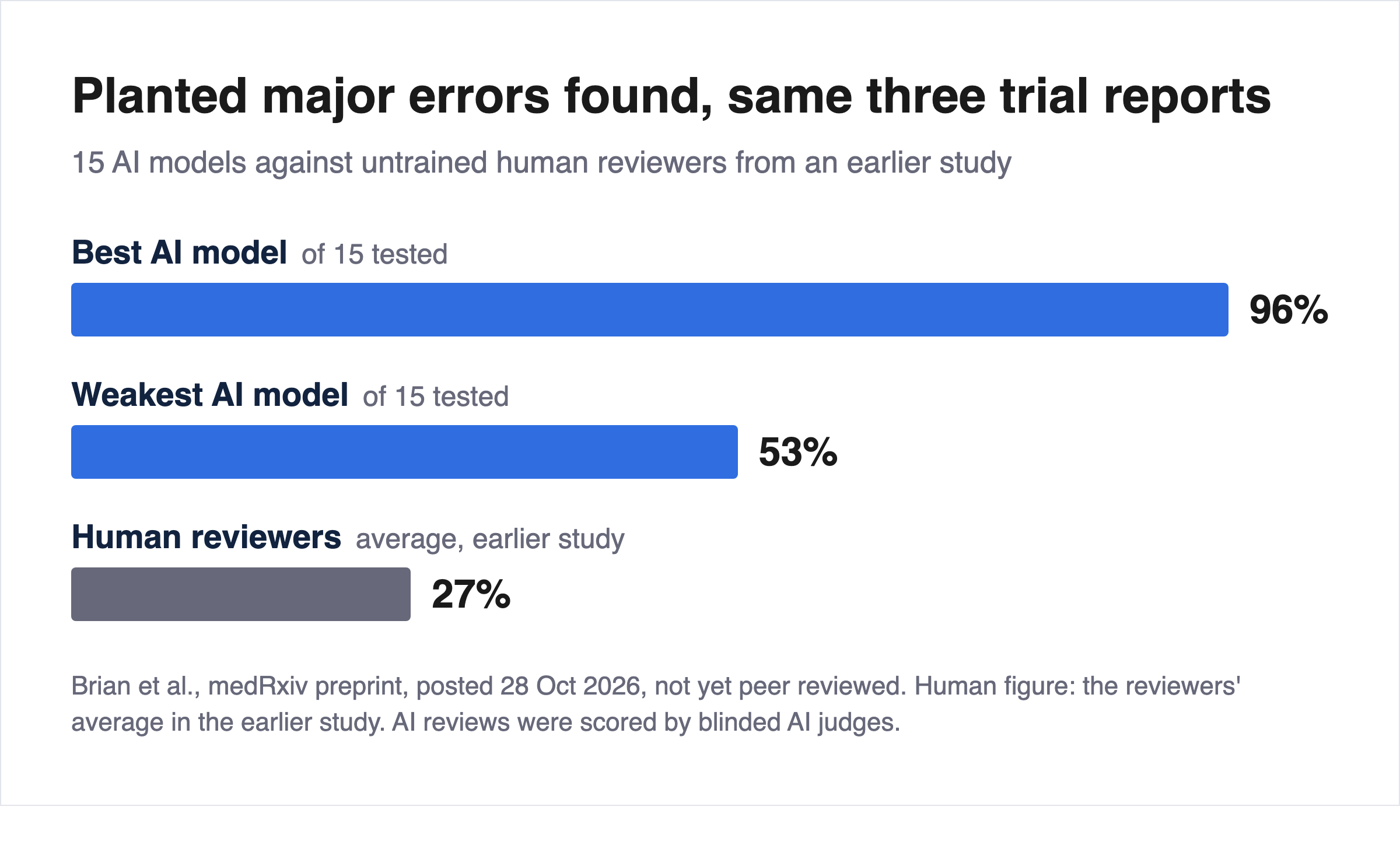
Read it with care. The human reviews are historical, the models worked without tools, and the AI reviews were scored by AI judges, blinded. It is also a preprint, posted on 28 October and not yet peer reviewed, and several of its authors are affiliated with ResearchHub Foundation, which is building AI-assisted review.
The part you can use. The models also read copies with no planted errors, and still flagged problems. The two they raised most often: conclusions the results do not support, and no reasons given for why screened patients were not enrolled.
My read: a reviewer will soon check your paper this way, whether or not anyone tells you. Run the same check first.
Do this today: Check your draft for both before you submit. Fixed now, they cost a sentence in your Discussion and a line in your CONSORT flow diagram; found by a reviewer, they cost a revision round.
Reference (preprint, not peer reviewed): Brian et al., Large language models detect methodological errors that human peer review misses in clinical trials, medRxiv, 28 Oct 2026 · 2 min
Forward this to a colleague with a trial paper going out soon. Send it to a colleague
Open your manuscript and give it to an AI assistant your institution allows you to use with unpublished work, with this prompt. Then read every sentence it quotes back to you.
California just voted billions into immunology. Half is for grants

For: Researchers at California universities and nonprofits
The state's ballot measure passed, according to the Associated Press, which called it on 9 November, with 54.2% of votes cast for yes that evening. Half the money goes to one institute, a founding member of UCLA's new Research Park. The rest goes in grants to select nonprofits and public universities, through a council of seven University of California representatives and 10 to 15 from other universities and nonprofit research institutes. Under the measure, the council picks the grant recipients from among its own member organisations.
Why it matters: A seat on that council decides who can get the grants, and the council will also set the research goals and the grant criteria.
What I would do: If you work at a California university or nonprofit research institute, ask your research office whether it is seeking a seat on the council.
Sources: Daily Bruin, 9 Nov 2026 · California Secretary of State, Official voter guide, Proposition 38
🇨🇦 Anyone on a Canadian Tri-Agency grant · Canada's new open-access rules start at submission. For grants and Chairs awarded from 1 January 2027, you must tell the journal about your obligations when you submit and keep the rights to apply an open licence; the paper must then be open immediately and deposited in a Canadian repository or trusted Canadian platform. UVic Libraries
📝 Anyone with a preprint · XSci will pay an independent expert to review up to 100 preprints, free to the author, usually within five to ten days. Any field, any country. If the expert says a paper has the potential to be published at its target venue and the report is made public, its submitting author gets a $500 award. Entries close 30 November. XSci call
Which one was most useful to you today? Tap it, then press send.
30 November: entries close for XSci's free expert review of preprints.
13 December: entries close for the Chen Institute and Science Prize for AI Accelerated Research, which you enter with a research essay.
Where to act: XSci Open Review Award (30 Nov) · Chen Institute and Science Prize (13 Dec)
Corrections: None this week. Last week I asked whether PubMed indexing had ever decided which journal you sent a paper to. Two of you answered, and both said you had never checked. Spot an error? Reply and we will run the correction right here, loudly.
That's the week. Forward this to a labmate who reads trial papers for a living, and if it reached you secondhand, subscribe here.
| Erik Founder, Manusights |
You're getting this because you subscribed at manusights.com or uploaded a manuscript for review.
Forward to a friend
Get this every Monday
What changed in publishing, what it means for your submission, and one thing to try. Free.