In 45% of journals, an editor is one of its own top authors

Nobody submits to a journal. You submit to about six people, and until this fortnight we had almost no numbers on who those six are or how they behave when the paper on the desk is their own. Now we have two studies, from opposite ends of the literature, that reach for the same drawer. Neither is about funding. Both are about the desk.
 | Erik Founder, Manusights |
The editors are publishing in their own journals, and we can now measure it
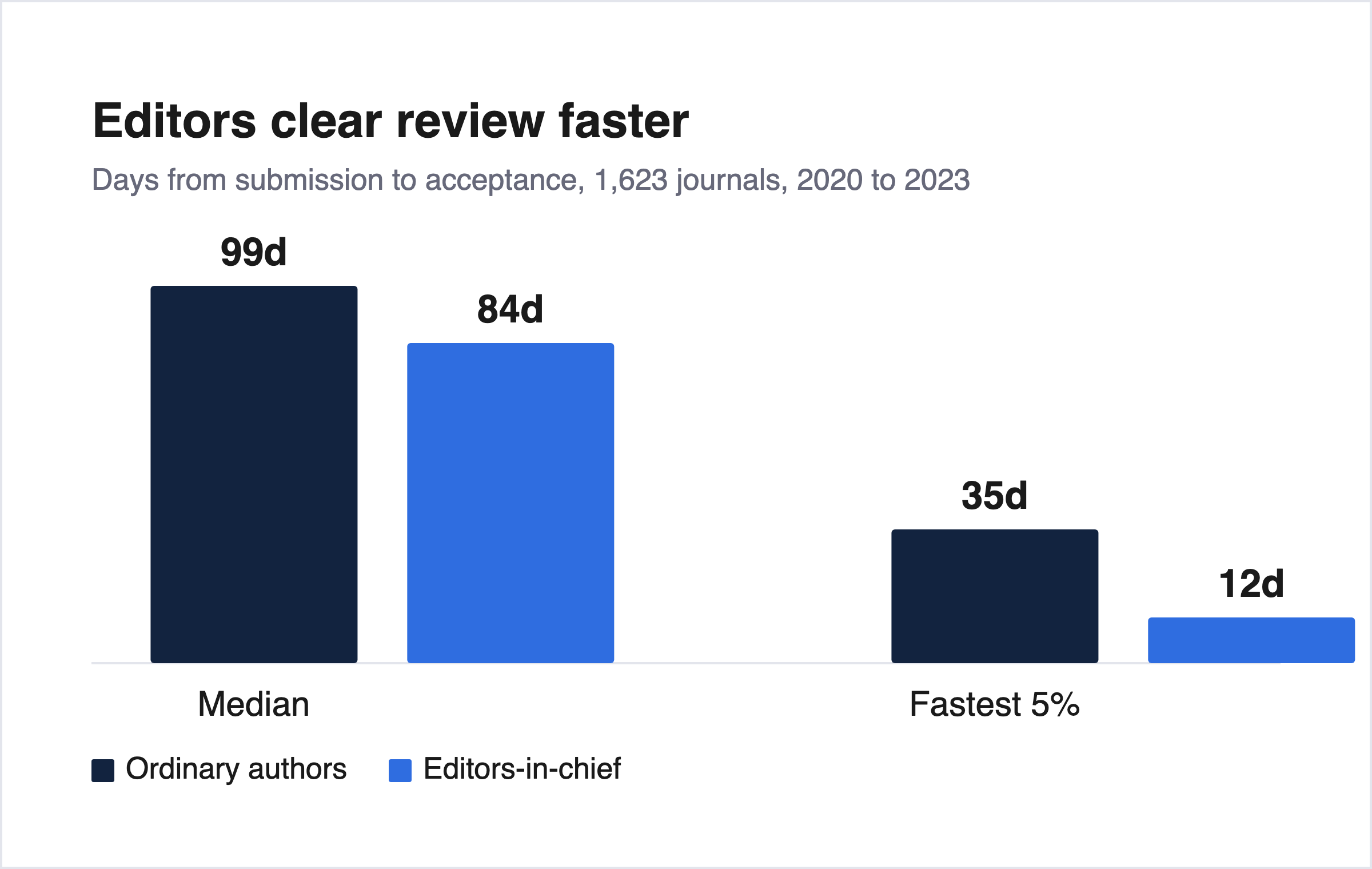
A French team matched a public dataset of editorial boards against PubMed and counted, journal by journal, who actually publishes there. Mega-journals were excluded, so this is the ordinary specialist literature that most of us submit to.
In 45% of them, one of the journal's own editors sits among its most prolific authors. In the top 5%, the most published editor has their name on more than one in every fifteen research articles the journal puts out.
Why it matters: Then there is the clock, which is the part you feel. At the middle of the distribution the gap is about a fortnight, small enough to explain away. At the fast end it stops being small. The quickest acceptances for an editor-in-chief landed inside two weeks. The quickest for everybody else took five.
Sources: Lemarchand et al., medRxiv preprint, 18 Aug 2026 · Open Editors, the editorial-board dataset behind it · COPE guidance on editors publishing in their own journal
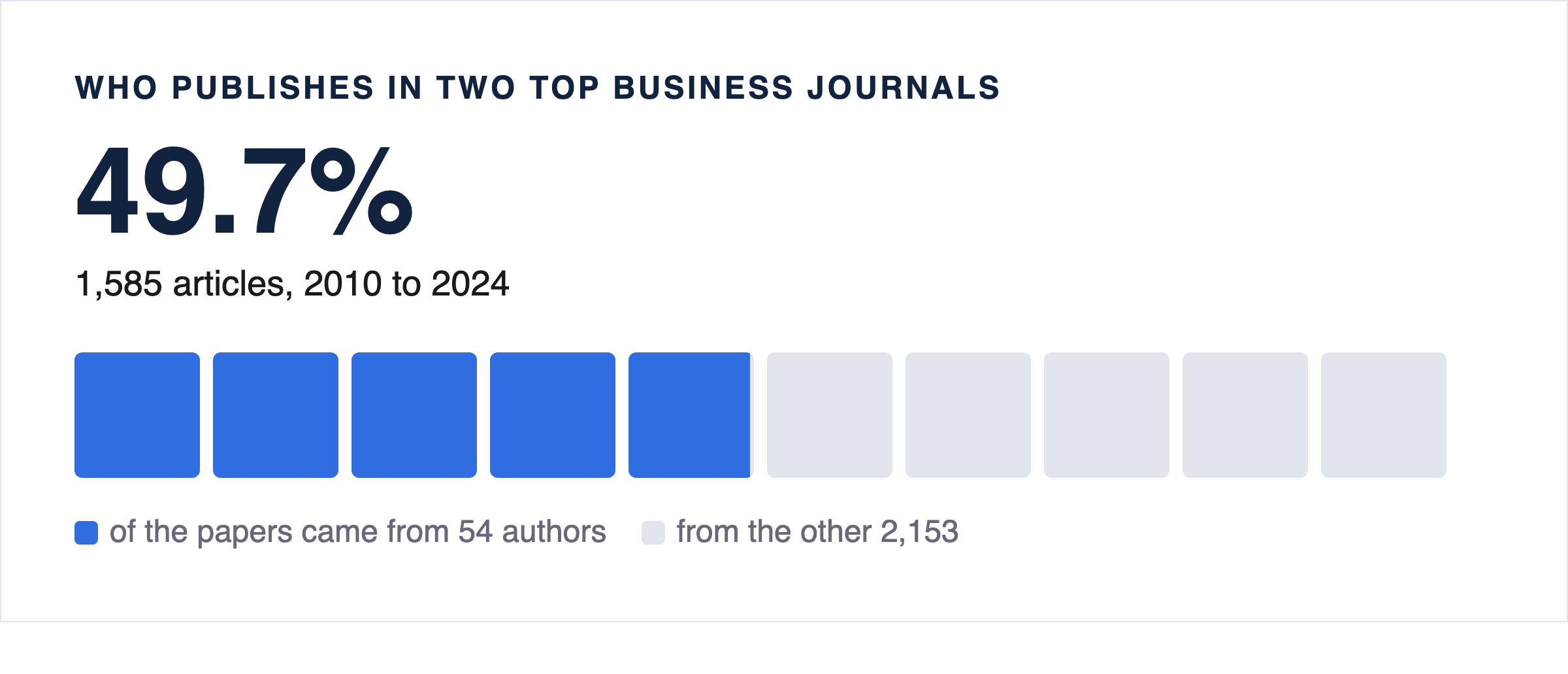
📊 Half the papers in two elite journals came from a few dozen people. An audit of fifteen years of the FT50, the list business schools treat as the only one that counts, found that a few dozen people wrote about half of everything in two of its titles. That is not a field. It reads like a regulars' table.
Why it matters: Across those fifteen years the audit found 946 ties between an author and an editor. Half of them carried at least one clear conflict of interest, with another 11.6% possibly conflicted. The group at the centre is also strikingly narrow: 90% did their doctorate in North America and 5% are women. It is a small room. The stakes are cash as well as standing, because some business schools pay a bonus of up to 22% of base salary for a hit in one of these titles.
What I would do: Find out whether your institution rewards a specific list in writing, because plenty do it by habit and deny it on paper. Then look at how many recent articles in your target journal come from people already inside it. If the answer is most of them, you are not competing on quality alone, and a wider journal one rung down may get your work read sooner and cited more.
Reference: Ciriello and Mindel, Journal of Business Ethics, 2 Sep 2026
Coverage: Times Higher Education, 2 Sep 2026 · 2026-09-02 · 4 min
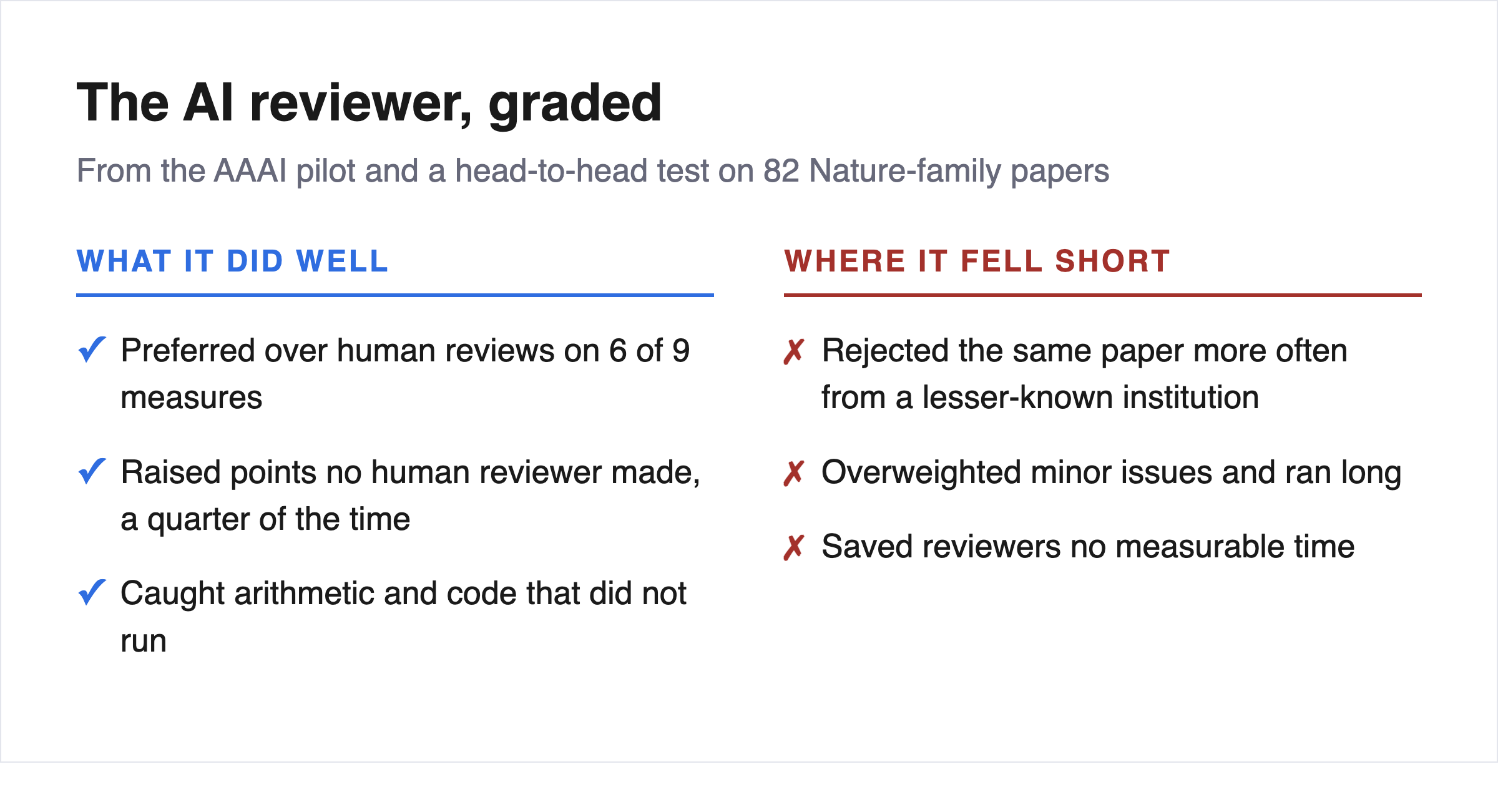
🤖 30,000 papers each got an AI reviewer, and the authors liked it. The AAAI conference took 30,000 submissions this year, double last year's, and gave every author a machine-written report alongside the human ones. It then asked nearly 6,000 authors, reviewers and judges what they made of it. The verdict is not the rout either camp was expecting.
Why it matters: The pressure behind this is arithmetic, not enthusiasm. Science reported this week that the world now publishes over 8 million papers a year, twice as many as five years ago, and that finding people willing to read them is getting harder every year. Something has to absorb that. In a separate test, GPT-5 was turned loose on 2,500 papers that had already been accepted at leading machine learning conferences and flagged roughly a third of them as carrying at least one error that could affect interpretation or reproducibility. Human checkers agreed with 83% of those flags.
What I would do: Write for a machine reading first, because increasingly one does. The mistakes it reliably catches are the boring ones: a figure that appears one way in the text and another in the table, a total that does not add up, a script that will not execute. Those cost an hour the week before you submit and a month in revision.
Reference (preprint, not peer reviewed): Kim et al., head-to-head AI and human review, arXiv preprint
Coverage: Science, Vol 393 Issue 6815, 3 Sep 2026 · 2026-09-03 · 5 min
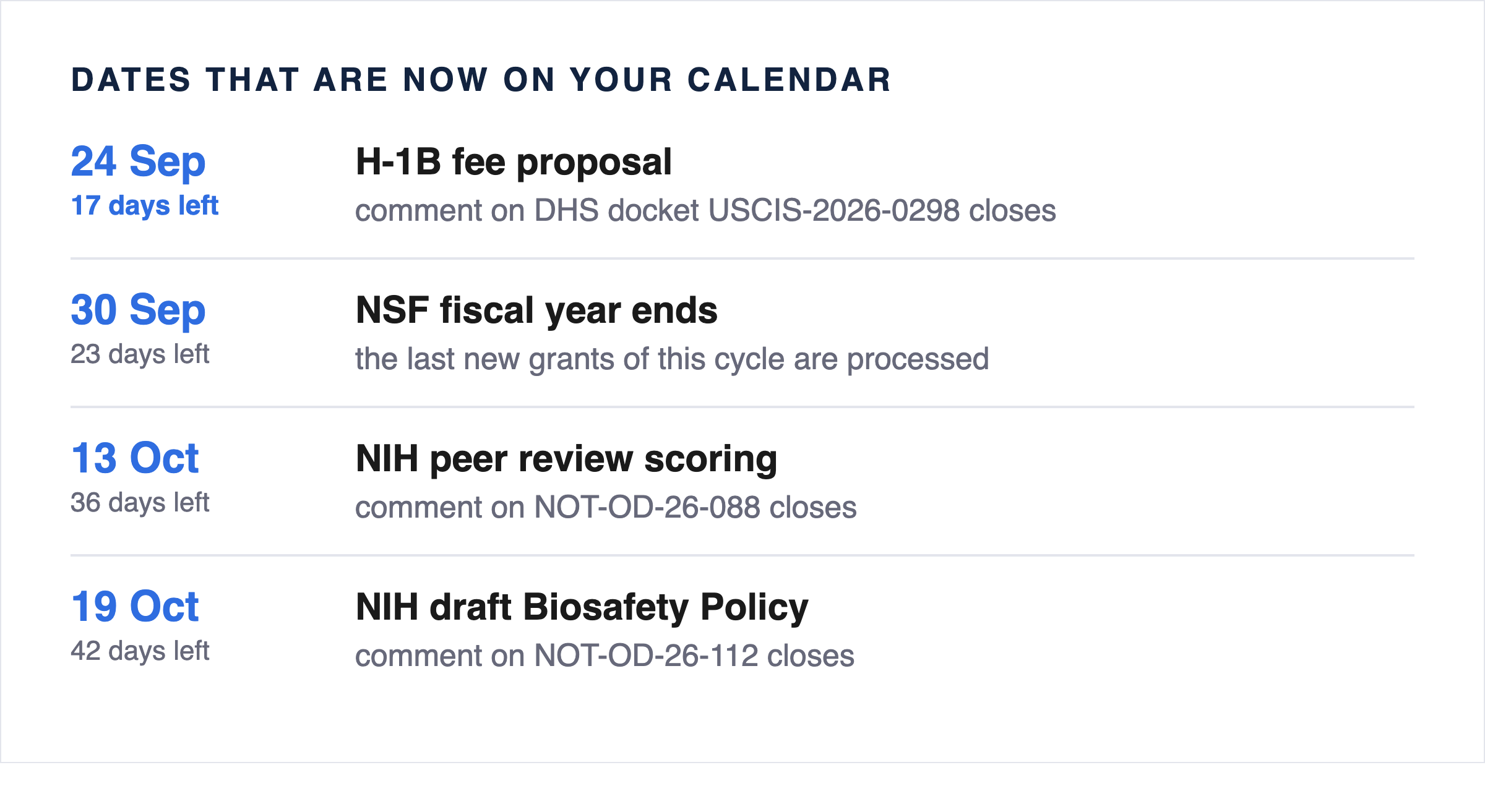
Three of the four are comment windows, which remain the cheapest influence a working scientist has. They take anonymous submissions, the responses get counted, and the counts get published. The fourth is a budget year ending, which is a different animal: it decides what gets processed, not what gets decided.
Open the editorial board page of the journal you are about to submit to. Take the five names at the top. Search each one inside that same journal and count what they have published there since 2023. Then find the journal's own reported time from submission to decision. You now know two things you did not know this morning: whether the board publishes in house, and what a normal wait actually looks like, so you can tell a slow decision from a stalled one. If the board is heavily represented and your paper sits in the same subfield as theirs, that is not a reason to give up. It is a reason to have your second journal chosen before the first one answers.
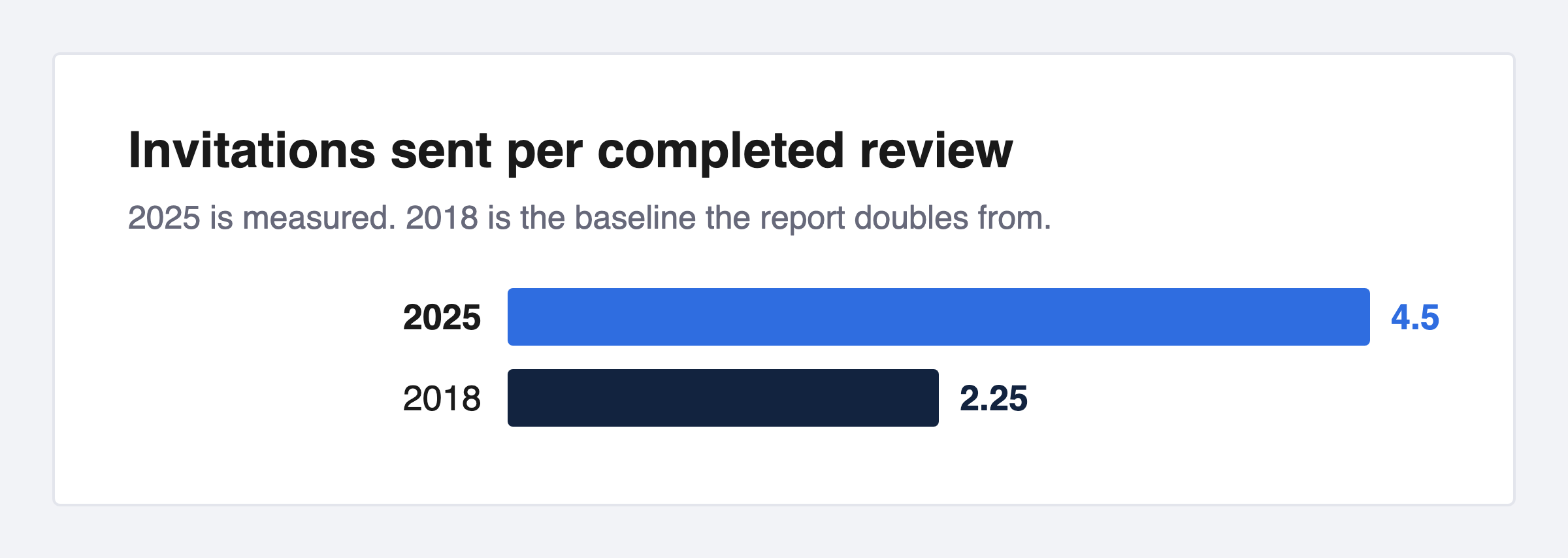
invitations an editor now sends to get one report back. It used to be half that, because the share of invited reviewers who say yes has slid from 43% to 22%. Per hundred invitations an editor sends, the report counts a combined 407 days spent waiting on people who will decline or never answer. That is the plain answer to why your paper sat for four months while nobody could tell you anything, and it is the argument for saying yes the next time one of those requests lands in your inbox.
Sources: Silverchair, 2026 Future of Peer Review report · Silverchair summary of the findings · Science, 3 Sep 2026
Corrections: Nothing to correct this week. When there is, it runs here first.
That's the week. Forward this to a labmate deciding where to submit, and if it reached you secondhand, subscribe in one tap.
Whenever it is useful: if you have a draft going, run it through the free check and see what an editor would screen for. If you are earlier than that, the Academy works the same method on whatever you have so far.
What should be in next week's issue? Reply to this email with the thing you wish someone would explain, or the deadline you nearly missed. I read every one, and the ones I can source go in with a note that you asked.
How was today's issue? Great · Fine · Meh
| Erik Founder, Manusights |
Forward to a friend
Get this every Monday
What changed in publishing, what it means for your submission, and one thing to try. Free.
Subscribe