Nearly half of authors did not fully disclose their AI use
Get Manusights Weekly free, every Monday

Oxford University Press asked 2,606 researchers what they do with AI and what they tell anyone about it. Most of them cannot say what counts as disclosable, and nearly half of journal authors left something out. Plus, The Lancet's staff strike on Tuesday, Science removes an article by someone impersonating a real journalist, and a tool that turns a paper into an agent you can question.
 | Erik Founder, Manusights |
Know someone who used an AI tool on their last manuscript and has not written a word about it? Forward this to them. Today's try-this-week gives them the sentence to write. Send it to a colleague
Whenever it is useful: if you have a draft going, run it through the free check and see what an editor would screen for. If you are earlier than that, the Academy works the same method on whatever you have so far.
📄 Papers from a single fake research network have reached clinical guidelines, policy documents and patents. Federica Silvi and Leslie McIntosh of Digital Science traced 1,975 papers whose authors listed the Pharmakon Neuroscience Network, an authorship-for-sale operation exposed in 2022, and followed where they were cited. Of those papers, 12 were cited in clinical guidelines, 57 in policy documents and 480 in patents. Of the 278 researchers involved, 90% kept publishing after the exposé. The analysis · Retraction Watch
➗ OpenAI has pulled its sponsorship of Caltech's Mathathon, Gizmodo reports, after an open letter drew 771 signatories from Caltech and the wider mathematical research community. The letter said 40 hours is not enough for real mathematics and that the verification burden would land on the community. The event still runs on 30 October. This is the same fight over credit that led last week's issue. The open letter · Gizmodo
🏛️ Researchers are suing the NIH over what their complaint calls "an ideological litmus test for NIH-funded research". The challenge, filed last week, says a text-analysis tool screened grants against a list that held at least 235 flagged terms in February, and that hundreds of grants were cut. One plaintiff says she was asked to describe gender equity research without using the words gender, equity or sexual. Inside Higher Ed
🏅 A 2015 paper by a Nobel laureate has a permanent expression of concern. Retraction Watch reports the notice and says the same researcher tops its list of Nobel winners by retractions, with 15. An expression of concern is not a retraction; it is the journal telling you to read with care while questions stay open. Retraction Watch
Nearly half of authors did not fully disclose their AI use. Most cannot tell you what counts.
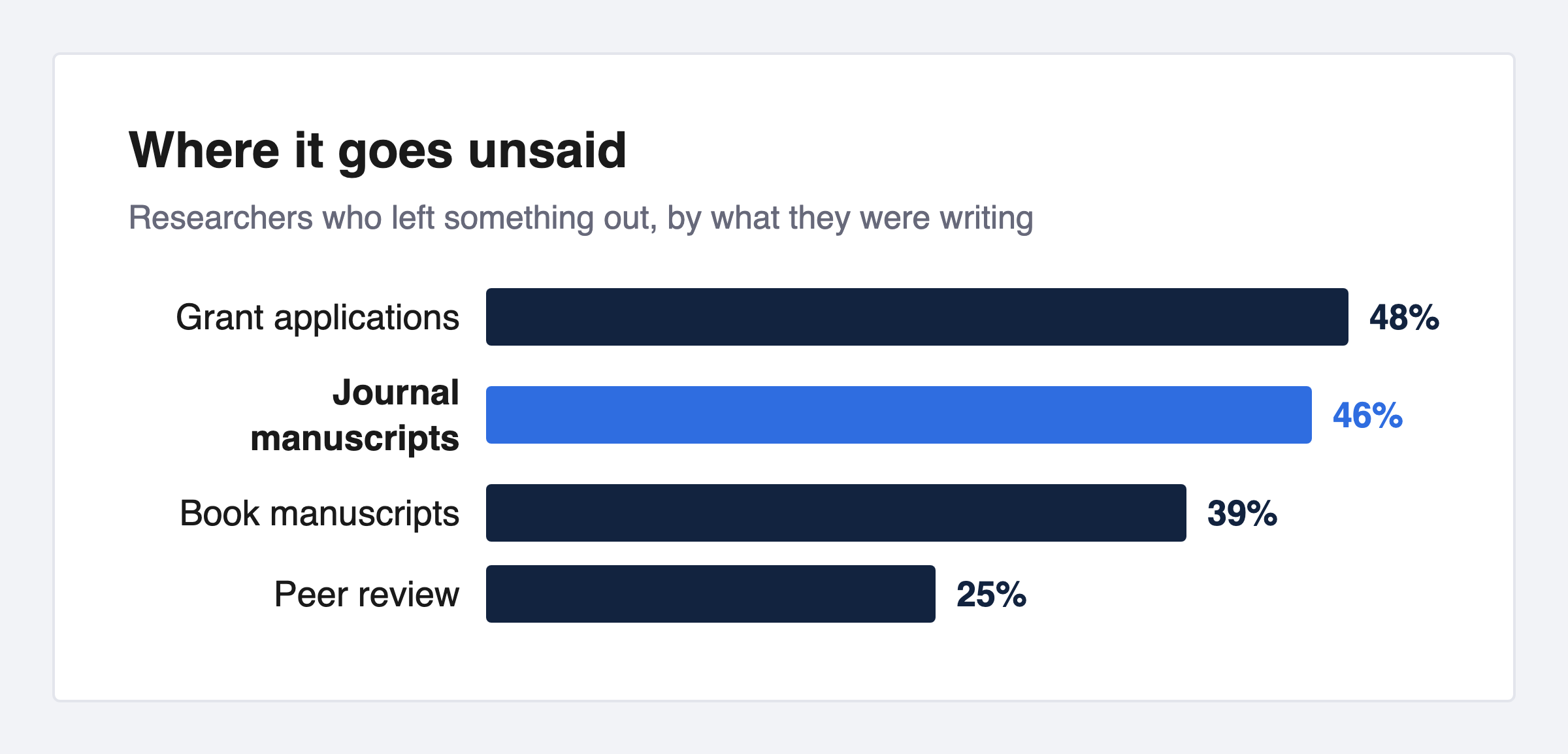
Oxford University Press surveyed 2,606 researchers in April and published the results on 10 September. Among those who use AI, just over two-thirds use chatbots on the open web, and 64% of everyone surveyed says AI benefits their research. Then the numbers turn: 74% say there is a general lack of clarity about what AI use should be disclosed, and only 36% keep any record of the AI they used while doing the work.
The gap shows up where it costs something. Over the past year, nearly half of journal authors did not fully disclose their AI use when preparing a manuscript, and the pattern holds across every kind of output the survey measured. This is not mostly people hiding a ghostwritten paper. It is people who edited a paragraph, translated a section or tidied a summary, and had no idea that counted.
The survey names the reason plainly: 44% worry that disclosing AI use will make others think less of their work. So the same researcher checks the citations an AI produced (83% do) and cross-checks its output (80% do), then writes nothing down and says nothing. OUP updated its own author and editor guidance alongside the report, which tells you which way the requirements are moving.
Why it matters: My read: the risk here is not that you used AI, it is that you cannot reconstruct what you did long after the fact, when an editor asks. So keep one line per use as you work, in the file you are already writing in: what tool, what it touched, what you changed afterwards. Then read your target journal's policy before you submit, because they differ on what needs saying. Today's try-this-week turns that log into the sentence.
Sources: Oxford University Press, 10 Sep 2026 · OUP, Disclosing AI use in academic research, Sep 2026 · Times Higher Education, 11 Sep 2026 · Research Professional News, 11 Sep 2026 · OUP, 6 min read
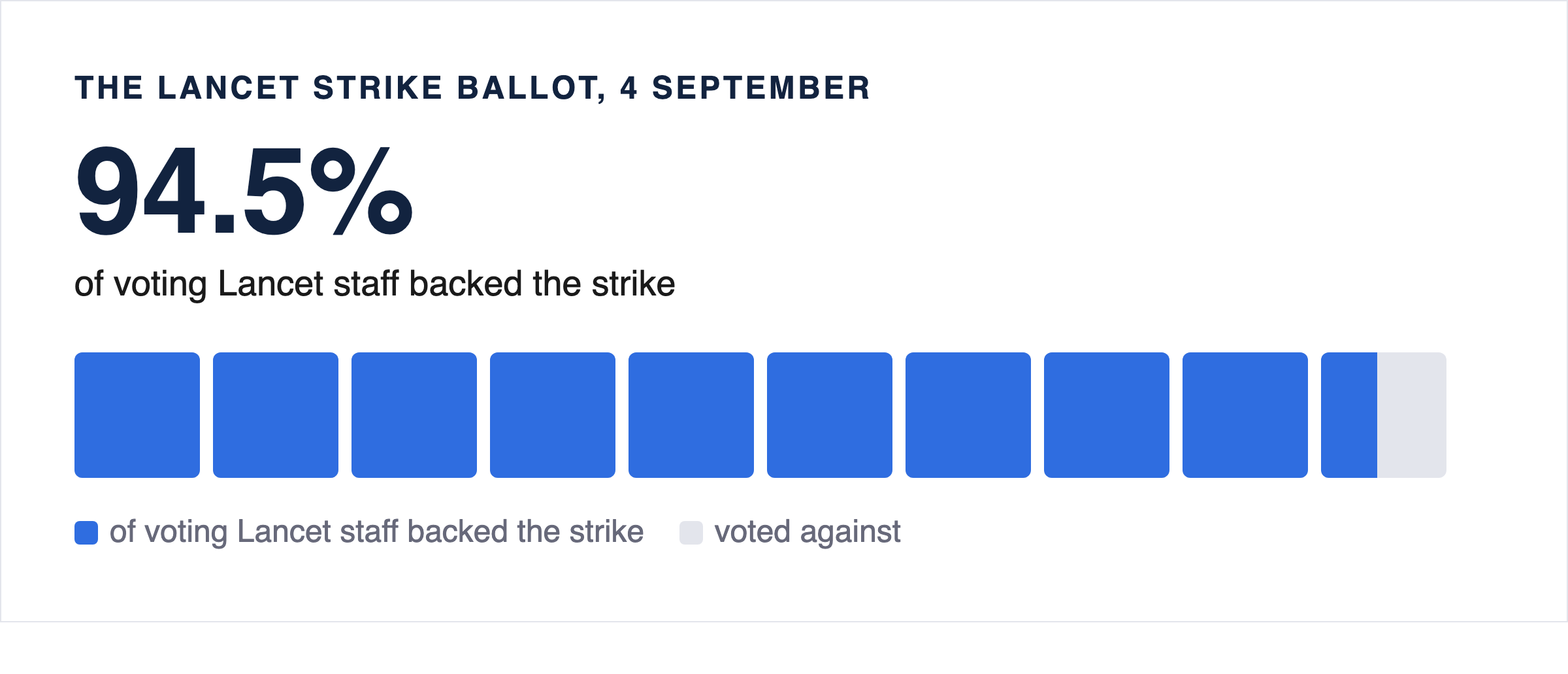
🪧 The Lancet's staff strike on Tuesday. Members of the National Union of Journalists at The Lancet, about 110 staff across several of its 30 journals, will strike for one day on 22 September and then work to rule from 23 to 30 September. The union asked for 7.5% in the first year; Elsevier countered with 4.1% for the first year and 2.9% for the second.
Why it matters: The union says it is the first strike in the journal's 200-year history. Editorial staff are the people who chase your reviewers, answer your status email and move your revision along. A week of contractual duties only is a week when nothing informal happens. Informal is how manuscripts move.
What I would do: If you have a manuscript with a Lancet journal this week, do not read silence as a decision. If a revision deadline falls inside the strike and the work-to-rule that follows it, email the editorial office now and ask for a written extension, rather than assuming one.
Reference: Retraction Watch, 16 Sep 2026
Coverage: National Union of Journalists · 2026-09-16
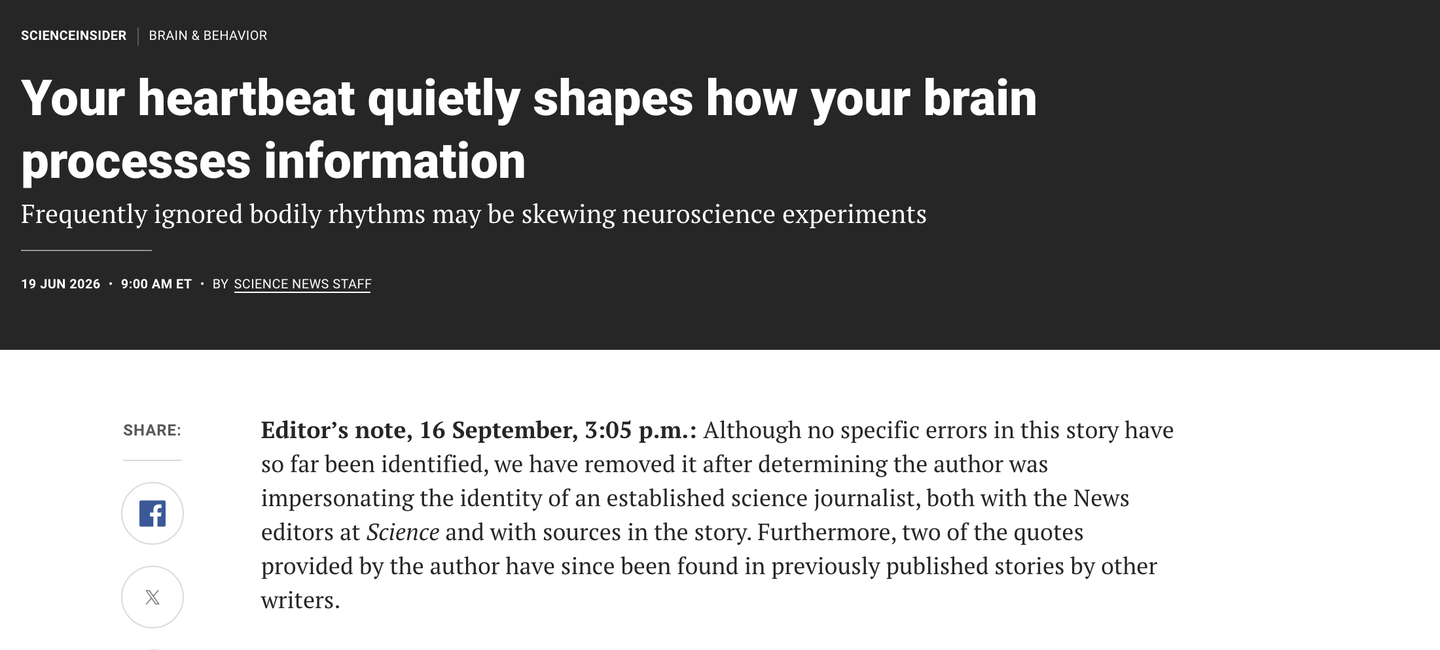
🎭 Science pulled a story after finding its author was not who they said. Science removed a news article after determining the author was impersonating the identity of an established science journalist, with its own news editors and with sources in the story. Two quotes in the piece were later found in stories published by other writers.
Why it matters: The forgery was not a fake paper or a fake reviewer. It was a fake reporter, and it cleared a professional news desk. Publishing has spent years learning to verify reviewers. Nobody verifies the reporter. The cost landed on the scientists who answered in good faith and are now quoted in a story that no longer exists.
What I would do: When a journalist you do not know asks for an interview, spend two minutes before you answer: find them on the outlet's own staff or contributor page, and reply to the address listed there rather than the one that contacted you. If you cannot find them, ask the outlet's newsroom to confirm the commission.
Reference: Retraction Watch, 19 Sep 2026
Coverage: Science, editor's note, 16 Sep 2026 · 2026-09-16
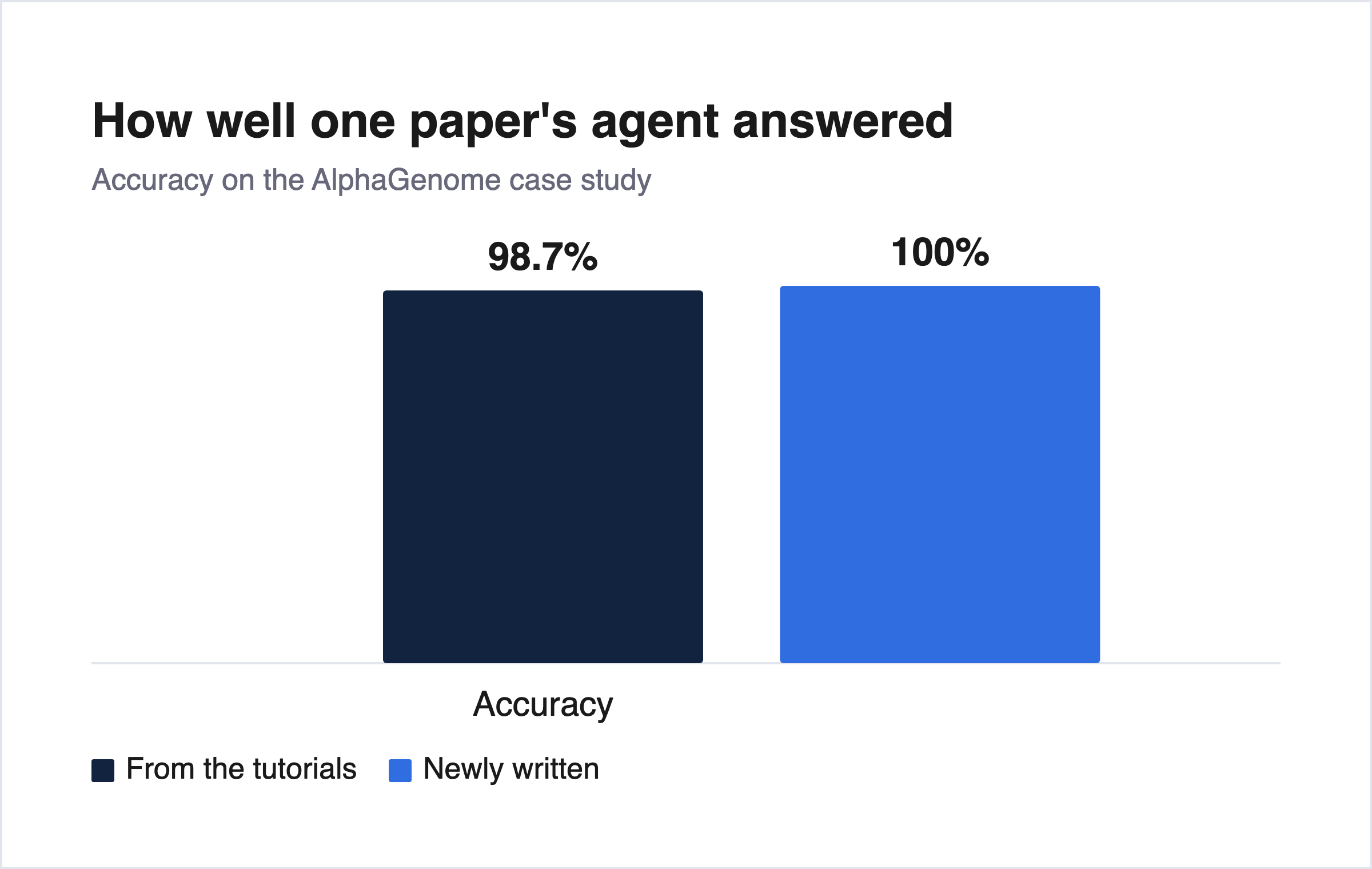
🤖 A tool that turns a paper into an agent you can question. A Nature paper published on 16 September describes Paper2Agent, which reads a paper's text, code and data and builds an agent that answers questions about the work. On the AlphaGenome paper it produced an agent in about 45 minutes for $14 of compute. Across 100 computational biology papers it succeeded on 74.
Why it matters: Look at the failures rather than the headline. The ones that did not work were mostly papers whose code or data was incomplete, which is exactly what stops a human trying to reproduce you, minus the politeness. Your repository is about to be read by software that never emails to ask which script runs first. It does not ask twice.
What I would do: Open your last paper's repository and try to run it from the README alone, in a clean folder. Fix what stops you: a missing environment file, a hard-coded path, a data file that lives only on your laptop. That is the difference between being reusable and being cited once.
Reference: Nature, 16 Sep 2026
Coverage: Nature news, 16 Sep 2026 · 2026-09-16
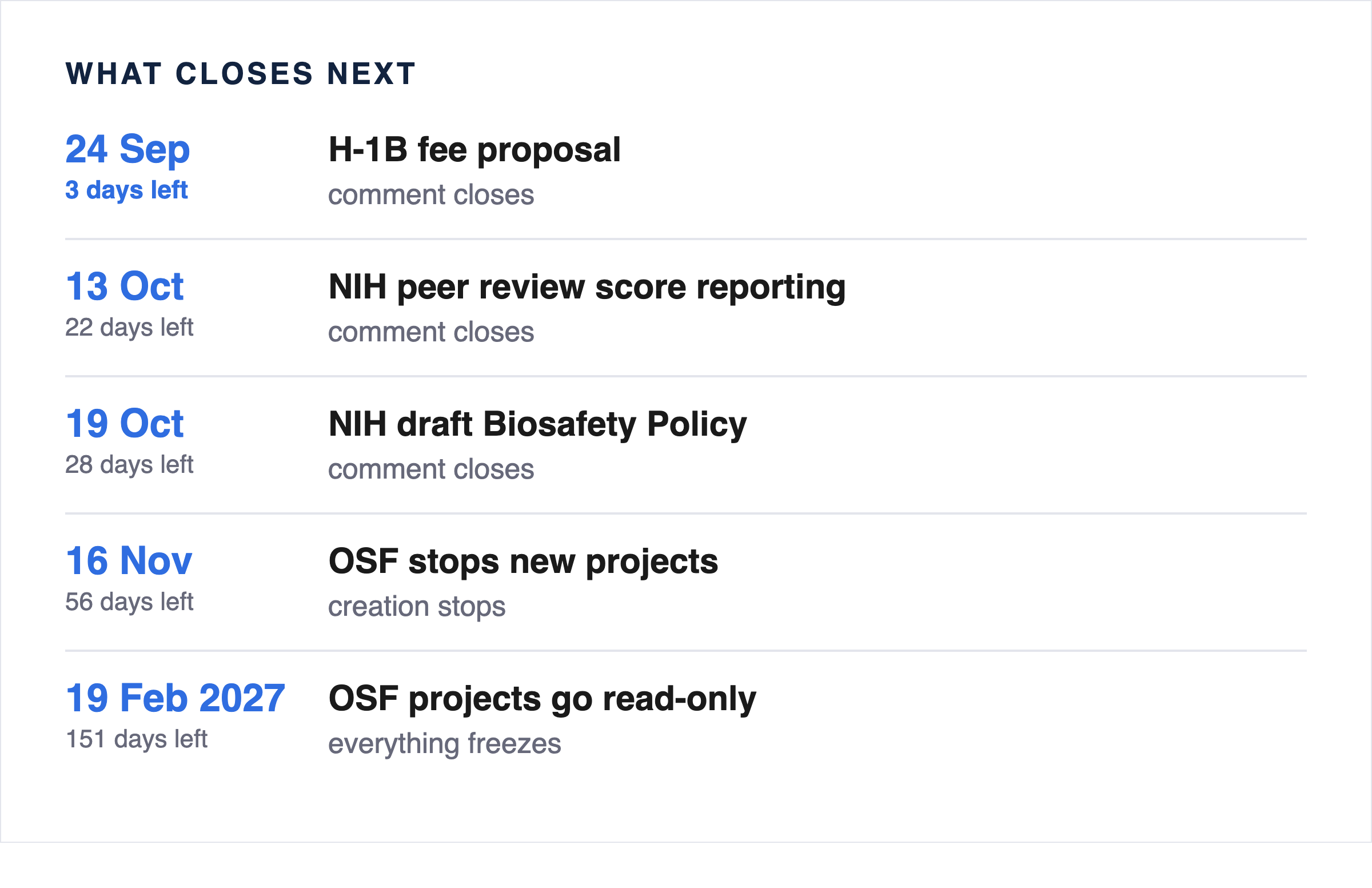
The nearest one closes this week, and it matters to any lab that hires from abroad. If yours does, that comment is the one to write this week.
The two NIH windows that follow shape how your work gets reviewed and how it has to be run, rather than whether it is funded, which is the kind of rule worth reading before you are inside it. And if any of your work lives on OSF, put both of its dates in the calendar now: one stops you starting anything new there, the other freezes what you already have. Moving a project after the freeze is a weekend you will not get back.
Open the manuscript you are closest to submitting and write two things. First, a short log: every AI tool you used on it, what it touched (literature search, drafting, translation, editing, code, figures) and what you changed afterwards. Second, the sentence you would put in the paper. Then check it against the journal's policy, because they differ: some want a statement only for drafting and editing, others want every use. If your log is empty, write that you used none, and you are done. The point is to write it now, while you still remember, instead of reconstructing it under an editor's deadline.
papers from a single authorship-for-sale network that were cited in clinical guidelines, out of 1,975 traced in one analysis. Another 57 of them were cited in policy documents and 480 in patents. Fake work does not stay in the journals it was sold to.
Sources: Silvi and McIntosh, arXiv, 31 Aug 2026 · Retraction Watch, 17 Sep 2026
Corrections: None this week. Spot an error? Reply and we will run the correction right here, loudly.
That's the week. Forward this to a labmate deciding where to submit, and if it reached you secondhand, subscribe in one tap.
What do you want more of? Reply to this email and tell me. I read every reply.
How was today's issue? Great · Fine · Meh
| Erik Founder, Manusights |
Forward to a friend
Get this every Monday
What changed in publishing, what it means for your submission, and one thing to try. Free.