PubMed hasn't added a Scientific Reports paper since September
Get Manusights Weekly free, every Monday

Good morning. PubMed has quietly stopped adding papers from one of the biggest journals in science, a diabetes journal's editors have put down their pens, and India is about to get a key to Europe's research money. A quick read, then back to the bench.
One tap: has PubMed indexing ever decided which journal you sent a paper to? Yes · No · I never checked. Tap one, then press send. I will share the answers next week.
 | Erik Founder, Manusights |
Yesterday we launched Manusights on Product Hunt. It reads your draft before you submit and flags what reviewers are likely to question. Run the free check on a paper you are about to send, or, with no paper handy, try the free reference checker. Then tell us honestly on our Product Hunt page what worked and what did not. Start from that page and your first review is 25% off through November 16.
PubMed hasn't added a Scientific Reports paper since September
For: Anyone thinking of submitting to Scientific Reports, in any field
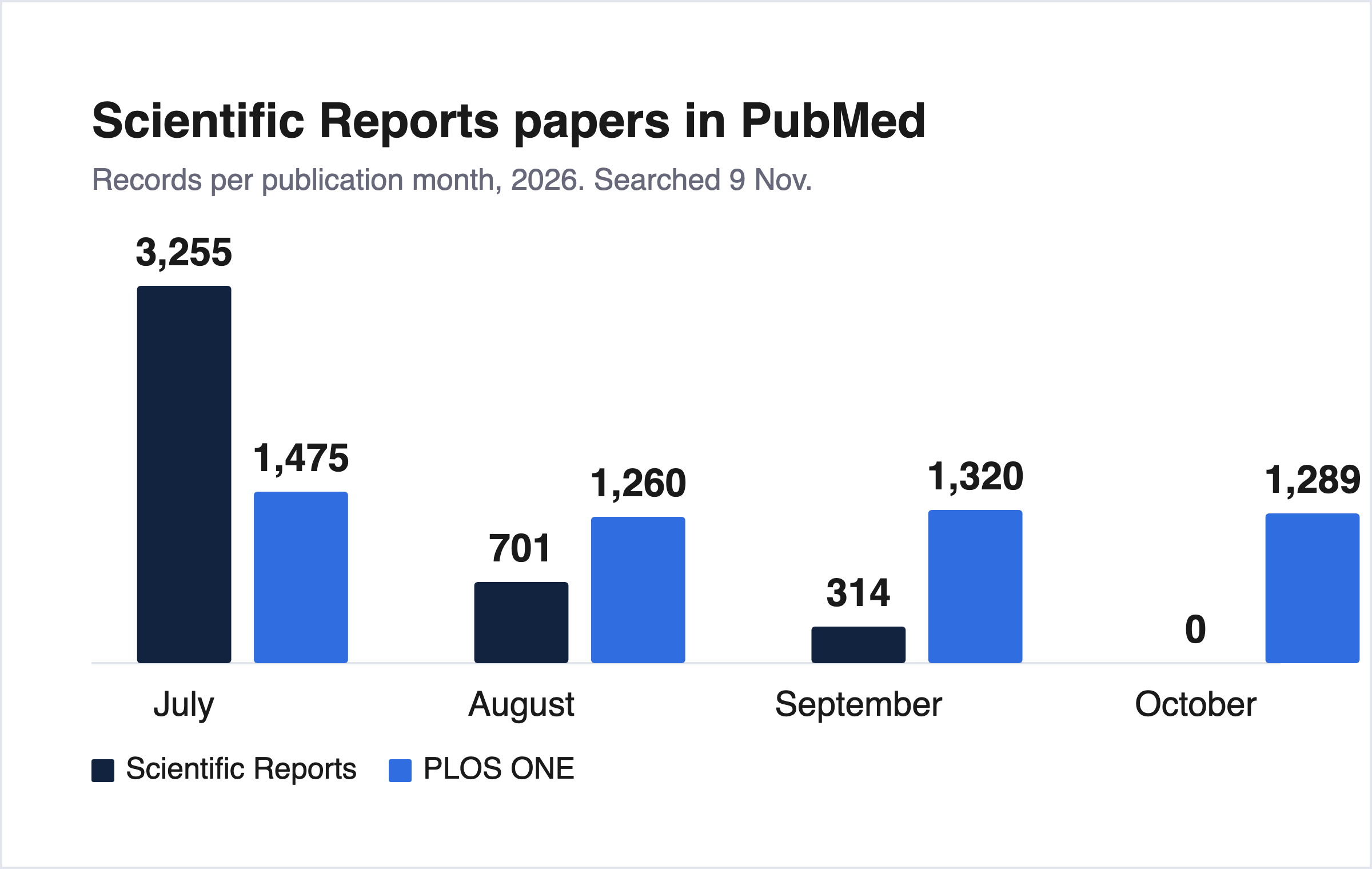
Scientific Reports describes itself as "the 2nd most-cited journal in the world". Since September, PubMed has not added a single one of its new papers.
What happened. The US National Library of Medicine has put the journal on hold in MEDLINE while it re-evaluates it, according to an email from the journal's chief editor reported by Retraction Watch on 30 October. Archiving in PubMed Central is paused too. NLM has not said why, and its catalogue still lists the journal as currently indexed. Our own PubMed search shows the drop month by month.
At least one library has noticed. On 2 November, Rockefeller University's library posted this warning for its researchers.

How it ends. NLM says a re-evaluation can typically take around 7 to 10 months. If the journal passes, every article published during the hold gets indexed. If it fails, none of them do, and NLM's decision is final.
My read: this is not a verdict on anyone's paper. It is a timing bet, and you would be placing it with your own CV.
Do this today: If you need a paper in PubMed or PubMed Central within a year, for a grant report, NIH public access or a promotion file, pick another journal for now, or get the editorial office's plan for the PubMed Central deposit in writing before you submit.
Reference: Retraction Watch, Scientific Reports on hold in PubMed while National Library of Medicine reevaluates journal, 30 Oct 2026 · National Library of Medicine, MEDLINE policies · Scientific Reports · 2 min
Coverage: Rockefeller University Markus Library, Scientific Reports under review by NLM, 2 Nov 2026
Forward this to a colleague with a paper headed to Scientific Reports. Send it to a colleague
Congress flipped. Your grant still hangs on 11 December
For: Researchers on US grants, and their collaborators abroad
Democrats won both chambers of Congress on 3 November, and the new majorities take charge on 3 January 2027. Before anyone drafts a wish list: Nature reports that a real increase in science funding, rather than holding it steady, is doubtful. Senator Susan Collins, who had protected science budgets, lost her re-election bid but remains chair of Senate Appropriations in the lame-duck session.
The date that matters sooner is 11 December, when the stopgap law funding the government runs out, with a shutdown likely if Congress does not act. "We still have some business for the remainder of this year," said Kei Koizumi, a science policy researcher at George Washington University.
Why it matters: Until then NIH runs at its 2026 level, may issue continuing awards below the amount on your last Notice of Award, and cannot implement the revised federal grant rules.
What I would do: Budget 2027 as flat, not rising. If a continuing award comes in low, keep both notices: NIH says it will consider raising awards once full-year funding passes.
Reference: NIH, NOT-OD-26-131, 28 Sep 2026
Coverage: AIP FYI, Science Policy Faces a Post-Election Shake-Up in Congress, 6 Nov 2026 · Nature, 4 Nov 2026 · 3 Nov 2026
India is about to get a key to Europe's research money
For: Researchers in India, and anyone in Europe who wants Indian partners
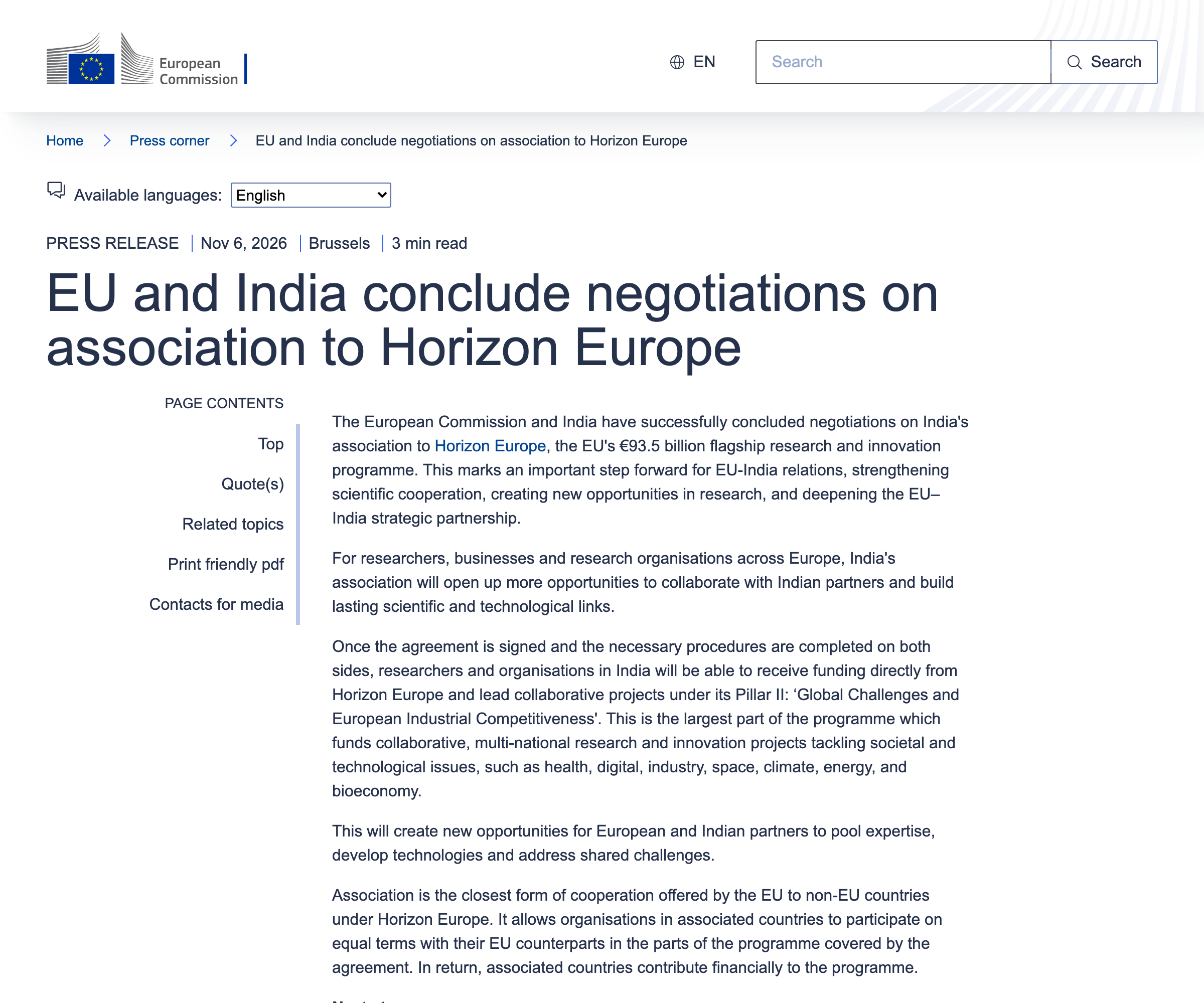
Once the agreement is signed, researchers in India will be able to take funding directly from the EU's €93.5 billion programme and lead projects in its largest part, Pillar II, which covers health, digital, industry, space, climate, energy and bioeconomy. Association is envisaged for January 2027.
Meanwhile Europe is arguing over the next pot. On 10 November, the European Parliament's research committee votes on the programme that follows. The committee's compromise asks for €200 billion, against €158.2 billion proposed by Ireland, which holds the presidency of the Council of EU governments. The full Parliament still has to back its position.
Why it matters: For researchers in India, this moves you from unfunded partner to funded lead. For everyone else, the size of the next programme, which starts in 2028, decides how many grants there will be.
What I would do: If you work in India in health or climate research, find a European partner now for the 2027 calls. In Europe, nothing changes for calls already open.
Sources: European Commission, IP/26/2334, 6 Nov 2026 · European Parliament, ITRE committee highlights · Times Higher Education, 9 Nov 2026
A university had a professor's name taken off his own paper
For: Anyone in the US with coauthors in China, and their collaborators
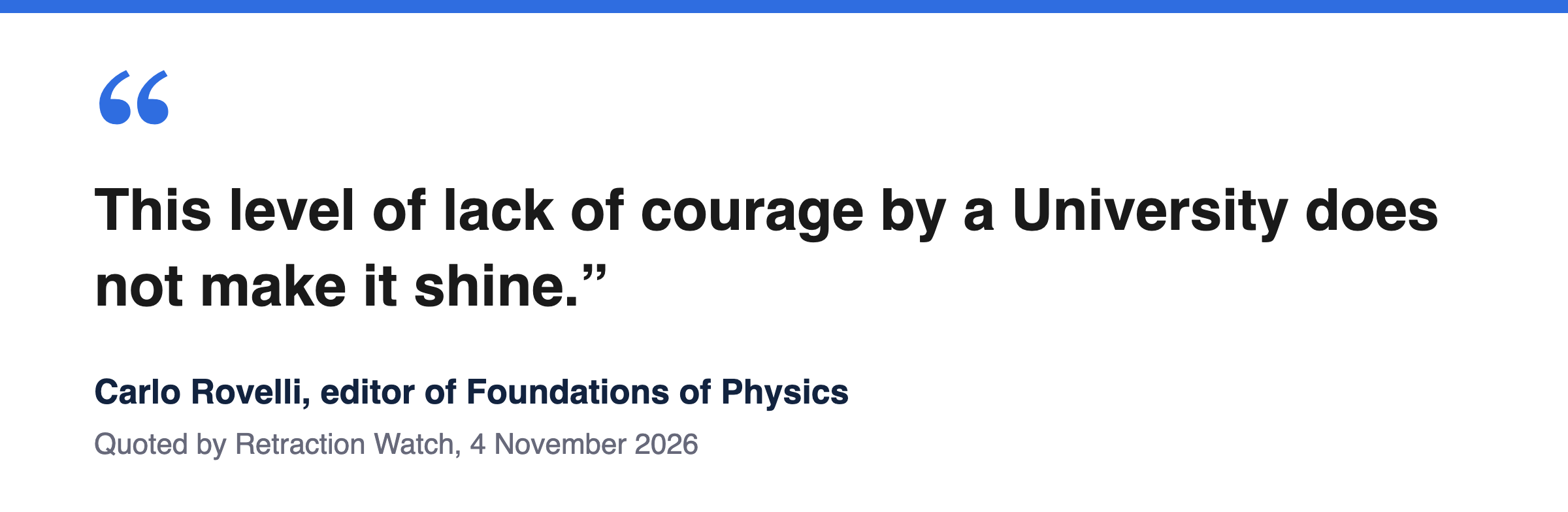
Idaho State University asked the journal Foundations of Physics to remove mathematician Emanuele Zappala, the senior author, from an accepted paper, and the journal did. The reason: a coauthor works at Fudan University, which the US Department of Defense added to its Section 1286 list in July, and the university says it does not allow its researchers to co-publish with collaborators from listed institutions. The journal's editor was not impressed.
Why it matters: The university says it acted out of "an abundance of caution". Rules like this vary by institution, so you may not know whether yours has one.
What I would do: Before your next paper with a coauthor in China, ask your research-security office whether your institution limits co-publishing with 1286-listed institutions.
Reference: Retraction Watch, 4 Nov 2026
A diabetes journal's editors put down their pens. About 400 papers are waiting

For: Anyone with a paper at, or headed to, Diabetes Care
It started in June, when five attendees at the American Diabetes Association's Scientific Sessions were ejected for handing out copies of a Diabetes Care editorial on NIH funding cuts. One of them was the journal's editor-in-chief, Steven Kahn. In September the editors stopped handling new papers, and new submissions have sat unhandled since.
On 6 November, the association's top publishing executive resigned in protest at how it has handled the boycott, including its plan for an interim editorial team. The association says his letter does not accurately reflect the qualifications of the people involved.
Why it matters: If your paper is in that pile, it may not be moving at all.
What I would do: Email the editorial office and ask who is handling your manuscript and when. If you are about to submit, weigh another journal until this is settled.
Reference: Retraction Watch, 7 Nov 2026 · 6 Nov 2026
Your library's free publishing money is running out for 2026
For: Anyone with a paper accepted in November or December
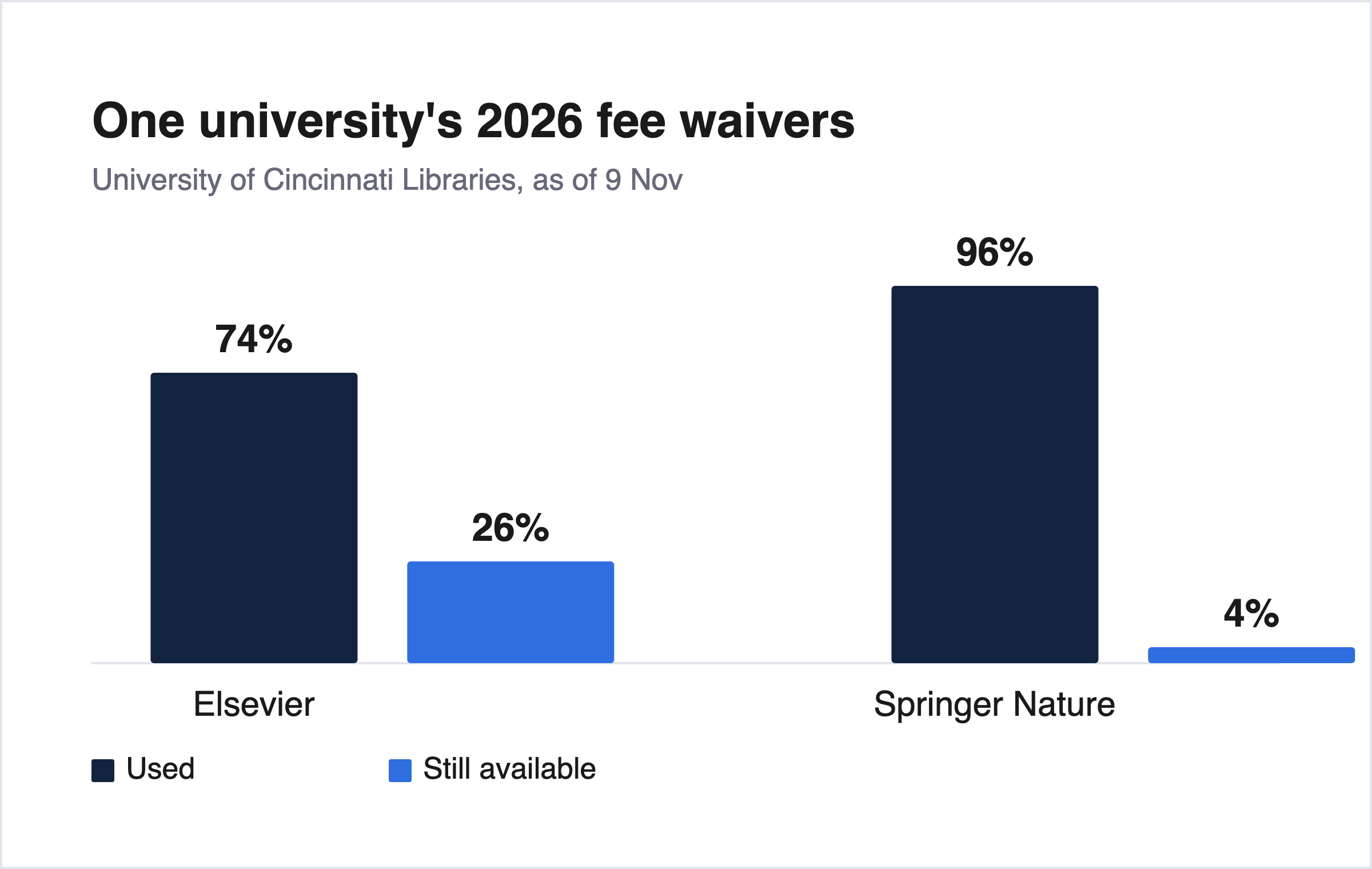
Many universities pay open-access fees through yearly publisher deals, and by November the money runs low. At the University of Cincinnati, the Wiley deal is already closed for the year. In the Netherlands, Utrecht University says the national deal with Emerald has hit its cap. In the UK, Wiley expects the shared national fund for its fully open-access journals to be fully allocated by November, with money back from January 2027.
Why it matters: In some deals, the date that decides it is the day you sign the publication agreement.
What I would do: If your paper is accepted now, ask your library today whether the deal still has room, and whether signing in January would get you the waiver.
Sources: University of Cincinnati Libraries, Open Access APC discounts · Utrecht University, 2 Nov 2026 · Loughborough University Library, 7 Oct 2026 · 9 Nov 2026
Pay reviewers £220 and they get fast. Pay them $250 and maybe not
For: Authors who care how long review takes, and editors
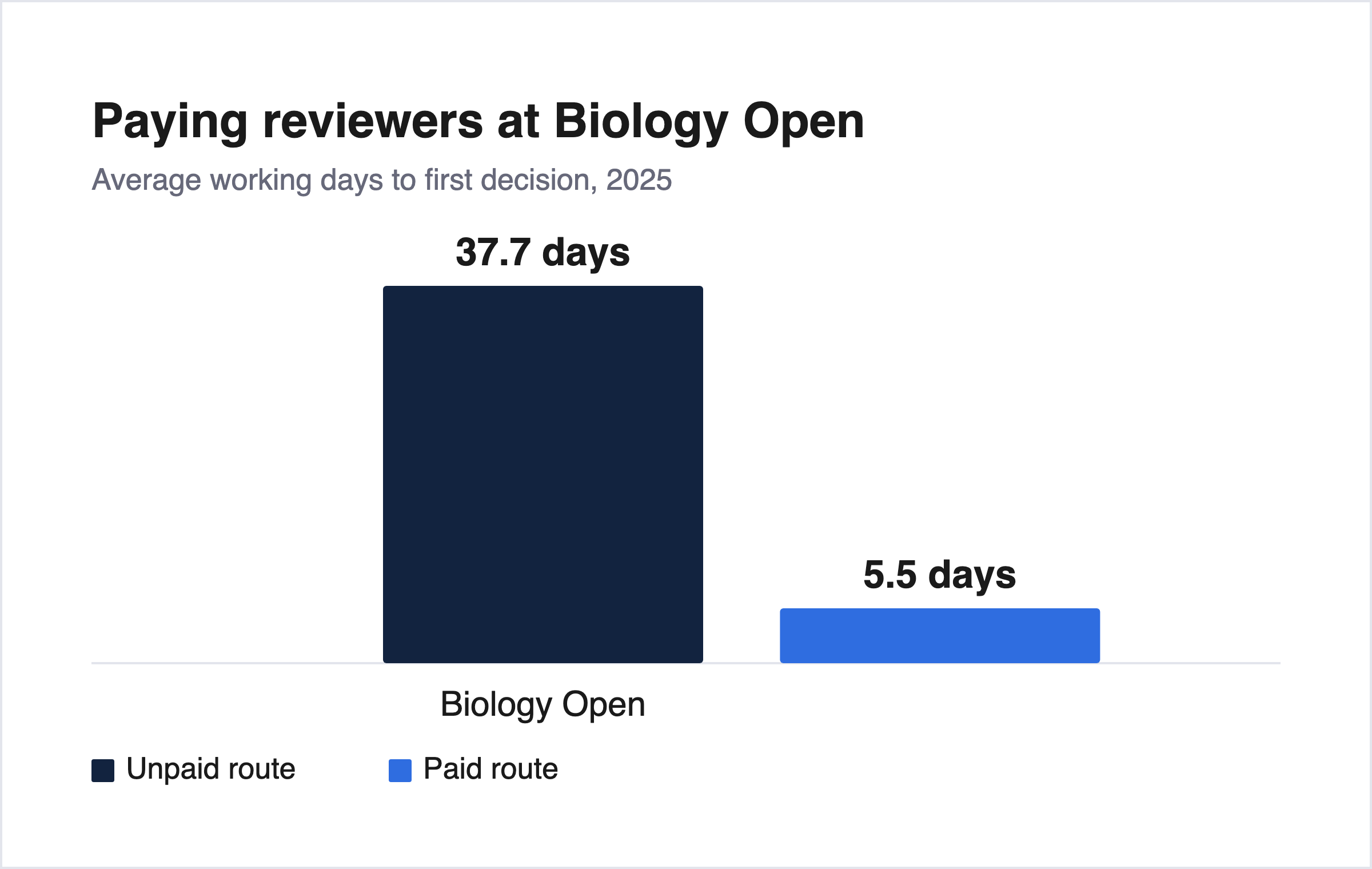
One journal has paid reviewers £220 per manuscript since 2024, and its paid route is now far faster than its free one. Another tried $250: at Critical Care Medicine, 50% of the invitations that offered the money produced a report within two weeks, against 42% without, and paid reviewers were just one day faster on average. "It didn't move the needle too much," said David Maslove, an editor there.
Why it matters: Similar money bought very different results at the two journals.
What I would do: Before you submit, look up the journal's median time to first decision. If it is not published, ask the editor.
Sources: Nature, 6 Nov 2026
🔢 Number of the week · 62,000. Abstracts submitted to the AI conference ICLR 2027 surpassed 62,000, triple the 19,500 the year before, and organisers cut the number sent for peer review. Expect desk rejections on clarity alone to spread: a readable first page now matters. THE
🤖 Anyone searching for AI funding in the US · The White House has told US agencies to stop saying "AI". Under Executive Order 14434, they are to use "Super Intelligence" and "SI" instead in official documents and websites, to the maximum extent permitted by law. The order covers agency documents, not your proposal, but search for "SI" too. White House
💶 Founders in Europe · The European Innovation Council put €1.8 billion on the table for 2027 and doubled Women TechEU grants to €150,000 per start-up. It is the last package under the current programme. European Commission
🌍 Researchers in lower-income countries · 73% of researchers surveyed in low- and middle-income countries say publishing fees are the main influence on where they publish, and only 48% have ever benefited from a waiver or discount. Check whether your journal honours Research4Life waivers before you submit. Elsevier
👪 Parents in academia · In a survey of more than 10,000 parent academics, the only task men consistently did more of than women was coaching their child's sports team. Women used flexible working to take on more parenting. Nature
Which one was most useful to you today? Tap it, then press send.
16 November: OSF stops new projects. Move ongoing work to Zenodo or your institution's repository.
19 November: applications close for NIH's Loan Repayment Programs for researchers outside NIH, up to $50,000 a year of educational debt.
30 November: ICMR's First in World Challenge grants close.
11 December: the US stopgap funding law expires.
6 January: comments close on NIH's draft safety monitoring policy.
Where to act: OSF changes (16 Nov) · NIH Loan Repayment Programs (19 Nov) · ICMR calls for proposals (30 Nov) · NIH, NOT-OD-26-131 (11 Dec) · NIH, NOT-OD-27-006 comments (6 Jan)
Corrections: None this week. Last week I asked whether you would want an AI assistant helping the reviewers of your next paper. Three of you said yes, one said only to check facts and figures, and nobody said no. Spot an error? Reply and we will run the correction right here, loudly.
That's the week. Forward this to a labmate with a paper headed to Scientific Reports, and if it reached you secondhand, subscribe here.
| Erik Founder, Manusights |
You're getting this because you subscribed at manusights.com or uploaded a manuscript for review.
Forward to a friend
Get this every Monday
What changed in publishing, what it means for your submission, and one thing to try. Free.