Sham academies are electing real scientists
Get Manusights Weekly free, every Monday

A Columbia computer scientist was elected to three academies she had never heard of, and her university announced it. Nature traced dozens of societies like them; I have added the checks I would run before accepting an honour from one. Plus, an Elsevier journal retracts 165 papers, most over authorship changes or editors with ties to the authors, and PubMed starts showing the papers most closely related to a research abstract.
 | Erik Founder, Manusights |
Forward this to whoever writes your department's news posts. More than 30 university press releases have already celebrated honours from two of these academies. Send it to a colleague
Whenever it is useful: if you have a draft going, run it through the free check and see what an editor would screen for. If you are earlier than that, the Academy works the same method on whatever you have so far.
💸 Hundreds of journals that were free to publish in now charge. An analysis found 440 journals that launched with no fees for authors or readers and changed model between 2009 and 2026: 369 now charge authors a fee to publish, 52 went hybrid and 19 went behind a paywall. The fees they began charging ran from US$8 to $5,300. Check the fee when you submit, and again when you are accepted. Nature
🤖 A UKRI-funded call used AI to triage 179 grant proposals. Rejected applicants to a cybersecurity pilot hosted at the University of Oxford were told by email that several AI models had judged the proposals against seven criteria. If a call lists its criteria, answer each one in so many words, because the first reader may be a model looking for them. Times Higher Education
📝 Reviewers told not to use a chatbot said they used one anyway. ICML 2026, a machine-learning conference, put some of its reviewers under a ban on language models. In an anonymous survey, 22.5% of those under the ban who responded said they had used one anyway, and the policy made almost no difference to decisions or scores. Assume a model reads your manuscript, whatever the journal's rules say. arXiv
📄 Six citations to publications that do not exist, all added after the first round of peer review, got a paper retracted. Disability Studies Quarterly now requires a working DOI link for every citation that has one. If you add references during revision, open each one before you resubmit. Retraction Watch
Sham academies are electing real scientists. Their universities are announcing it.

In July, a computer scientist at Columbia University was elected to the European Academy of Engineering. Its website billed it as the "premier institution representing the highest professional distinction in engineering", with 35 Nobel laureates among its more than 400 elected members. Days earlier she had been elected to an Austrian Academy of Engineering, and in 2025 to a National Academy of Artificial Intelligence, which made three international honours in quick succession. Columbia published an announcement, and congratulations came in.
Then someone from the European academy's secretariat offered to nominate her as its rotating chair, paid US$2,000 a year. When she checked its website, her name was already at the top of the leadership list, for a post she had never agreed to take. She had never been asked for references or attended a meeting, and she had never heard of any of these organizations.
Looking into dozens of societies with similar features, Nature found:
- high-profile scientists listed as members and leaders without their knowledge or consent
- names and acronyms that resemble established organizations, and in some cases text plagiarized from them
- addresses that mask where the societies operate
- doctored photos: the European academy's building on Google Maps is an altered image of the University of Gothenburg's main building
The websites of the European and artificial-intelligence academies claim to work with the NAS, the Royal Academy of Engineering and the American Meteorological Society. Most of the organizations Nature asked said they had no knowledge of it; the rest have not yet replied.
The aim, an educational-policy specialist told Nature, seems to be to build a facade of legitimacy and then sell memberships and awards to early-career researchers, particularly in China. Nature identified dozens of researchers in China and Pakistan listing fellowships and awards from these societies on their CVs. It has not found anyone who admits paying for such a title, but the artificial-intelligence academy lists membership dues of up to $600 on its website, along with a virtual PhD programme for $10,000. More than 30 press releases from leading universities, Columbia among them, have celebrated faculty members' achievements at the two academies.
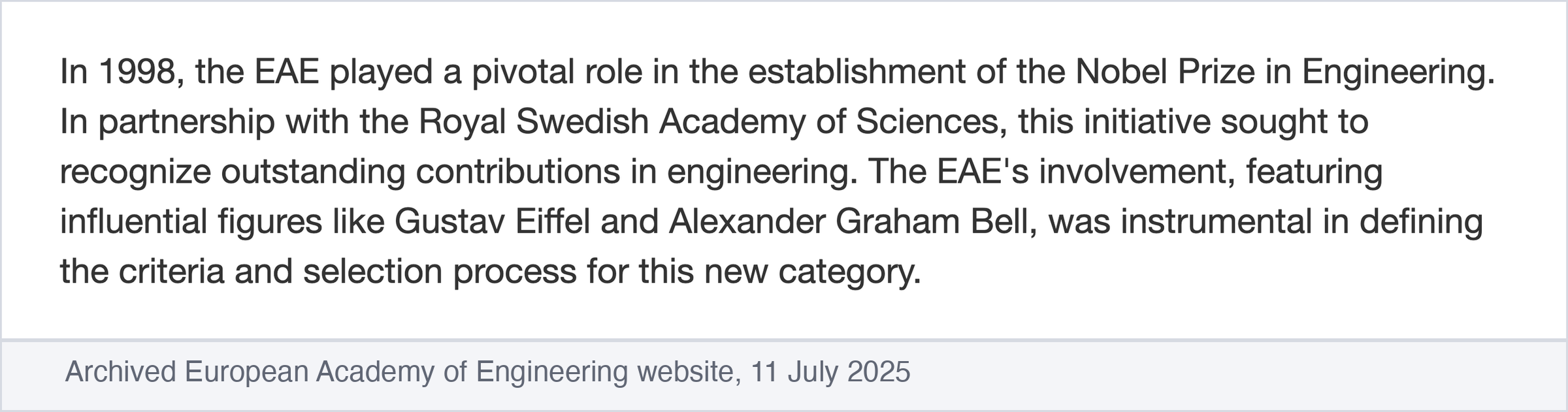
An archived copy of the European academy's own website went further. It said the academy "played a pivotal role in the establishment of the Nobel Prize in Engineering" in 1998, with "influential figures like Gustav Eiffel and Alexander Graham Bell". (There is no Nobel Prize in Engineering. Eiffel died in 1923 and Bell in 1922, so neither was around to help.)
Why it matters: Your name is what a scheme like this is after. A real scientist on the member list, and a university press release announcing it, are what make the next early-career researcher's dues look safe to pay. If you accept, the honour becomes a line on your CV, and your department's announcement a page that anyone can look up. So check an honour you never applied for, from a body you had never heard of, before you reply and before anyone announces it.
Sources: Nature, 25 Sep 2026 (10 min read) · European Academy of Engineering homepage, archived 4 Dec 2025 · European Academy of Engineering website, archived 11 Jul 2025
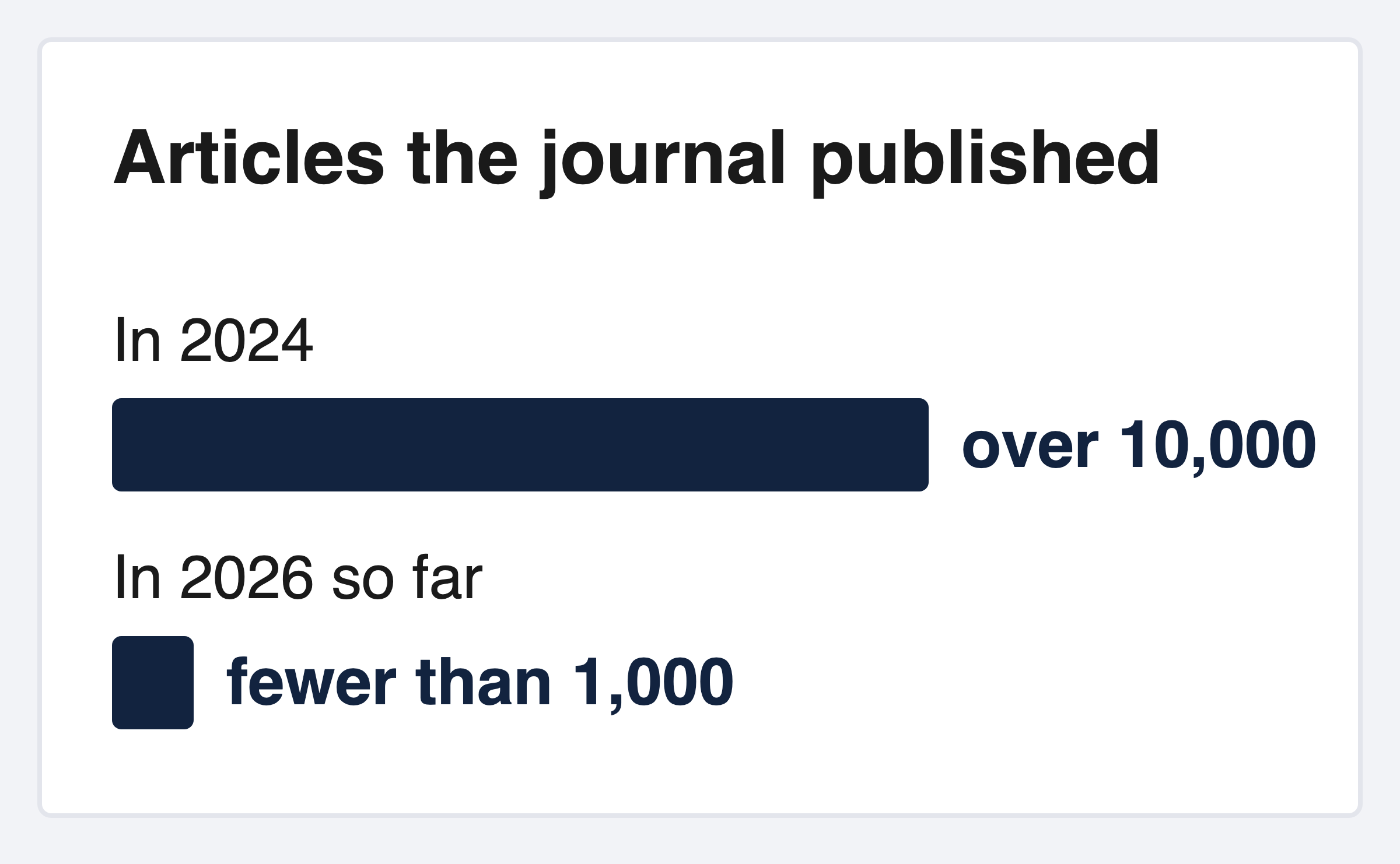
Chart: Manusights, from Retraction Watch's figures, 22 Sep 2026
🧾 An Elsevier journal retracted 165 papers, most over authorship or editor ties. Science of the Total Environment has retracted 165 papers this year, most of them in August, on articles published from 2018 to 2025. At least 50 went through associate editors with an ongoing or extensive record of collaboration with the authors. Other notices cite authors added or removed between submission and publication without the editors' approval. Web of Science stopped listing the journal last November.
Why it matters: Neither of those feels like misconduct from the author's chair, and both can take a paper down years later. An author list that changes during revision without the editors' approval can indicate paper-mill activity, Retraction Watch notes.
What I would do: If your author list changes after you submit, for any reason, ask the editor in writing and keep the reply. And if anyone on the journal's editorial board has published with you, say so when you submit.
Reference: Retraction Watch, 22 Sep 2026
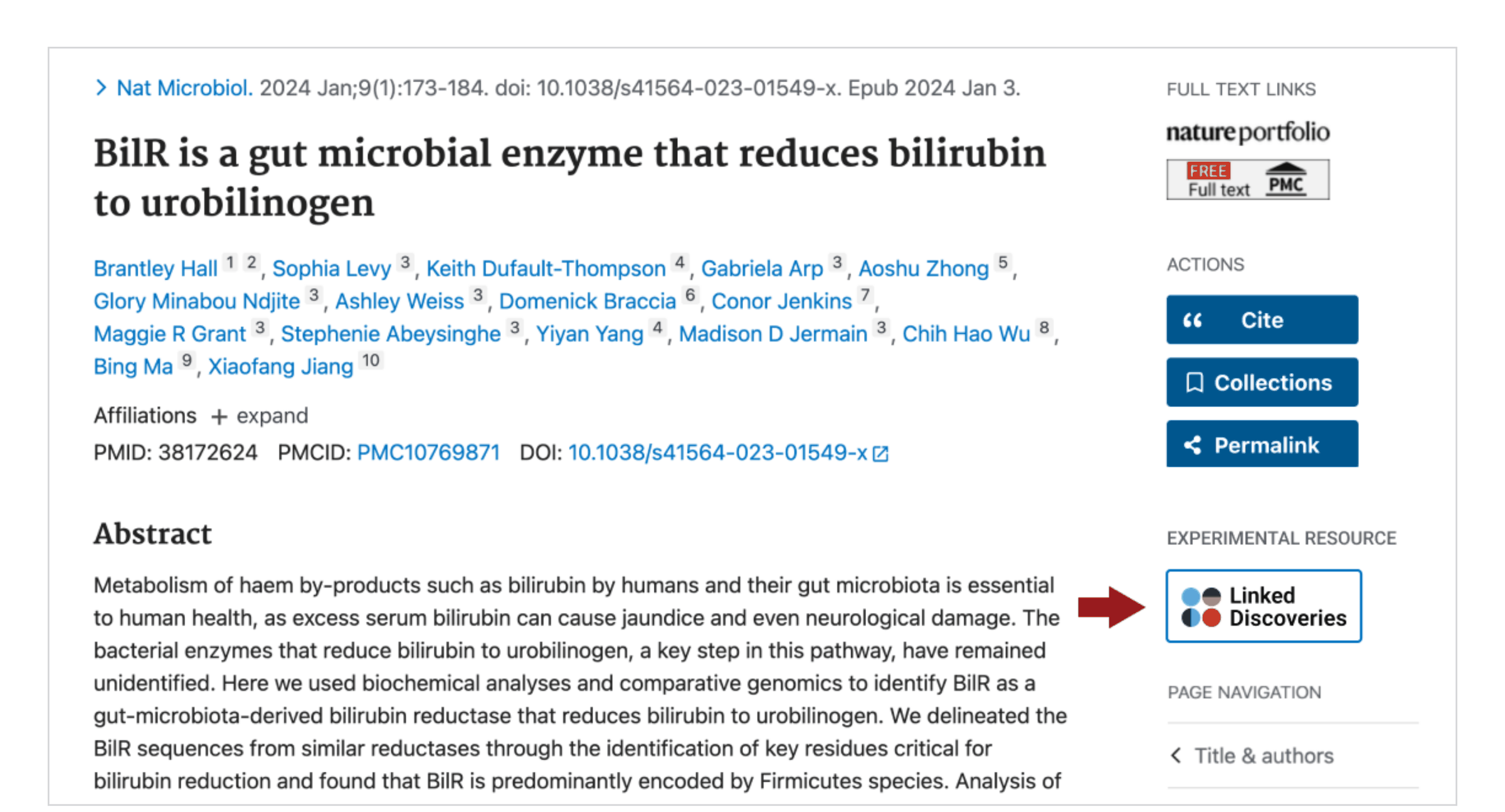
Screenshot: National Library of Medicine, Linked Discoveries user guide
🔗 PubMed now maps the papers related to a research abstract. The National Library of Medicine has added Linked Discoveries to PubMed, an experimental tool that places a paper among the articles most closely related to it and highlights the conditions, genes and chemicals they share, along with context such as NIH funding. It judges relatedness from titles, abstracts and keywords, using a language model trained on biomedical text.
Why it matters: It is part of NIH's push on replication and reproducibility, and the part you can use today. Because it gathers the closest related studies around a paper, one that complicates a finding can sit a click away from it, although the tool will not tell you whether a result has been replicated. A reviewer can open the same page for your paper that you can.
What I would do: Before you cite a finding as settled, open its Linked Discoveries page and read the closest recent papers. Then do the same for your own most-cited paper, and know what sits next to it before a reviewer tells you.
Reference: National Library of Medicine, Linked Discoveries user guide, 24 Sep 2026
Which story was most useful to you this week? Tap one to vote.
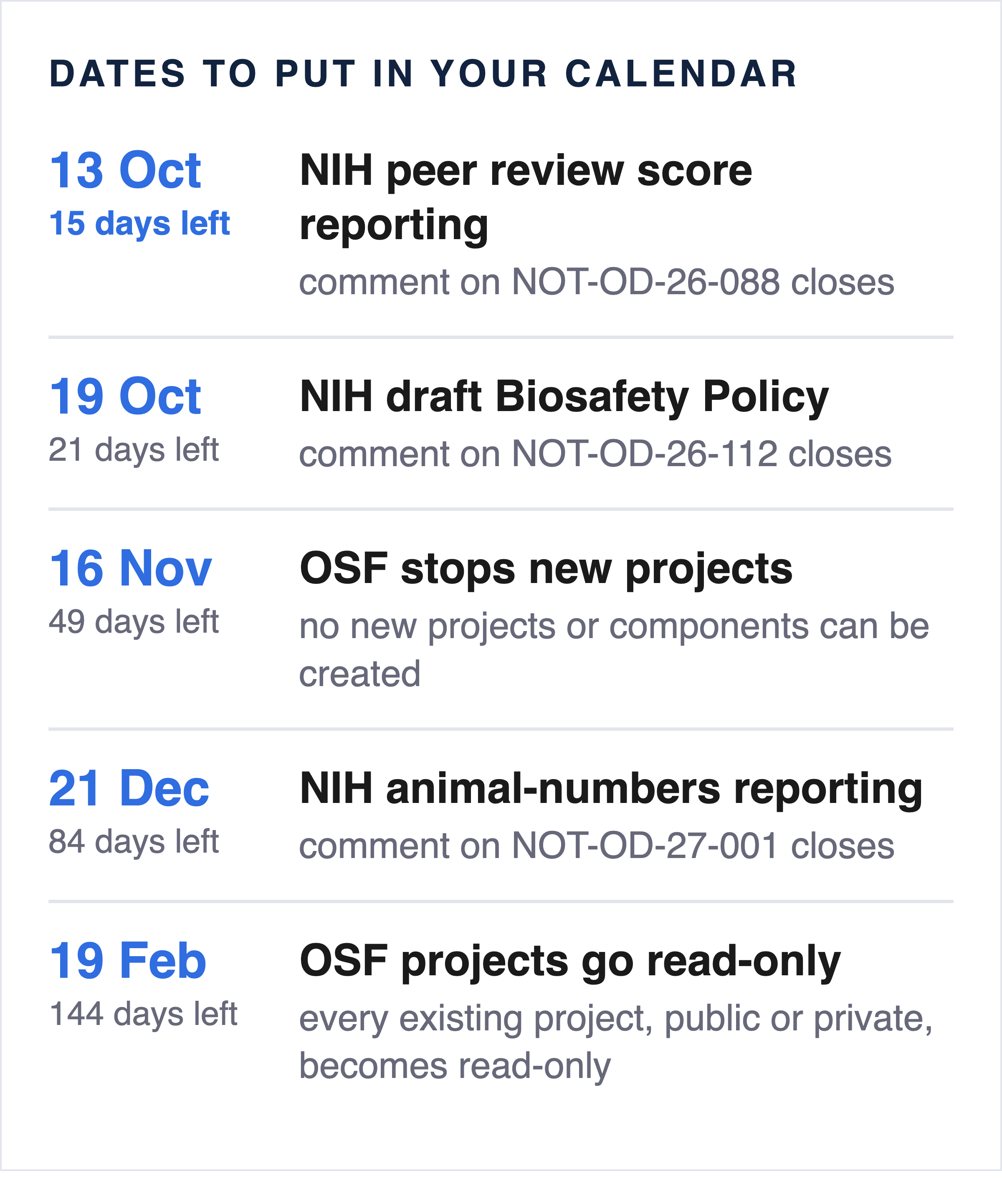
Two NIH comment windows close in October, both on proposals rather than final rules. The first would change what reviewers' scores tell the people who make award decisions, so it bears directly on funding.
New on the card this week: NIH is asking whether institutions could report, every year, how many live vertebrate animals they use, with pain and distress categories, in reports that would be made public. If your lab works with animals, those numbers start with you, so it is worth weighing in while it is still a question.
Where to act: NIH score reporting, NOT-OD-26-088 (13 Oct) · NIH biosafety policy, NOT-OD-26-112 (19 Oct) · OSF changes (16 Nov and 19 Feb) · NIH animal numbers, NOT-OD-27-001 (21 Dec)
If an election, fellowship or award arrives that you did not apply for, from a body you had not heard of, check it before you reply and before your department announces it. A few simple checks were enough for the University of Michigan's director of faculty honorifics to warn colleagues off one in July, and Nature's reporting adds the rest. None of them proves anything on its own, but a real academy should have easy answers to all of them.
- Look for the body anywhere but its own website: an entry in a public register, independent coverage, a mention in the biographies of the famous members it lists.
- Ask one listed member, at their university address, whether they know they are a member.
- Check each partner it claims, on that partner's own website or by asking it.
- Look up the address it gives; a virtual mailbox where a headquarters should be is a warning sign.
- If dues, a fee or a paid role come up before anyone has asked for your references, stop.
of submissions to TMLR, a machine-learning journal, are now rejected without being sent out for review, up from 6% in 2023, its editor says. The editor tried to interview 10 authors of papers marked for rejection; of the seven reached, three could not answer basic questions about their own work. The journal is now setting yearly caps on how many papers each author can submit.
Sources: Times Higher Education, 17 Sep 2026
Corrections: Issue #6 got this wrong. It described two NIH comment windows as being about how your work is reviewed and run, not whether it is funded. One of them, the proposal to stop reporting overall impact scores (NOT-OD-26-088), is meant to support NIH's Unified Funding Strategy, and NIH says it would help program officials make award recommendations. Spot an error? Reply and we will run the correction right here, loudly.
That's the week. Forward this to a labmate deciding where to submit, and if it reached you secondhand, subscribe in one tap.
What do you want more of? Reply to this email and tell me. I read every reply.
New on YouTube: How to Submit a Paper to a Journal, Step by Step, a 10-minute watch.
How was today's issue? Great · Fine · Meh
| Erik Founder, Manusights |
Forward to a friend
Get this every Monday
What changed in publishing, what it means for your submission, and one thing to try. Free.