The $103,265 visa fee that skips universities

The H-1B is the work visa most international researchers in the US are here on, and this week the government proposed charging six figures to file a new one. Cue panic in every group chat. The part that would have calmed most of you down travelled nowhere. Meanwhile NSF quietly found $47 million to pay graduate students to go and work in industry. One of these two things probably applies to you, and it is not the one you have been reading about.
 | Erik Founder, Manusights |
The $103,265 visa fee that skips universities
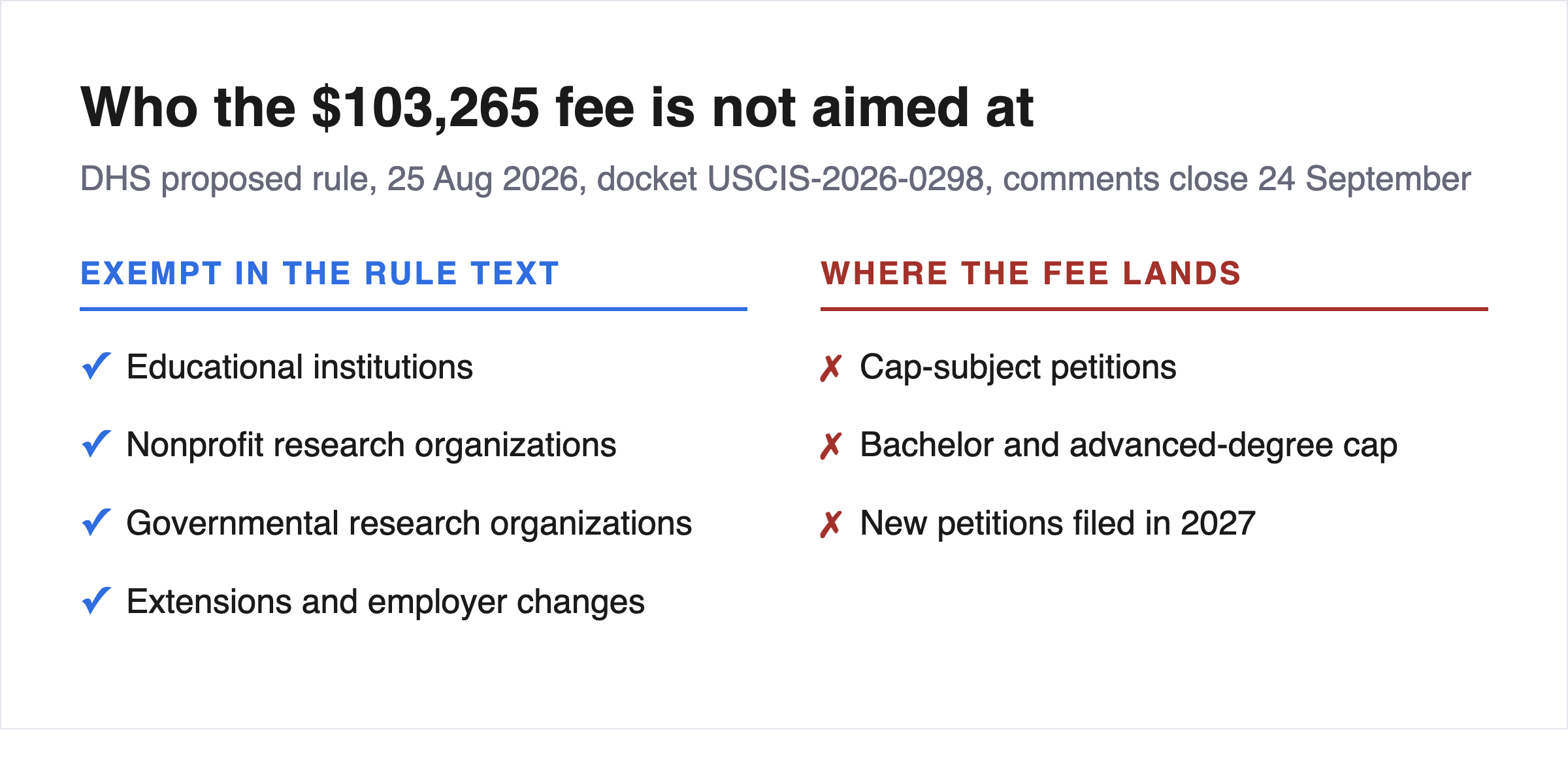
If you are an international researcher working in the US, the H-1B is very likely the visa you are on. Your employer petitions for it, and until now that petition cost them a few thousand dollars in filing fees. The Department of Homeland Security has proposed adding a six-figure charge on top. The number did a lap of academic group chats by the weekend, almost always with no context attached.
Here is the context. It is not law, it is a proposal, and the window for public comment is still open. It reaches only new petitions in the annual lottery, which is the route private employers use. And the exemption is the part nobody forwarded: if a university, a research institute without shareholders, or a government lab hired you, you are outside the lottery and the text leaves you out. It also leaves out renewals, amendments, and moving to a new employer on a visa you already hold.
Why it matters: For most people on this list the correct response is relief, and the reason you have not felt it is that a six-figure headline travels about a hundred times faster than a clause about who is exempt from it. If you are a postdoc on a university petition, this was never aimed at you. If you are weighing an offer from a company, it is aimed squarely at you, and it is now a line item that employer has to want to pay. That changes the maths on the offer, not on your visa.
Sources: DHS proposed rule, 25 Aug 2026
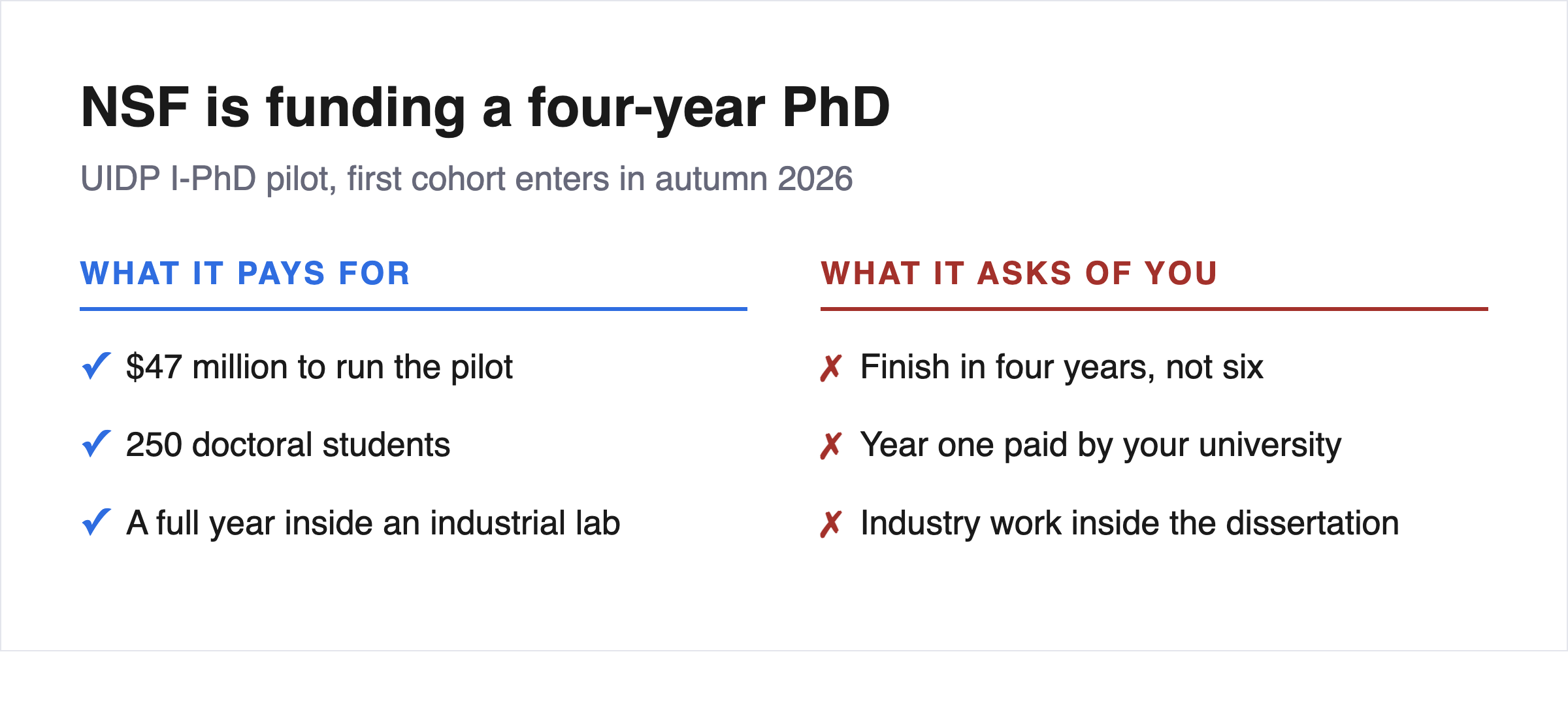
🎓 NSF found $47m to pay PhD students to leave the lab. NSF is funding a pilot called I-PhD that rebuilds the doctorate itself. Students spend a year working inside a company lab, and that year counts as part of the thesis rather than a break from it. Your university covers the first year, NSF covers the rest.
Why it matters: The gap it targets is real. About two thirds of new US science and engineering PhDs expect to end up in industry, and most have never spent a working day outside a university by the time they defend. The unsaid part is the trade. A shorter clock and a year away from your bench is a different thesis, and a pilot programme still needs someone to fly it. Somebody goes first. This autumn that somebody is a room full of first-years with no results to look at, because there are none yet.
What I would do: If you supervise graduate students, ask your graduate office this week whether your department is in. Places are being allocated right now, and the students most likely to want this are exactly the ones least likely to hear about it in time.
Reference: NSF news release, I-PhD pilot
Coverage: Science, 27 Aug 2026 · 2026-08-27 · 3 min
🔎 One copy edit, thirteen detectors, no agreement. A study at EMNLP 2026 ran 13 AI detectors over 135,389 pairs of documents from a professional editing service: the same manuscripts before and after a native English speaker cleaned them up, same authors, same science.
Why it matters: The detectors could not agree on which way editing moved you. "The same edits increased AI scores in some detectors but decreased them in others." So if you pay someone to fix your English, whether that reads as diligence or as cheating comes down to which tool the person judging you happened to open that morning. That is not a standard. That is a coin toss with your paper on it.
What I would do: Build the paper trail now, while nobody is asking. Turn on version history, keep the draft from before the edit, keep the editor's invoice. If you are ever flagged, do not argue with the score. Send the history.
Reference (preprint, not peer reviewed): Park, Jeong and Kim, EMNLP 2026 (arXiv:2608.26710) · 2026-08-27 · 4 min
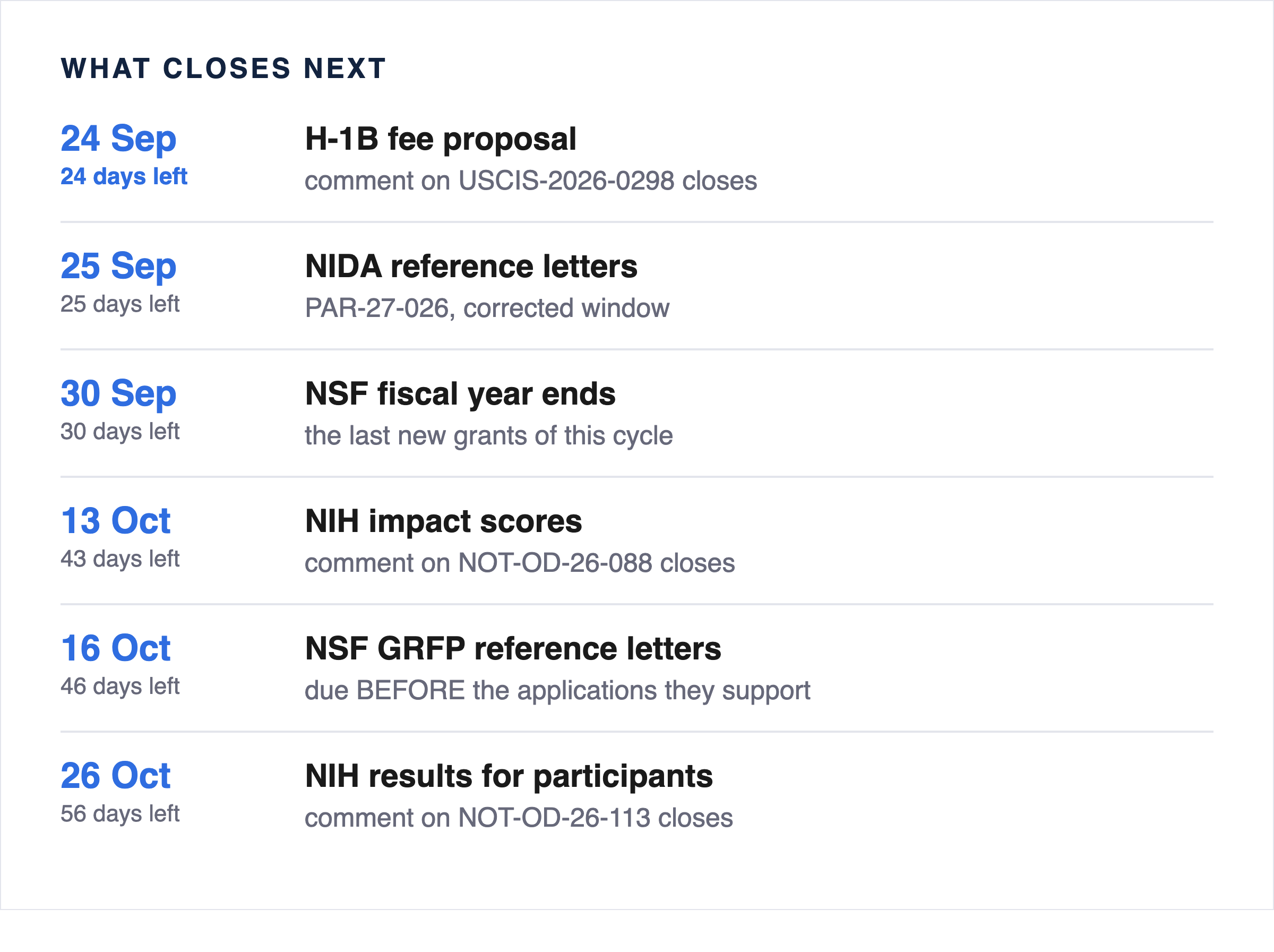
Three of these are open comment windows on rules that will bind you, and they take anonymous submissions, so there is no professional cost to saying the inconvenient thing. The one people miss every year is the GRFP reference letter, which falls due before the application it supports.
Not a pitch. An honest translation. Take your current aims and write three sentences that answer what problem this solves, who has that problem today, and what changes for them if it works. If you cannot name the who without saying "the field", that is worth knowing about your own project before a panel tells you. This is also the exact paragraph the industry placements will be selecting on.
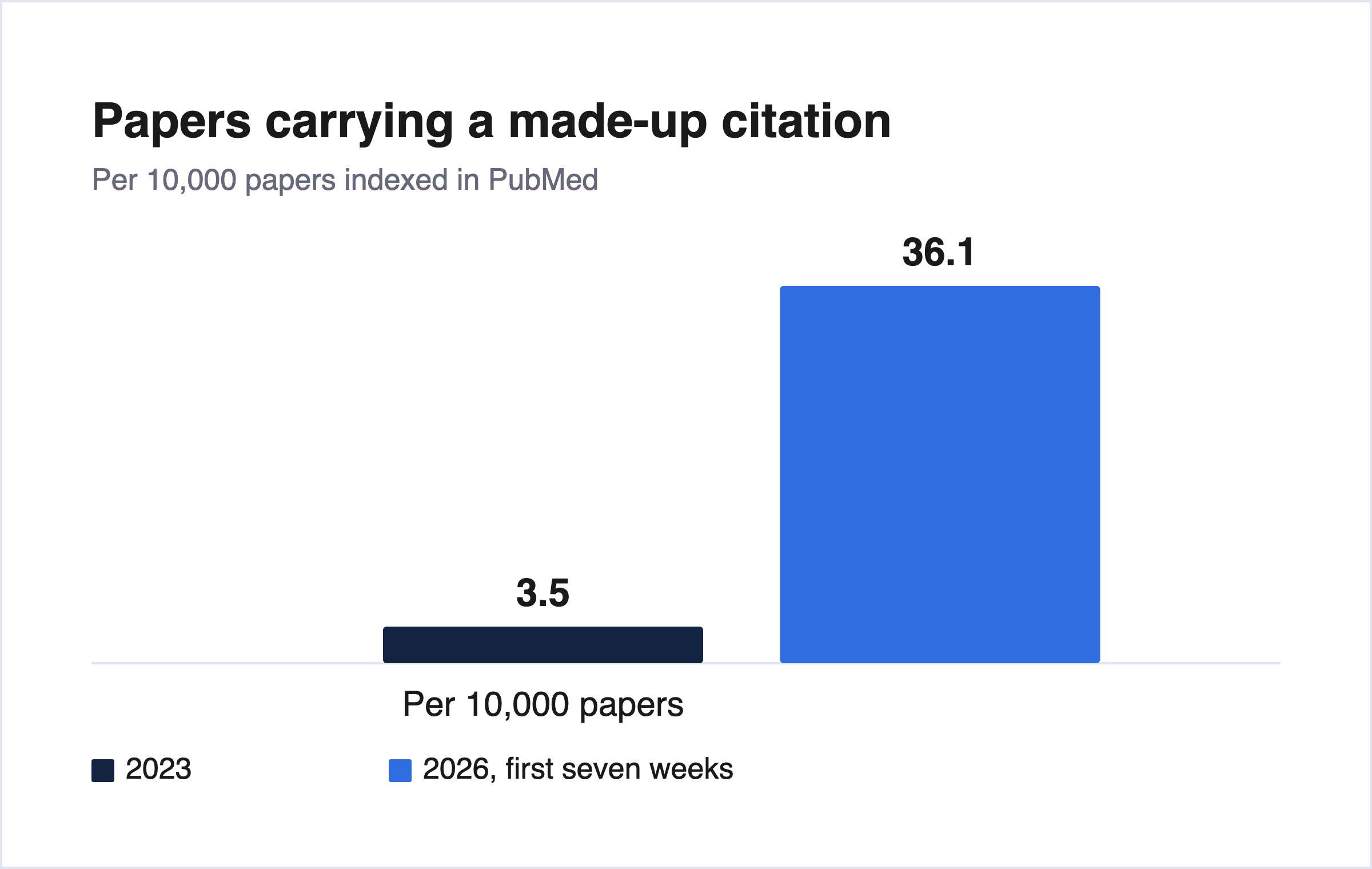
of everything PubMed indexed early this year now carries at least one reference that does not exist. In 2023 it was 1 in 2,828. The analysts date the sharpest part of the climb to mid-2024, which is exactly when the writing tools arrived. Go and read your own bibliography this week, particularly anything a tool handed you.
Sources: The Lancet (Topaz et al., 2026) · Retraction Watch
Corrections: Nothing to correct this week. When there is, it runs here first.
That's the week. Forward this to a labmate deciding where to submit, and if it reached you secondhand, subscribe in one tap.
Whenever it is useful: if you have a draft going, run it through the free check and see what an editor would screen for. If you are earlier than that, the Academy works the same method on whatever you have so far.
What should be in next week's issue? Reply to this email with the thing you wish someone would explain, or the deadline you nearly missed. I read every one, and the ones I can source go in with a note that you asked.
How was today's issue? Great · Fine · Meh
| Erik Founder, Manusights |
Forward to a friend
Get this every Monday
What changed in publishing, what it means for your submission, and one thing to try. Free.
Subscribe