The one word NIH wants out of your grant
Get Manusights Weekly free, every Monday
Good morning. Peer review is the only job where the pay is zero, the hours run nights and weekends, and the publisher still clears a38% margin. That gap is this newsletter's whole beat, and this week it widened. NIH decided one word no longer belongs in your grant. A journal pulled 120 papers at once. The pattern is the point: publishing's rules keep moving, and the bill for keeping up lands on you. Here is what moved, and what to do about it.
Erik
The one word NIH wants out of your grant
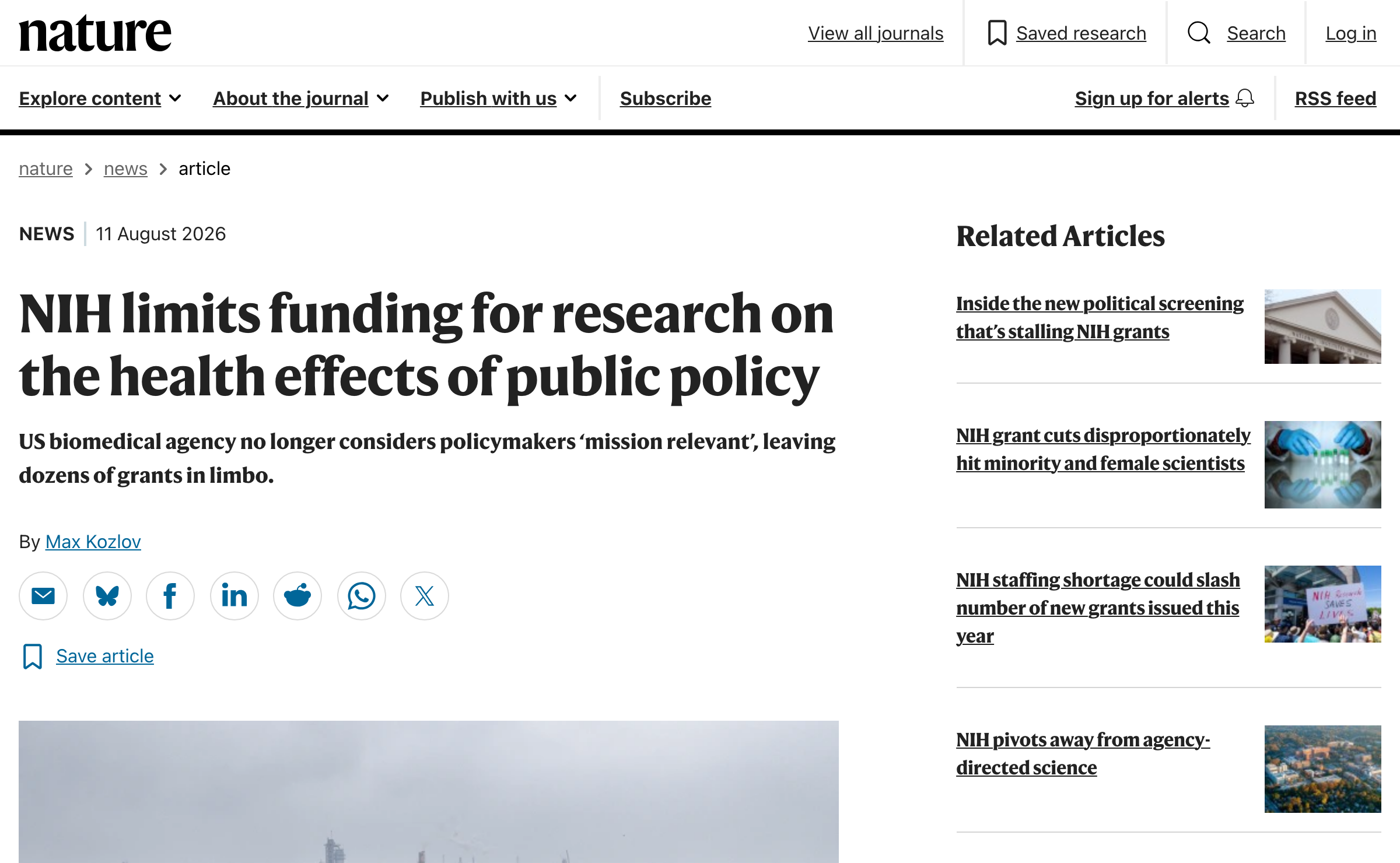
If your work touches how laws and rules shape health, read this one twice. Internal NIH documents seen by Nature show the agency has started rejecting applications whose "primary function" is informing policymakers, on the logic that policymakers are not a "mission-relevant" stakeholder. NIH now says research must be "actionable, rigorous, and in scope," and "in scope" is defined to exclude policymakers. The change was never formally announced. It is already sending grants back to program officers with a note to strip out the word "policy" and anything close to it.
This is not a fringe carve-out. More than 3,700 NIH projects funded in 2025 carry "policy" in the title or abstract, and the work most exposed is exactly the kind that shapes real decisions: firearm safety, environmental health, drug policy. A former head of NIH extramural research says he cannot see how this counts as lobbying, the label being used to justify it.
My read: this is less about lobbying than about who gets to define "mission-relevant" science, and that definition is now narrowing from outside the lab. Watch the direction, not just this one rule. The same week, a journal pulled 120 papers it should never have run and COPE rewrote the ethics code you are judged by. The machinery of publishing keeps getting less stable, and the job of tracking it has quietly become yours.
Why it matters: if your research speaks to policy, the defensive move is to frame the science around the stakeholders NIH still counts (patients, clinicians, hospitals, other scientists) and keep the policy implications in your discussion, not your aims. It should not have to work like that. And next year's winners will not be the best scientists. They will be the best scientists who also read the fine print.
Sources: Nature (DOI) · Science
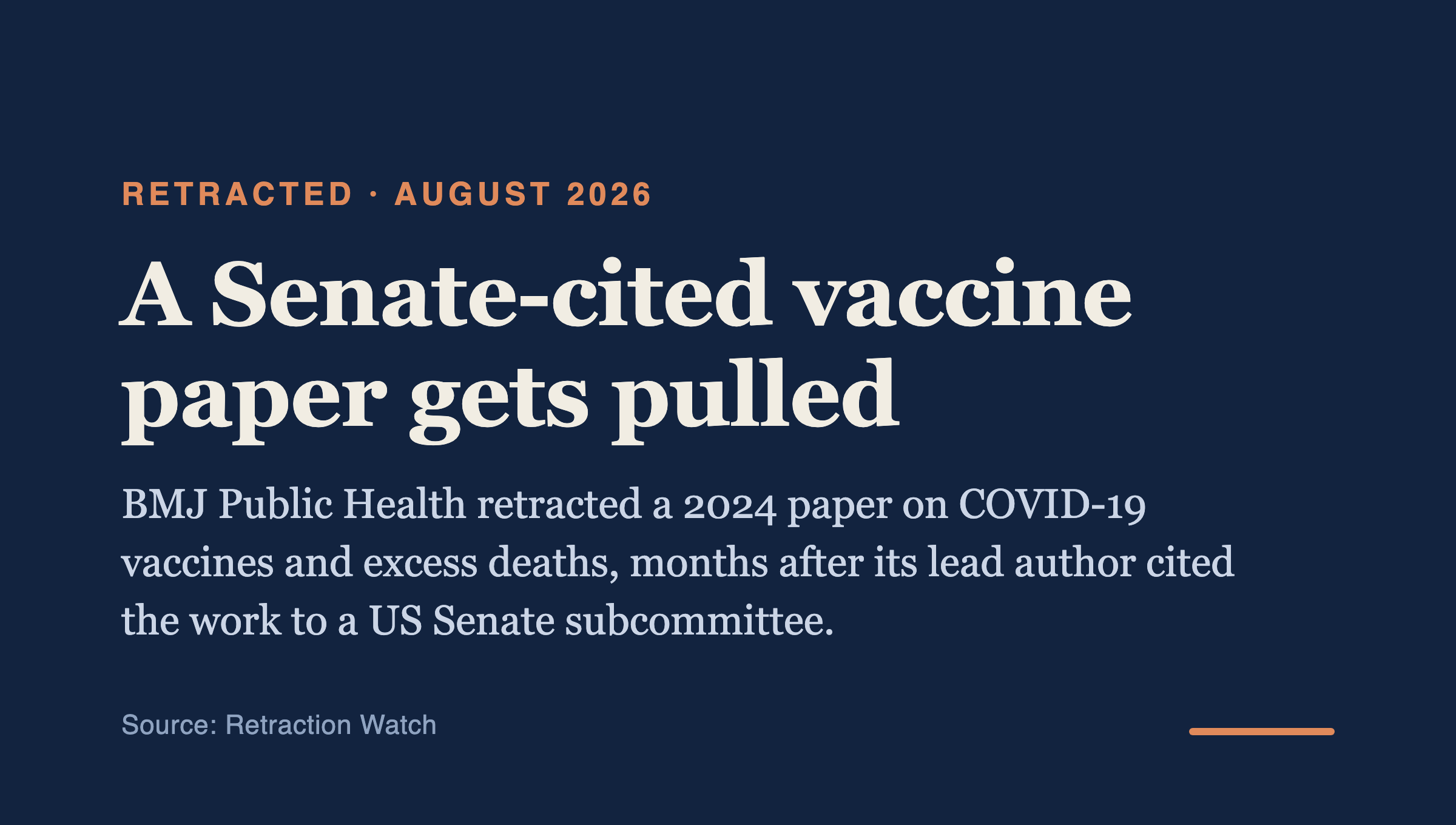
🧪 A Senate-cited vaccine paper gets pulled. BMJ Public Health retracted a 2024 paper on COVID-19 vaccines and excess deaths, citing problems that included misinformation in the discussion, months after its lead author cited the work to a US Senate subcommittee. Why it matters: a citation in a hearing and a citation in the literature turn out to be very different things. The scientific record just moved the opposite direction from the political one, and only one of them issues corrections.
Sources: Retraction Watch · 2026-08-11 · 4 min
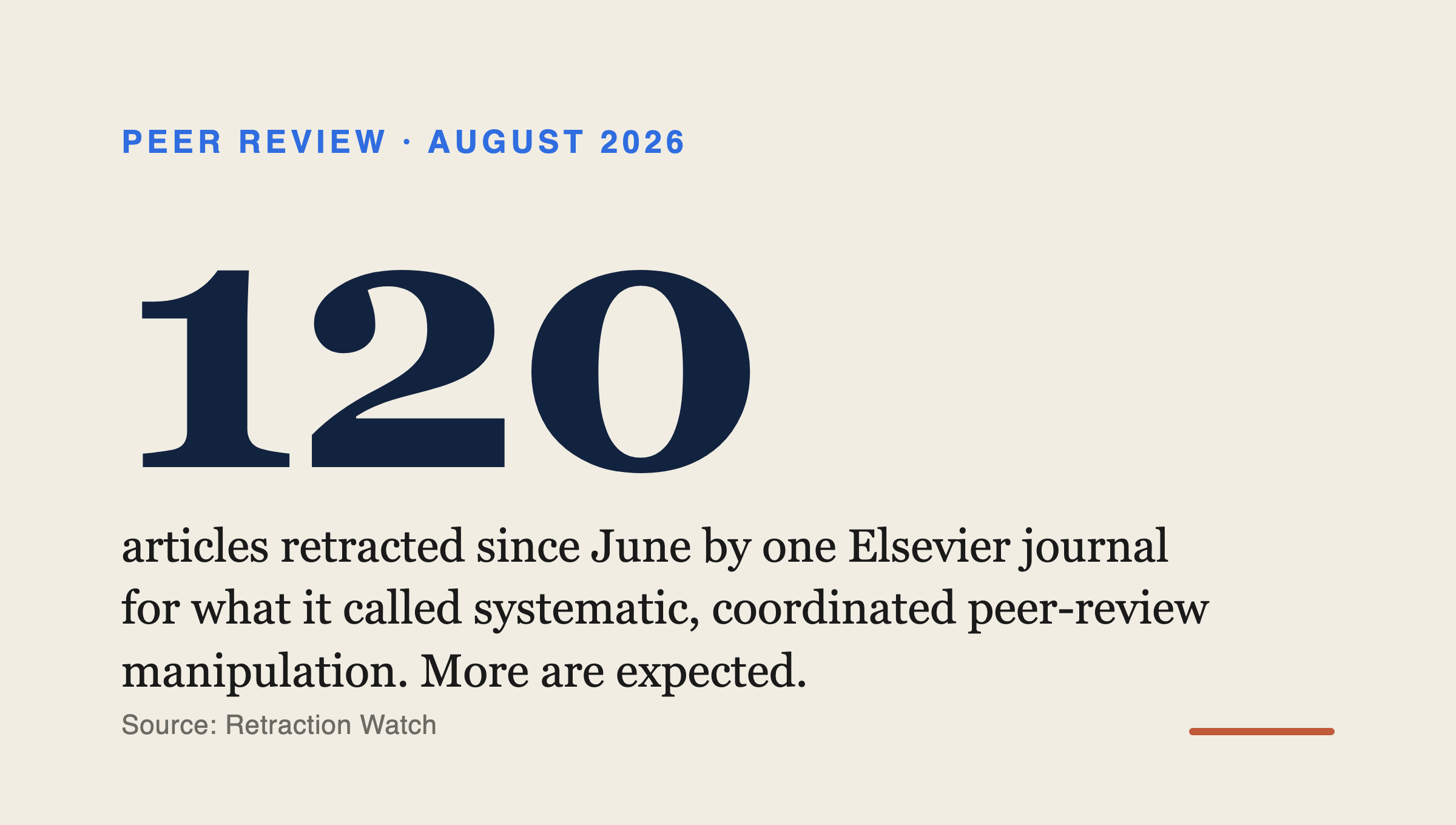
🧹 One journal pulled 120 papers, and it is not done. Elsevier's International Journal of Biological Macromolecules has retracted 120 articles since June for what it called systematic, coordinated peer-review manipulation, with more expected. Why it matters: special-issue peer review, it turns out, let authors pick the referees grading their own homework. Almost all the pulled 2024 and 2025 papers shared a tight cluster of affiliations, so anything you cite from that pile has earned a second look.
Sources: Retraction Watch · 2026-08-12 · 3 min
🧠 AI's real cost is not errors, it is cognitive debt. The term "cognitive debt" is not a metaphor. An MIT team wired 54 writers to EEG, and the group leaning on an AI assistant showed the weakest brain connectivity of the three, an effect that lingered after the AI was taken away. A companion essay in The Scholarly Kitchen argues this, not the occasional wrong fact, is AI's real risk in publishing: the erosion that sets in when you outsource thinking before forming your own judgment. Why it matters: think of it as a credit card for your attention, convenient today and expensive when the bill lands. The move is not to avoid AI but to reach for it after you have a view, to pressure-test your reasoning rather than to skip it.
Sources: MIT Media Lab (Kosmyna et al., 2025) · The Scholarly Kitchen, Part 2 · The Scholarly Kitchen, Part 1 · 2026-08-13 · 9 min
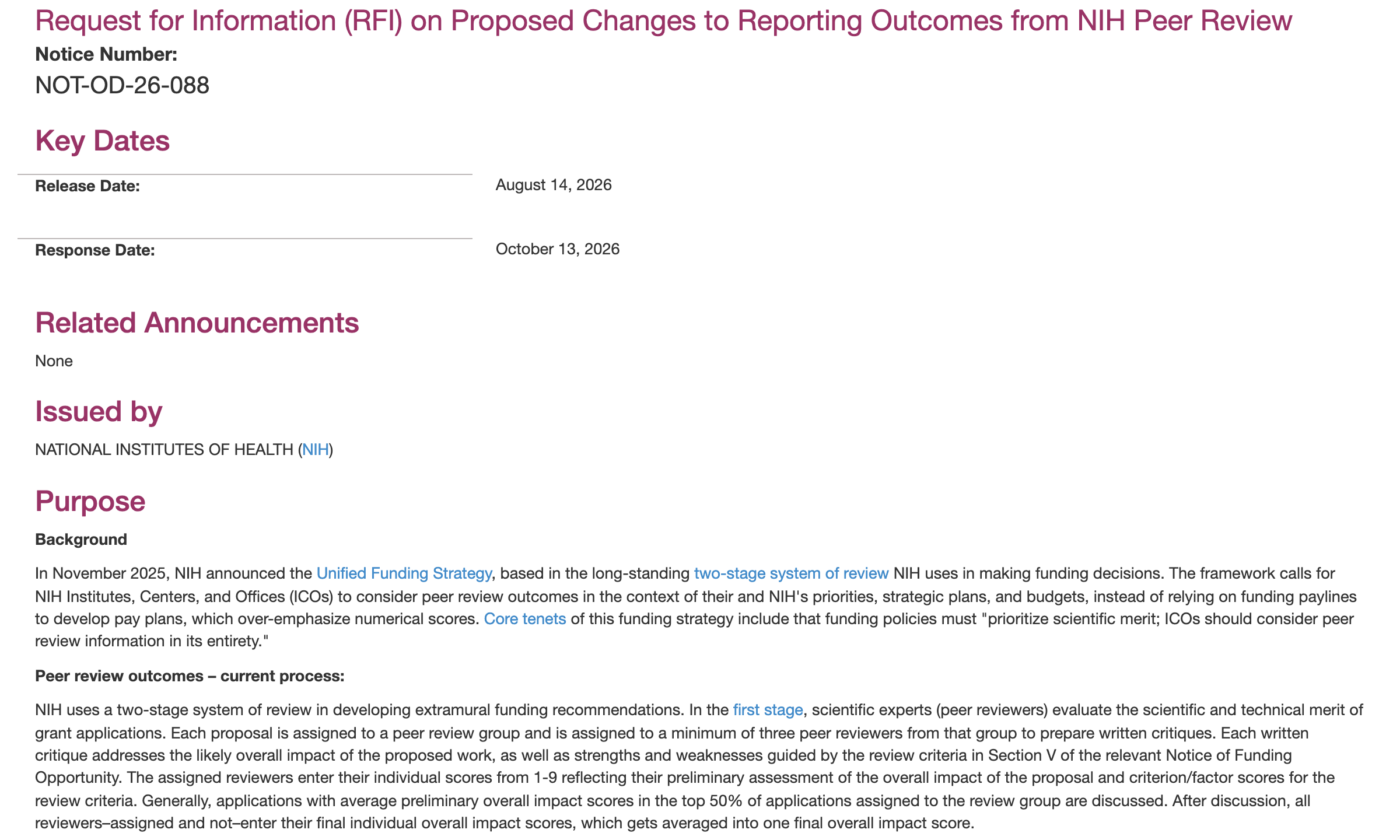
🔎 NIH may stop telling you your score. In a request for information posted August 14, NIH proposed replacing the 1-to-9 overall impact score with three buckets, "most competitive," "competitive," and "not discussed," and not releasing the underlying score or percentile to applicants at all. Comments are open until October 13. Why it matters: the score is how you work out whether a resubmission is worth another year of your life. Swap the number for a bucket and "competitive" covers both a near miss and a distant one. A bucket is not a signal. Written critiques still come back, but if a 34 has ever told you exactly how far you had to move, this is the notice to answer.
Sources: NIH Guide, NOT-OD-26-088 · Inside Higher Ed · Science · 2026-08-14 · 4 min
Before you submit, paste your abstract into any AI tool and let it review you like the reviewer you fear. Catch the overclaim at your own desk, not the editor's.
The submission box almost nobody fills in
Most submission forms have a field labeled "recommend reviewers," and most people scroll right past it. That is a mistake. It is one of the last levers you control after the science is done.
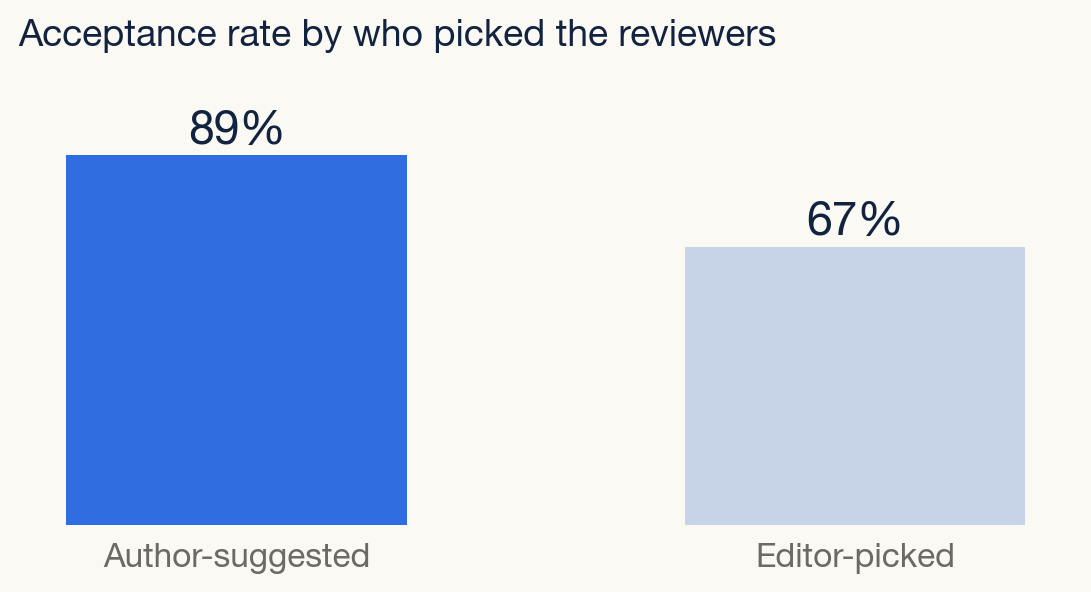
The numbers are not subtle. In a 2022 study of PLOS ONE's neuroscience section, papers sent only to author-suggested reviewers were accepted 89% of the time (n=762). Papers sent to editor-picked reviewers landed at 67% (n=4,556). Two earlier analyses, across three BMC journals and a nephrology journal, found the same lean. One honest caveat: this compares review panels, not the same paper twice, so it is an association, not a law of nature.
Why it matters: used cleanly, it is a real edge, and most people leave the box blank. Name three to five genuinely qualified, arm's-length experts (not your co-authors, not your grad-school roommate, and never invented ones, which is a fast track to retraction). Then use the "oppose" box to fence off the one competitor who would sink you for sport.
Sources: PLOS ONE, 2022 (DOI) · Kowalczuk et al., BMJ Open, 2015 · J. Am. Soc. Nephrology, 2011
the fee to publish one open-access paper in Nature Communications (Springer Nature's 2026 list). That is a used Honda Civic per article, and the journal still gets the peer review for free.
Sources: Nature Communications, open-access fees · DOAJ record, ISSN 2041-1723
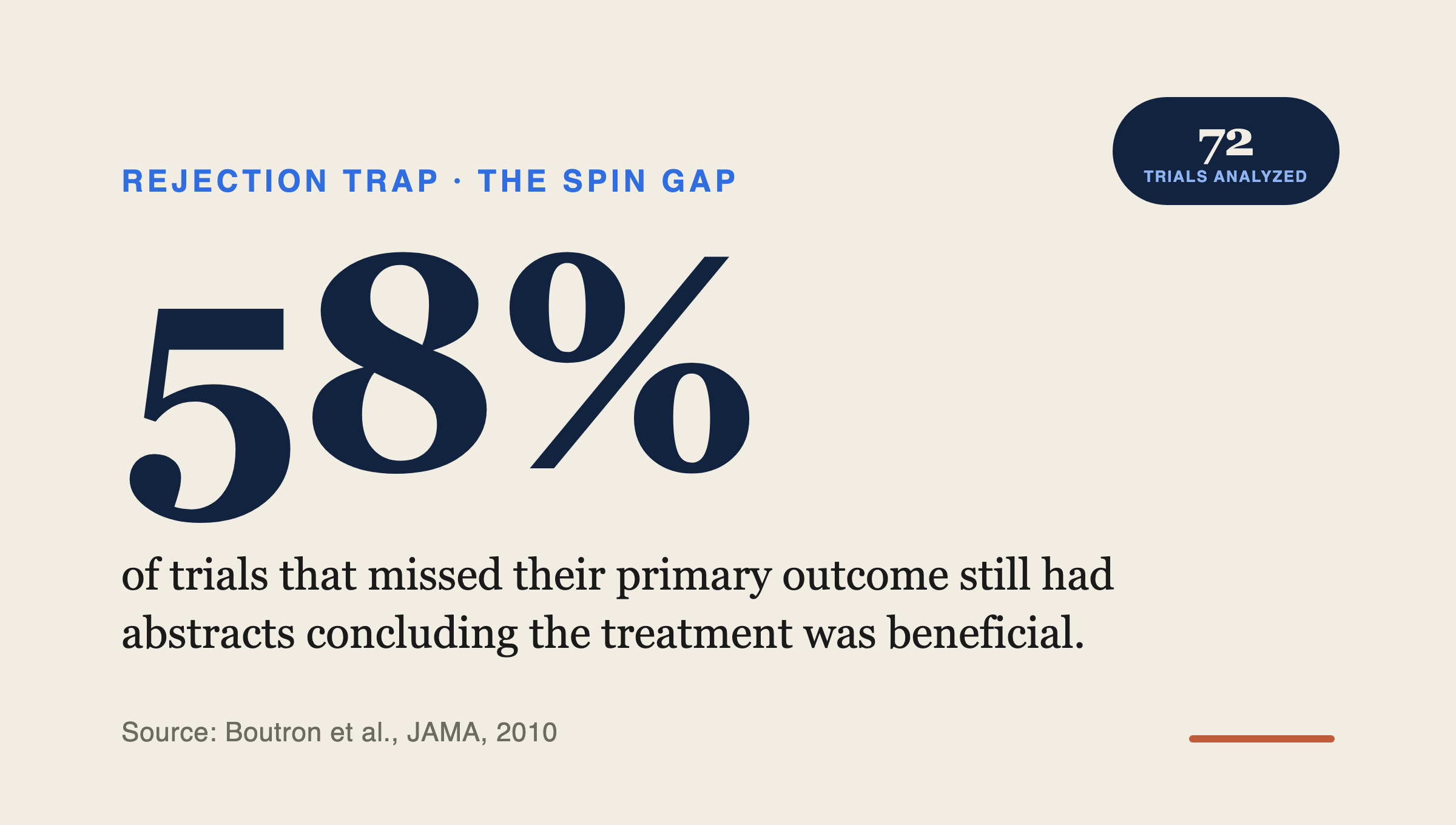
The abstract that outruns its own data. A JAMA analysis examined 72 randomized trials whose primary outcome came back statistically nonsignificant, meaning the treatment did not beat its comparison. In 58% of them, the abstract's conclusion still presented the treatment as beneficial. The trial said no. The abstract said maybe.
The fix: make the last line of your abstract claim exactly what your primary outcome shows, and not a millimeter more. A null result stated plainly reads as competence. A conclusion that drifts toward "promising" is the first thing a skeptical editor circles, and it is the exact failure the Try This Week prompt is built to catch.
From published evidence, not our own client data. Pattern shown, no journal or individual named.
Sources: Boutron et al., JAMA, 2010 (PubMed) · JAMA (DOI)
Q: My grant will not cover a $5,000 article fee. Am I hurting my career by publishing somewhere cheaper?
Almost certainly not. A five-figure article fee buys open access and a logo on the PDF, not better peer review and not one extra citation, and the ground is shifting your way. NIH now requires a free PubMed Central copy with no embargo (NIH public-access policy), so your accepted paper is public wherever it runs, and even the Chinese Academy of Sciences has stopped covering fees at the priciest open-access journals (reported here). Publish in a rigorous, indexed journal you can afford, deposit the accepted manuscript, and the only thing you lose is a line item. Reply with your own question and it may run here next week.
Now that you have seen 89 versus 67, will you name your own reviewers next time?
Yes · Never · I already do
- NIH is winding down a marquee career grant for early-career clinical researchers: from July 2027, K awards can fund trial experience under a mentor, but not a trial you run yourself. More
- A JAMA journal turned down a petition to retract a decades-old oxycodone paper, saying it found no falsification and will not act unless every surviving author agrees: a unanimity rule that lets the record outlive the people who could correct it. More
- Some good news: a college student found errors in a paper she had published in high school, asked the journal to retract it herself, and clarified which results were calculated rather than measured. Self-correction, working as intended. More
- Retraction Watch on the week's misconduct and integrity news · 6 min - Retraction Watch
- The Scholarly Kitchen lays out a cognitive framework for AI in publishing · 9 min - SSP
- The Scholarly Kitchen on the promise and pitfalls of no-fee open access · 8 min - SSP
- Times Higher Education: AI is not a peer, so it cannot do peer review · 5 min - THE
“Peer review is a flawed process, full of easily identified defects with little evidence that it works.”
Richard Smith, former editor of The BMJ (1991-2004) · J. Royal Society of Medicine, 2006
Corrections: None this week. Spot an error? Reply and we will run the correction right here, loudly.
That's the week. Forward this to a labmate deciding where to submit, and if it reached you secondhand, subscribe in one tap. Reply with your toughest publishing question and I may answer it in next week's Ask the Editor.
How was today's issue? Great · Fine · Meh
Erik, Founder, Manusights
Manusights · 100 Van Ness Ave, San Francisco, CA 94102 · Unsubscribe · Forward to a friend
Get this every Monday
What changed in publishing, what it means for your submission, and one thing to try. Free.