From Literature Map to Submission Strategy: The Paper You Find Too Late
What to do when a literature map finds a paper uncomfortably close to your own.
Readiness scan
Find out if this manuscript is ready to submit.
Run the Free Readiness Scan before you submit. Catch the issues editors reject on first read.
Quick answer: A literature map cannot prove that your paper is novel. It can show you the papers your novelty claim has to survive. Start with the sentence you most want to say in the abstract, use Litmaps to search around your closest papers, and pay special attention to the study that makes you uncomfortable. That paper may change your claim, your figures, or your target journal. That is not the search going wrong. It is the search becoming useful.
Evidence basis: We checked current Litmaps and ResearchRabbit documentation and current citation-searching guidance on August 31, 2026. Product facts come from official sources. The worked example and submission decisions are Manusights editorial synthesis. No payment was exchanged for this article. This workflow cannot prove novelty or predict acceptance.
By the end, you should have:
- a contribution sentence that survived the closest papers
- an honest comparison with the study most like yours
- a dated record of where and how you searched
- three journals that fit the contribution that remains
The paper you find too late
You are nearly ready to submit. The analysis is finished, the abstract finally sounds right, and someone has already suggested a journal.
Then a paper appears in your literature map with a title that is far too familiar.
Researchers often explain the paper away before reading it carefully, or assume the whole project has been scooped. Neither reaction answers the scientific question. A close paper is not a verdict. It is a test of what your manuscript can honestly claim.
Imagine a team studying an interpretable model for treatment response in a rare cancer. Their draft says:
We introduce the first interpretable model for predicting treatment response in this disease.
It is a clean sentence and a fragile one. “First” is not something the team can establish from its own data. It is a claim about the literature.
So instead of using the search to support that sentence, the team has to use it to try to break it.
Start with the sentence you are afraid to test
Write down the sentence you most want the literature to confirm. “This study offers a novel approach” is too vague. “We introduce the first interpretable treatment-response model for patients with this rare cancer” can lose because a previous study might match the disease, method, outcome, or all three.
Bring the current abstract, five to eight central papers, your contribution sentence, and a blank list for papers that weaken it. The blank list matters because discovery tools are easy to use as reassurance machines. If you save only work that supports the story you already like, the map becomes decoration.
Let Litmaps make the question harder
Litmaps works from one or more starting articles. You can explore how papers connect through citations and references, try different search approaches, add relevant work to a Litmap, and monitor the search as new papers appear.
The useful starting set is not every paper on cancer prediction. It is the small group closest to the claim: an earlier model in the same disease, the interpretability method paper, a recent validation study, and the strongest black-box benchmark.
Then the team searches in three directions:
Follow the citation conversation. Which papers share references with the seed set, and which newer studies cite the same foundational work?
Follow the people. If the same authors keep appearing, look at their related work. A group may describe the same idea differently across papers.
Follow the language. Similar-text searching can surface newer or weakly connected papers that have not accumulated much citation history.
The point is not to build the largest map. It is to find the smallest group of papers that can change the manuscript.
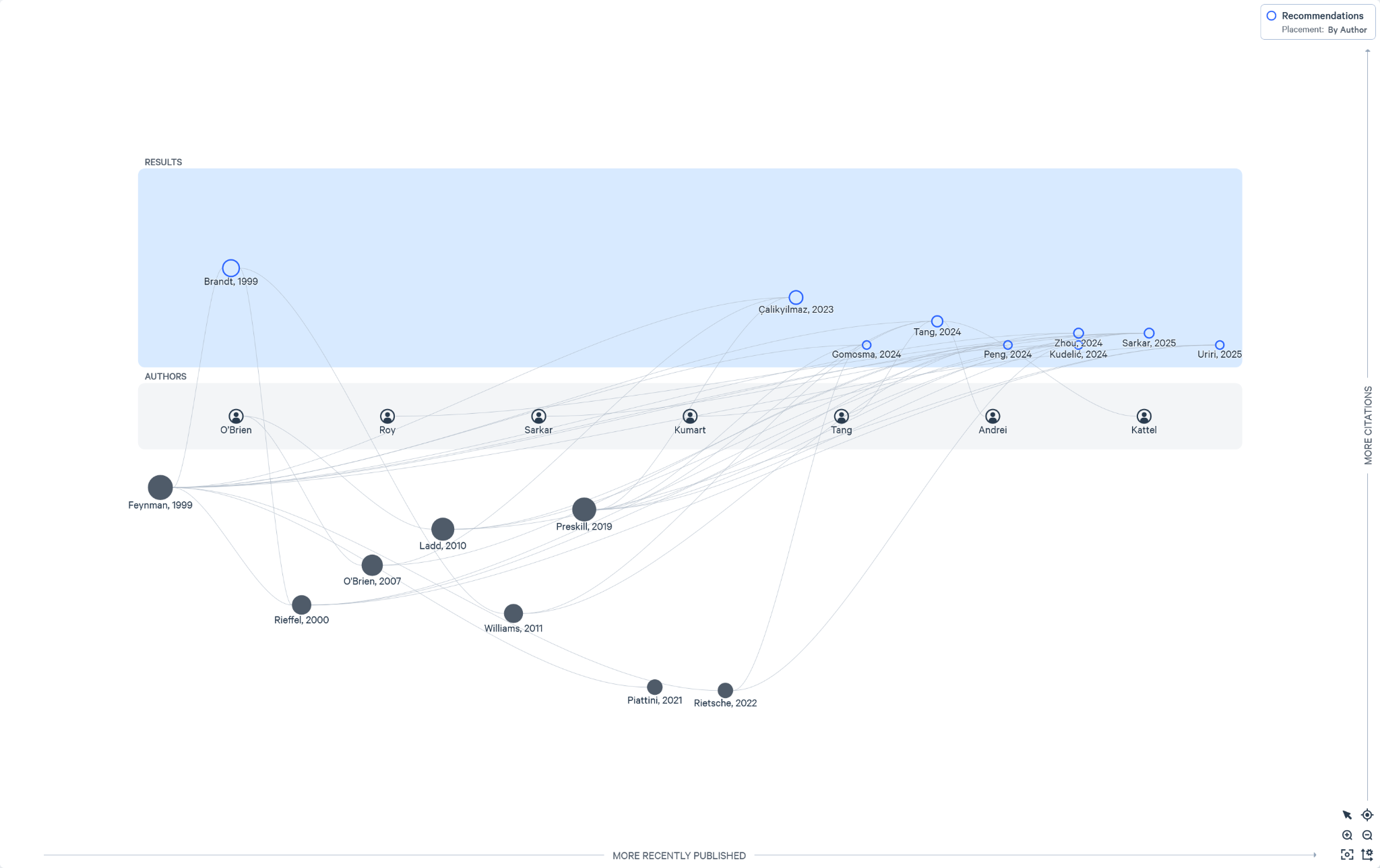
The team finds two uncomfortable studies. One used interpretable features in the same disease but had no external validation. A newer preprint validated a related model in a different cancer and treatment class.
The word “first” is gone. The project is not.
Where ResearchRabbit fits
ResearchRabbit is a useful alternative when you are still learning the shape and vocabulary of a topic. Starting from a few papers, you can follow your curiosity into related work, recurring authors, and emerging themes. Save the papers that teach you how the field describes the problem, not only the papers you expect to cite.
The distinction is simple: if you already have a serious seed set and need to pressure-test a claim, begin in Litmaps. If you are still exploring a newer topic, ResearchRabbit is another good place to begin. Neither tool can decide whether two studies are scientifically equivalent. That requires reading them.
Give the uncomfortable paper its own row
Do not hide the closest paper in a paragraph with fifteen citations. Put it next to your manuscript and make the comparison explicit.
Study | What overlaps | What is different | What changes in the manuscript |
|---|---|---|---|
Earlier rare-cancer model | Same disease and interpretable features | No external validation | Remove “first interpretable model” |
Newer preprint | External validation and treatment response | Different cancer and treatment class | Validation alone is not the contribution |
Current manuscript | Rare cancer, interpretable model, external validation | Black-box comparison and failure analysis | Center the paper on where the models diverge |
Read beyond the title and abstract before judging overlap. Population exclusions, outcome definitions, comparators, preprocessing, validation design, and uncertainty reporting are often where the meaningful difference lives.
The paper that changes your claim may be a recent preprint with few citations. Citation count does not decide whether it is the closest competitor.
Readiness check
Run the scan to see how your manuscript scores on these criteria.
See score, top issues, and what to fix before you submit.
Let the smaller claim choose the journal
After the comparison, the team can no longer say it built the first interpretable model in the disease. What it can say is more useful:
We externally validate an interpretable treatment-response model in a rare cancer and identify where its performance diverges from a black-box benchmark.
That sentence is less dramatic and easier to defend. It also tells the team what to revise:
- the abstract should emphasize external validation and failure analysis
- the introduction should name both close studies
- the results should bring the external cohort and black-box comparison forward
- the strongest figure should show where the models diverge
- the discussion should stop presenting interpretability itself as new
If the abstract changes but the figures still sell the old claim, the paper has not actually changed.
The revised claim also changes the journal shortlist. The team can now look for journals publishing clinical validation, explainable prediction, or rare-cancer decision support.
Choose an ambitious fit, a natural home, and a specialist option. Read the current scope and several recent papers resembling yours. A journal appearing frequently in the map is a reason to investigate it, not to submit automatically.
Write one sentence explaining why the revised paper belongs in each journal. If that sentence still depends on the abandoned “first” claim, remove the journal.
At this point, create a separate Litmap for the submission decision. Keep the closest competitors, the papers defining the method, and recent work from the journal shortlist together. The goal is not to archive the whole field. It is to preserve the evidence behind the claim and journal choice.
Know when to stop, and when to check again
No search proves that an earlier paper does not exist. Stop when exact phrases and useful synonyms are no longer producing close competitors, searches from the closest studies no longer change the claim, a second author has reviewed the comparison, and the tools, seeds, and final search date are recorded.
Then make the uncertainty visible. “No previous study has done X” pretends to know the entire literature. “We found no previous study combining X and Y in this population” describes what you actually searched.
Citation searching is supplementary. The TARCiS statement advises against using it alone when complete recall is the goal. For a systematic or scoping review, follow the registered protocol and relevant reporting standard.
Keep the search active until submission. Litmaps Monitor can alert you when new articles enter a saved search. If a new paper changes only the background, cite it. If it removes a “first” claim, rewrite the claim. If it raises the evidence standard, add the analysis, state the limitation, or reconsider the target.
What literature maps cannot tell you
Maps depend on the papers you start with and the citation and metadata connections available to the service. ResearchRabbit notes that papers, references, citations, newer versions, or abstracts can be missing or delayed when metadata is incomplete. Litmaps searches likewise depend on the selected seeds, search approach, filters, and available citation data.
Watch for these failure patterns:
Seed bias. A weak starting set produces a reassuring but incomplete neighborhood.
Citation lag. Very new work may not yet be well connected.
Vocabulary drift. An adjacent field may describe the same idea in different language.
Quality blindness. A connection does not tell you whether the study is rigorous or trustworthy.
Use the map to discover and organize. Read the papers to judge.
The paper that makes you nervous is often the useful one
A literature map is doing its best work when it makes the novelty sentence harder to write.
The paper that makes your stomach drop may remove the sentence you liked most. It may also help you replace it with a claim that is clearer, more honest, and harder for a reviewer to dismiss.
That is the move from literature discovery to submission strategy. Stop asking the map to prove that you were first. Use it to decide what the paper can still say, which evidence matters most, and where that contribution belongs.
Build the working map in Litmaps. If you are still discovering the vocabulary, authors, and boundaries of a newer topic, begin with ResearchRabbit.
Frequently asked questions
No. A literature map helps you find and organize the papers your claim must survive. Novelty still depends on comparing the question, method, population, evidence, and result.
Compare the overlap directly, identify what still differs, and decide whether that difference supports a narrower claim, additional analysis, or a different target journal.
Litmaps can help you search around trusted seed papers, organize the closest work, and monitor the field. ResearchRabbit is a useful alternative when you are exploring a newer topic and want to follow related papers, authors, and emerging themes.
Record what overlaps, what differs, how strong the other paper's evidence is, and what must change in your manuscript because the paper exists.
Sources
- Litmaps: Do a Literature Review with Litmaps
- Litmaps: Search for Articles with Litmaps
- Litmaps: Search Algorithms
- Litmaps: Monitor for New Research
- ResearchRabbit: How to Get Started
- ResearchRabbit: How to Search
- ResearchRabbit: Database Coverage and Limitations
- TARCiS Statement on Citation Searching
- PRISMA-S Reporting Guideline
- Cochrane Handbook, Chapter 4
- Citationchaser Methods Paper
- Evaluation of Academic Search Systems
- Nature: Publication Criteria and Process
- Think. Check. Submit.: Journal Checklist
Final step
Find out if this manuscript is ready to submit.
Run the Free Readiness Scan. See score, top issues, and journal-fit signals before you submit.
Private API processing. Your manuscript is not used to train models.
See example reportsPut the guidance to work
Move from draft advice to a practical manuscript pass.
Choose the reporting framework first, then use the final checklist when the manuscript and submission files are ready to travel together.